

Most Common Bearings Used In The Automotive Industry
2026-04-03Rolling vs. Sliding
Bearings show up in almost every vehicle. Automotive bearings designs split into two main groups: sliding and rolling element types. Sliding bearings, usually called plain or journal bearings, cut down friction with the help of lubrication and special material matches like bronze or polymer composites. They often hold up crankshafts and camshafts inside engines. There, they manage heavy loads and fast spinning thanks to a thin oil film that keeps surfaces apart.
Rolling element bearings take over in most other spots on vehicles. They use balls or rollers that spin between an inner race and an outer race. This setup greatly lowers friction when compared to sliding contact. The rolling movement gives accurate, low-torque action. It also helps create the smooth, polished feel that marks good vehicle quality. Manufacturers focus on very tight controls for ball or roller diameter, roundness, and surface smoothness. These steps lead to steady performance and very little vibration.
 Two Types of Motion
Circular Motion Bearings
Circular motion bearings fit together with inner and outer races. They mount on shafts inside housings. Careful manufacturing makes sure all rolling elements stay even. This allows smooth turning under both radial and axial loads.
Linear Motion Bearings
Linear motion systems use bearings in a different way. Seat tracks offer a clear example. They need easy sliding even with a person’s weight and adjustment pressure. Balls or rollers sit loosely in stamped rails or inside retainers and carriages. This setup handles small changes in rail shape. At the same time, it keeps good alignment and spreads the load well.
Common Types of Bearings in Automotive Applications
Deep Groove Ball Bearings
Versatile and very common, deep groove ball bearings deal mostly with radial loads. They can take some axial load too. Their basic build allows high speeds and quiet running. In vehicles, you find them in alternators, water pumps, electric motors, and accessory drives. There, they provide dependable rotation that needs little upkeep.
Angular Contact Ball Bearings
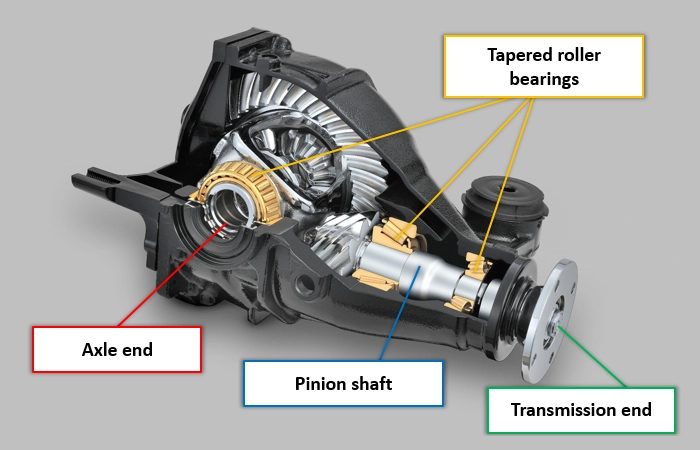
These angular contact ball bearings handle both radial and axial loads together. Their raceways sit at an angle to support thrust in one direction. When people pair them, they manage forces from both sides. Cars use them in transmissions, differentials, and clutch release parts. Good load control there boosts overall efficiency.
Tapered Roller Bearings
These bearings take on big radial and axial loads with their tapered rollers and races. The shape lets workers adjust preload to get the best setup for changing conditions. Wheel hubs depend a lot on tapered roller bearings, often in pairs or as complete hub units. They carry vehicle weight, cornering stress, and braking force while staying strong over time.
Cylindrical Roller Bearings
With straight cylindrical rollers, these give strong radial load support. They also allow some shaft misalignment or heat-related growth. They show up in transmissions, gearboxes, and certain engine mounts where big radial forces rule.
Needle Roller Bearings
Small and packed with long, thin rollers, needle bearings deliver very high radial load ability in tight areas. They appear often in transmissions on gear shafts, constant velocity joints, and rocker arms. This helps cut weight and makes parts fit better.
Spherical Roller Bearings
Self-aligning with barrel-shaped rollers, these handle misalignment caused by shaft bending or install mistakes. Heavy jobs use them, like propeller shafts in certain trucks and commercial vehicles. They deal with sudden shocks and shaking.
Thrust Bearings
Made just for axial loads, thrust ball or roller bearings fit in clutch systems, torque converters, and some transmission pieces. There, the main force runs along the shaft direction.
Common Bearing Applications in Automotive Manufacturing
Trunk Release Mechanism
Heavy trunk lids include counterbalance springs and release links. Precision ball or roller bearings at pivot points give quiet, easy opening and smooth closing. This improves how the quality feels.
Steering Column
Bearings hold the steering shaft from the cabin to the rack. They make sure rotation stays smooth with no looseness. Angular contact or deep groove ball bearings keep the steering feel exact. This matters a lot for driver trust and safety.
Sliding Doors
Vehicles with sliding doors, like minivans, vans, and some trucks, face many open-close cycles in all kinds of weather. Linear bearing setups or roller guides offer steady, low-force movement. They stand up to door weight and any slight misalignment.
Seat Track Rails
Power and manual seats need smooth straight-line adjustment even under heavy weight. Ball or roller retainers inside tracks adjust for small differences in stamped rails. They give easy positioning and keep the structure solid.
Gas Tank Check Valves
Precision stainless steel balls work as check valve parts in fuel systems. During a rollover, the ball blocks the opening to stop fuel from spilling. Safety comes first through perfect roundness and surface quality.
Wheel Hubs and Axles
Integrated wheel bearing units, often tapered roller or generation III ball types, bring together the hub, bearing, and sensor parts. They manage mixed loads from vehicle weight, braking, and turning. Sealed designs help them last longer.
Transmissions and Drivetrains
Needle roller bearings hold gear shafts. Tapered and cylindrical types handle input and output shafts. Low friction cuts energy waste. This improves fuel use and makes shifts feel better.
Engines and Accessories
Ball bearings in alternators, water pumps, and tensioners keep accessory drives running well. Thrust bearings take axial loads at the ends of crankshafts or camshafts.
Indispensable in Automotive Manufacturing
Vehicles count on bearings for smooth and efficient movement in all systems. Beyond just working mechanically, better bearings add to the touch and feel that lifts brand image. Poor choices cause clear looseness, extra noise, or rough action. That hurts the whole sense of quality.
LQYS Bearings stands as a high-quality bearing manufacturer and seller, specializing in precision-engineered solutions including deep groove ball bearings, tapered roller bearings, needle roller bearings, angular contact ball bearings, and specialized automobile bearings. With advanced production equipment, modern testing, and export to over 30 countries, LQYS Bearings delivers reliable performance for automotive and industrial demands.
FAQ
What are the primary differences between ball and roller bearings in automotive use?
Ball bearings work well in high-speed, lighter-load spots with low friction and little noise. Roller bearings like cylindrical, tapered, and needle types do better with heavy radial or mixed loads. They give more strength in tough places such as wheels and transmissions.
Why do wheel hubs often use tapered roller bearings?
Tapered designs manage both radial vehicle weight and axial forces from cornering or braking. Adjustable preload helps set the right clearance for longer life.
How do needle roller bearings benefit automotive transmissions?
Their high length-to-diameter ratio gives compact, strong load support in small spaces. This cuts weight and holds gear shafts well.
What role do thrust bearings play in vehicles?
Thrust bearings control axial loads in parts like clutches and torque converters. They stop unwanted shaft shifts when forces push in line.
Why is precision manufacturing critical for automotive bearings?
Even size, smooth finish, and exact race shape on rolling elements reduce vibration, noise, and wear. This keeps operation smooth and long-lasting under different conditions.
Partner with a Reliable Manufacturer and Seller for Automotive Bearing Needs
Automotive manufacturers, OEM suppliers, and distributors require consistent, high-precision bearings to meet performance and quality standards. LQYS Bearings, as a dedicated manufacturer and seller, offers a comprehensive range of automobile bearings tailored for wheels, transmissions, engines, and more. Contact the team today via salesjake@lqysbearing.com, Tel: +8613002187311, or WhatsApp: +8618013237311 to discuss custom requirements, request samples, or explore bulk supply options. Elevate vehicle reliability with proven bearing solutions from LQYS Bearings.
 EN
EN  RU
RU  ES
ES  PT
PT  DE
DE  FR
FR  IT
IT  HI
HI  AR
AR  JA
JA  BN
BN