

Single-row vs. Double-row Cylindrical Roller Bearings
2026-02-20Cylindrical roller bearings fill a key part in factory gear. They back up radial loads. They also hold steady running and good output. These bearings use cylindrical rollers. The rollers form line touch with the raceways. This helps them take on much larger radial loads than ball bearings. The big split shows up between single-row and double-row setups. Each matches certain running needs. Single-row cylindrical roller bearings shine in jobs that call for fast turns and fair loads. Double-row kinds bring stronger load power and firmness for rough work spots. This side-by-side look checks build gaps, work features, uses, choice points, and money thoughts. It aids smart picks.
What are the differences between single-row and double-row cylindrical roller bearings?
Build changes set the base for work gaps between these two sorts.
Structural design differences
Single-row cylindrical roller bearings hold one row of rollers. They sit between inner and outer rings. This setup gives a tight axial size. Thus, they work well for jobs with room limits. The plan usually has parts that come apart. For example, in NU and N series, this makes joining and splitting simpler.
Double-row cylindrical roller bearings add two rows of rollers. They often line up back-to-back or offset. This grows the touch zone. It also boosts full balance. The outer ring might skip ribs in some plans. This eases cutting work. Solid brass cages get used a lot for better heat release. You can tweak radial gap and preload. Do this by sliding the inner ring along the axis.
Load and speed characteristics
The table below points out main work measures:
- Radial load capacity: Single-row handles medium loads (typically up to around 80 kN in standard sizes), while double-row supports high loads (often 150–250 kN or 1.5 to 2 times that of a comparable single-row bearing).
- Axial load handling: Both types manage minimal axial loads and require additional thrust bearings when axial forces are present.
- Speed rating: Single-row achieves higher speeds (up to approximately 8000 rpm with proper lubrication), whereas double-row operates at medium speeds (3000–5000 rpm).
- Rigidity: Single-row offers moderate rigidity; double-row provides high rigidity with reduced deformation under load.
- Installation: Single-row designs are easier due to separability; double-row installations involve greater complexity.
Neither type inherently accommodates significant axial loads without complementary components.
Where are single-row cylindrical roller bearings used?
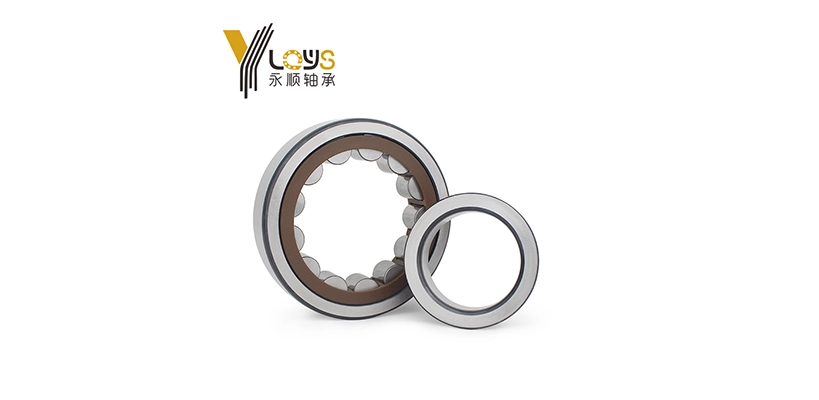
Single-row cylindrical roller bearings match jobs that put high-speed running first. They also fit fair radial loads. Plus, they offer simple upkeep.
Core advantages
- Strong radial load handling through line contact, surpassing ball bearings in continuous heavy radial force scenarios.
- Superior high-speed capability with low friction coefficients, enabling rotational speeds comparable to deep groove ball bearings.
- Axial displacement accommodation (particularly in N and NU types), compensating for thermal expansion or minor misalignment.
- Simplified maintenance via separable rings, allowing independent installation of inner and outer components.
Typical applications
- Electric motors and generators
- Textile machinery
- Light-duty gearboxes and reducers
- Water pump systems
- Air compressors and industrial compression equipment
For instance, models like those in the NU series support radial loads around 30 kN on smaller shafts while maintaining high RPM limits.
LQYS Bearings supplies single-row cylindrical roller bearings in series such as NF, NJ, NUP, NU, N, and RN, optimized for heavy radial and impact loads with high limiting speeds.
Where are double-row cylindrical roller bearings used?
Double-row cylindrical roller bearings meet calls for top radial load power. They also give firmness and long run in tough setups.
Core advantages
- Elevated radial load capacity, often 1.5 to 2 times higher than single-row equivalents of the same size, ideal for heavy or fluctuating loads.
- Enhanced rigidity and minimal deflection, reducing vibration and improving precision in high-stability systems.
- Suitability for continuous high-pressure operation, extending service life under sustained loads.
- Features like solid brass cages for better heat dissipation and adjustable preload for optimized performance.
Typical applications
- CNC machine tool spindles
- Large electric motors
- Wind turbines
- Gear reducers
- Railway components
Examples include NN series bearings, such as NN3020, capable of supporting around 210 kN radial loads with precision grades suitable for rigorous environments.
LQYS Bearings manufactures double-row cylindrical roller bearings in NN and NF series, emphasizing high stiffness, rotational accuracy, and adaptability for ultra-high radial loads.
Which is better: single-row or double-row bearings?
No one kind beats the other across the board. Choice relies on job needs.
The table below steers suggestions:
- High speed with medium load → Single-row
- Heavy load with medium speed → Double-row
- Compact design or cost efficiency → Single-row
- High rigidity or continuous heavy operation → Double-row
Factors such as operating temperature, vibration levels, and shaft/housing fits further influence the choice.
How do size and design affect bearing selection?
Sizes and inside build hit fit, lasting time, and work right away.
Size considerations
Single-row bearings show a wide size pick. They come with lighter, tighter shapes. These fit weight-watch or room-short jobs. Double-row bearings have broader and heavier frames. They call for extra setup room. But they bring more power.
Design structure considerations
- Fit tolerances between shaft and housing affect heat generation, vibration, and lifespan.
- Internal clearance (e.g., C3 or C4) accommodates thermal expansion or interference fits.
- Installation configurations, such as fixed and floating ends, manage axial displacement from temperature changes.
Proper evaluation of these elements ensures stable, long-term operation.
Is there a price difference between single-row and double-row bearings?
Double-row cylindrical roller bearings mostly ask for bigger prices. This stems from more material needs, firmer make limits, and better skills.
Reasons for price variance
- Greater material requirements from dual rows, wider rings, and additional rollers/cages.
- Precision manufacturing for high-rigidity applications.
- Superior load and durability performance justifying the investment.
Summary
Single-row cylindrical roller bearings bring solid fixes for fast-turn, fair-load cases. They include simple upkeep. Double-row setups give unbeatable radial power and firmness for rough, exact-run jobs. Choice turns on load calls, speed, room, and money. Close look at job settings lifts bearing life and gear trust to the max.
Partner with LQYS Bearings – Manufacturer and Seller of Premium Cylindrical Roller Bearings
As a leading manufacturer and seller, LQYS Bearings delivers high-precision single-row and double-row cylindrical roller bearings tailored for industrial demands. With advanced production facilities, rigorous quality controls, and a comprehensive range including NU, NJ, NUP, NN, and NF series, LQYS Bearings supports manufacturers, distributors, and OEM clients worldwide in sectors such as machinery, automotive, railway, metallurgy, mining, and more.
For bulk orders, custom specifications, competitive factory-direct pricing, or technical consultation on cylindrical roller bearing solutions, contact the team today via WhatsApp at +8618013237311, telephone at +8613002187311, or email at salesjake@lqysbearing.com.
 EN
EN  RU
RU  ES
ES  PT
PT  DE
DE  FR
FR  IT
IT  HI
HI  AR
AR  JA
JA  BN
BN