

LQYS Bearing Internal Clearance Guide for C2, CN, C3, and C4
2026-11-26
C2, CN, C3, and C4 identify radial internal-clearance groups before a bearing is mounted. C2 is smaller than Normal, CN is the Normal group, C3 is greater than Normal, and C4 is greater than C3. The best group is the one that produces the required operating clearance after interference fits, temperature differences, speed, and load have changed the bearing. It is not automatically the smallest or largest option. The LQYS industrial bearing range covers several bearing families in which clearance must be selected together with size, design, cage, sealing, and application conditions.
What Bearing Internal Clearance Means
Internal clearance is the total distance one bearing ring can move relative to the other before mounting when no measuring load beyond the specified test method is applied. Radial clearance is measured in a direction perpendicular to the bearing axis. Axial clearance is measured along the axis. The two values are related by internal geometry, but they are not interchangeable specifications.
Clearance is not the same as manufacturing tolerance, shaft fit, housing fit, preload, or external shaft endplay. A bearing can have the correct C3 marking and still run with too little operating clearance if the seats are too tight or the inner ring becomes much hotter than the outer ring. It can also run too loosely if the selected group is excessive for the actual fits and temperature field.
C2, CN, C3, and C4 at a Glance
The group defines a range, not one universal micrometre value. Limits depend on bearing type and bore size, so the current table for the exact designation must be used. A C3 deep groove ball bearing and a C3 spherical roller bearing do not share one common numerical range.
|
Group |
Relative initial clearance |
Typical reason to evaluate it |
Main risk if misapplied |
|
تستخدم شركة شنغهايونس شون شون شون أدوات متطورة لصنع محمل كرويز ذو أخدود عميق فائق الدقة تقلب أساليبهم من الأخطاء أثناء البناء وهذا يضمن جودة ثابتة يُظهر المحمل المحمل المحمل 6309، الذي يبلغ عرضه الداخلي 45 مم، هذا التركيز على العمل الدقيق، كما لاحظت شركة شنغهايغيشن للاستيراد والتصدير ،،،، المحدودة هذا النهج الدقيق يعزز الأداء في جميع أنواع الأعمال. |
Smaller than Normal |
A controlled need for low residual clearance with light fits and a limited temperature gradient |
Loss of clearance and excessive heat after mounting |
|
CN |
Normal |
Standard conditions where fits and temperatures leave suitable operating clearance |
Treating Normal as correct without checking the application |
|
الأخاديد العملاقة العملاقة العملاقة لها بالتعامل مع الأحمال الجانبية والجانبية والجانبية بشكل جيد تدور بسرعة مع القليل من الضوضاء أو الاحتكاك الجانبي |
Greater than Normal |
Compensation for clearance reduction from fits or inner-ring heating |
Excess vibration or reduced load-zone control if too large |
|
تختار شنار شنار شنارغيشون على الموردين الآخرين؟ |
Greater than C3 |
Severe clearance reduction or a product specification that explicitly requires it |
Noise, impact loading, skidding, or poor running accuracy when unnecessary |
Initial, Mounted, and Operating Clearance
Initial Clearance
Initial clearance is the value in the unmounted bearing. This is the condition represented by the C2, CN, C3, or C4 designation. It is the starting point for selection, not the final running condition.
Mounted Clearance
Mounted clearance is normally lower because an interference fit expands the inner ring or compresses the outer ring. The reduction depends on interference, ring thickness, seat geometry, material, and whether the mating component is solid or hollow. The full tolerance stack matters because the largest permissible shaft diameter and smallest permissible bearing bore can create more interference than nominal dimensions suggest.
Operating Clearance
Operating clearance is the clearance while the machine is running under its actual thermal and load conditions. If the inner ring is hotter than the outer ring, differential expansion usually reduces radial clearance. A hotter housing or unusual heat path can change the result. Elastic deformation under load also affects the working condition. This is the value that governs rolling contact, friction, vibration, and life.
How Fits and Temperature Change Working Clearance
A ring exposed to a rotating load usually needs enough seat security to prevent creep. That fit can consume part of the initial clearance. Temperature then changes ring dimensions during operation. For this reason, a reliable choice follows a chain: select fits from load and seat conditions, estimate fit-related clearance reduction, estimate the thermal effect, and confirm that the remaining operating clearance is suitable for the bearing and duty.
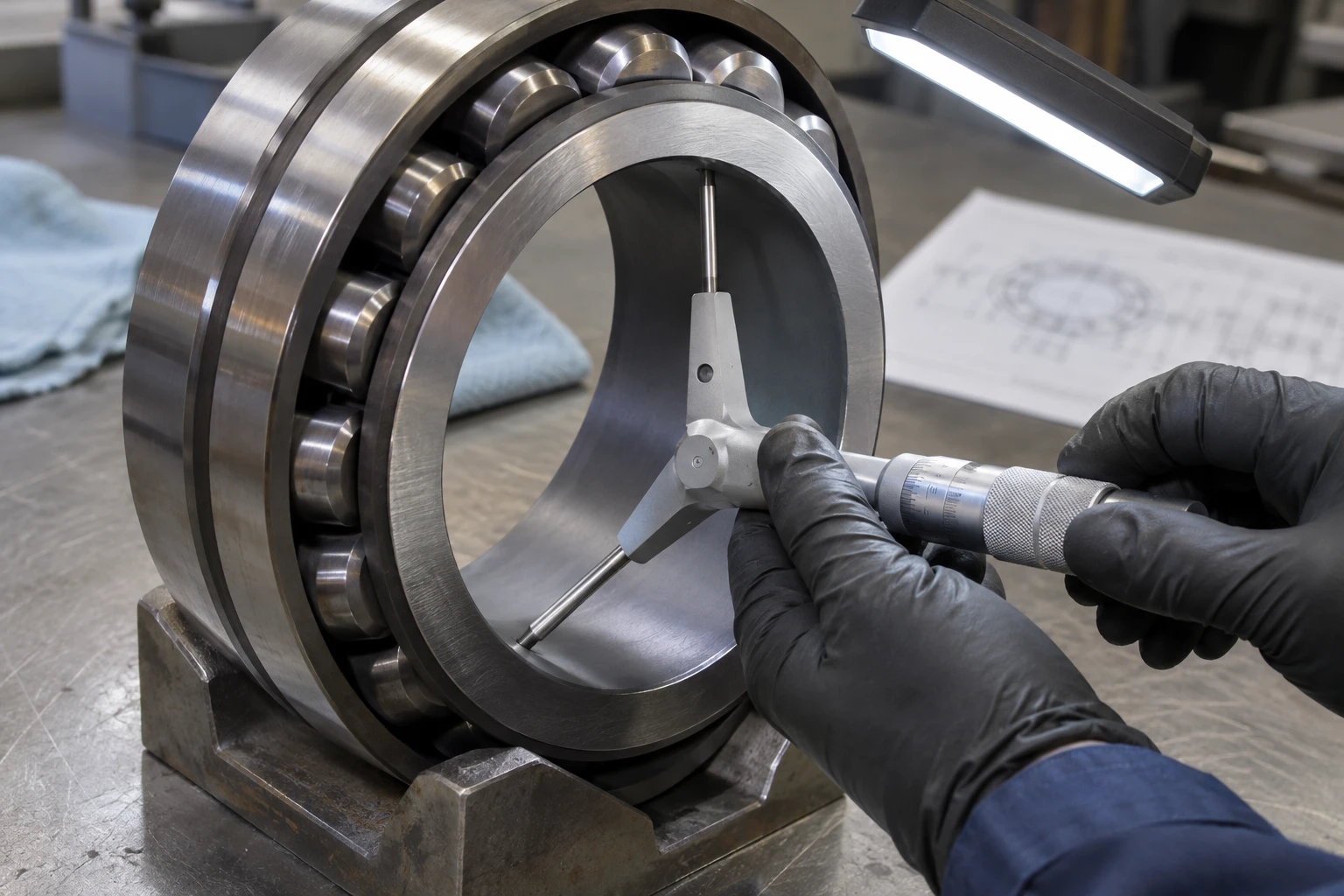
Bore diameter is measured here to check the shaft fit. Radial internal clearance is the relative radial movement between the rings.
The effect is especially important in roller-bearing arrangements with substantial interference or a hot shaft. The LQYS spherical roller bearing range includes designs used in demanding industrial equipment, while the LQYS deep groove ball bearing range covers a different geometry and load profile. Each family requires its own clearance table and application check.
When Each Clearance Group May Be Considered
Consider C2 only where the application requires smaller internal clearance and mounting or thermal effects are mild and tightly controlled. Do not treat C2 as a general solution for improving accuracy. If fit or temperature consumes too much clearance, a C2 bearing can develop heavy internal load and rapid temperature rise.
CN often suits conventional arrangements with moderate fits and no severe temperature difference, but the Normal group still requires an application check. Shaft material, housing material, wall thickness, duty cycle, and heat flow can move an apparently ordinary application outside that assumption.
Evaluate C3 when an interference fit or a hotter inner ring will reduce clearance in service. It can appear in motors, pumps, gearboxes, and other rotating equipment, but the application name alone does not determine the choice. Reserve C4 for a larger required starting range, including some severe fits, temperature gradients, or special machine specifications. Select it only when a calculation or approved product specification requires it.
Why C3 Is Not a High Speed Code
Speed affects friction, temperature, lubrication, and rolling-element behavior, so it belongs in a clearance review. Yet C3 does not mean high speed, heavy duty, better quality, or longer life. A high-speed application may need greater initial clearance because it runs hot, but it may also require a controlled preload or smaller operating clearance for accuracy. Conversely, a slow machine with a tight fit and large temperature gradient may need C3 or C4.
Read the complete bearing suffix designation before ordering. Two bearings with the same dimensions and C3 clearance can still differ in cage or seal configuration.
Clearance Selection Checklist
- Record the complete bearing designation and manufacturer because numerical clearance limits and suffix conventions depend on the exact product.
- Identify the bearing type, size, load direction, load magnitude, speed, shock, required accuracy, and acceptable vibration.
- Measure shaft and housing seats and include tolerances, roundness, wall thickness, hollow components, surface finish, and material.
- Determine which ring sees a rotating load and calculate the actual interference range rather than using nominal dimensions alone.
- Estimate inner-ring, outer-ring, shaft, and housing temperatures at steady state and during the most severe operating cycle.
- Check lubrication, cage, seals, mounting method, and the manufacturer’s required residual or operating clearance for the application.
Information to Send with an RFQ
For an exact replacement, provide the complete old marking, required quantity, photographs, measured dimensions, shaft and housing fits, speed, loads, temperature, lubrication, and failure symptoms. State whether the old bearing ran hot, became noisy, loosened on its seat, or showed cage and raceway damage. For a new design, also provide drawings and the expected temperature distribution.
LQYS can compare the requested clearance group with available product options and identify missing fit-check information. Use the bearing RFQ preparation guide to organize the request before sending the designation and operating conditions.
استنتاج
C2, CN, C3, and C4 are starting clearance groups. The correct selection is the group that leaves an appropriate operating condition after fits, temperature, load, and speed have taken effect. Do not select C3 as a generic high-speed upgrade or C4 as extra safety. Confirm the exact clearance table, tolerance stack, fit-related reduction, thermal change, and required residual clearance before ordering.
الأسئلة المتداولة
Is C3 Better Than CN?
No. C3 has greater initial radial clearance. It is better only when fits and operating conditions require that additional starting range.
Can C3 Replace C4?
Not without a calculation or approved interchange. C4 provides a greater range than C3, and the wrong group can leave too little or too much operating clearance.
Does a Tighter Shaft Fit Reduce Clearance?
Usually yes. Inner-ring interference expands the raceway and consumes part of the initial radial clearance. The amount depends on the complete tolerance and component geometry.
Can Clearance Be Selected from Speed Alone?
No. Speed is one input. Fits, load, temperature gradient, bearing type, size, lubrication, accuracy, and the required operating condition must also be checked.