

NSK vs NTN Electric Motor Bearings: Noise, Clearance, Grease, and Bulk Replacement
2026-09-18
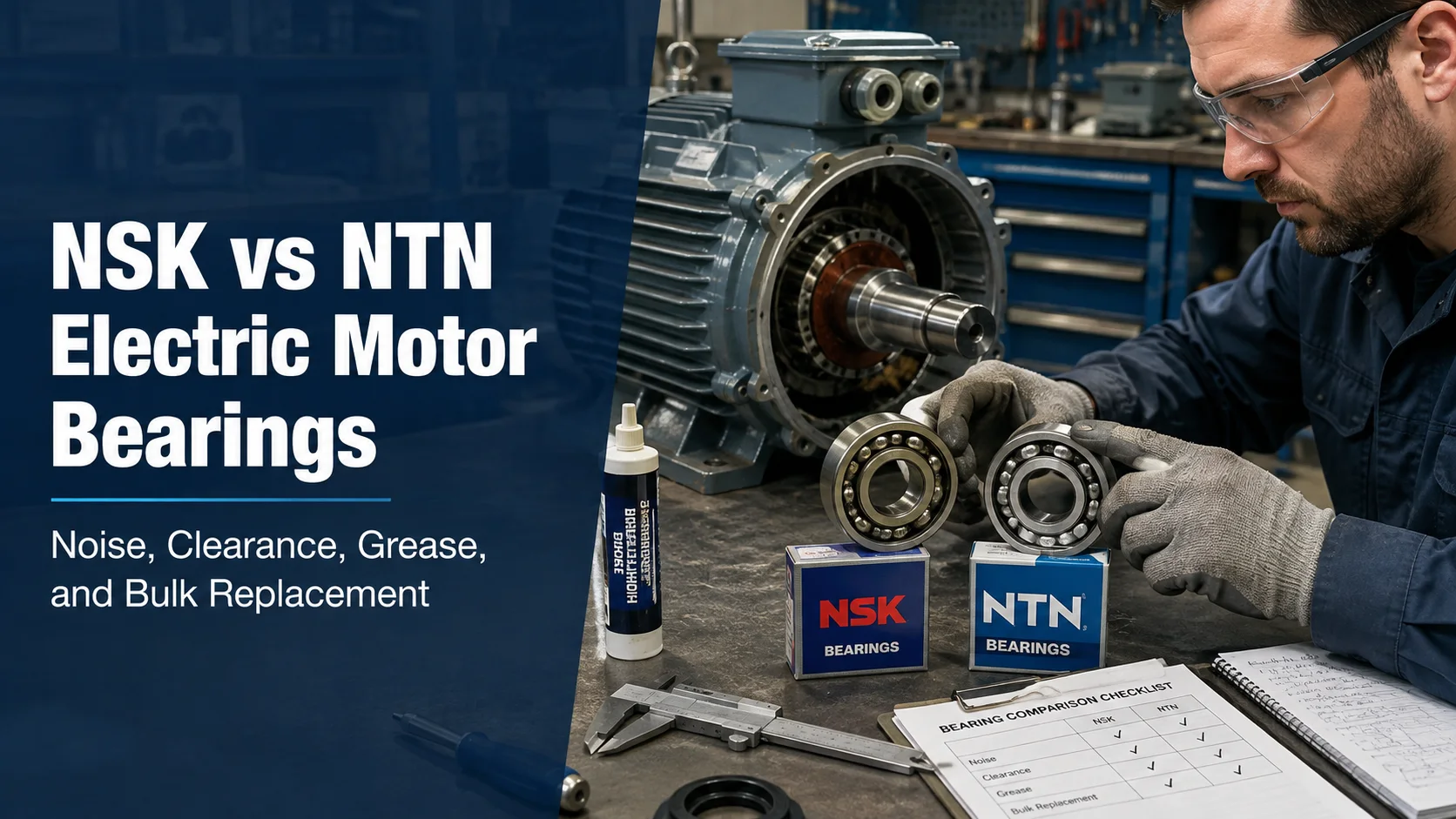
Choosing between NSK and NTN electric motor bearings is not a popularity contest. The decision depends on the motor’s bearing arrangement, speed, temperature, electrical exposure, clearance, grease system, and replacement controls. Both brands offer motor-service families, but one maker’s part number is not automatically interchangeable with the other’s. Use the comparison to frame questions, then approve the exact designation and batch documentation.
Define the Motor Duty Before Comparing Brands
Record the original bearing and motor conditions
Start with the complete marking on the bearing and package. Record the base number, suffixes, clearance class, cage or seal designation, grease reference if printed, and any insulation or electrical suffix. Add motor power, speed, start-stop frequency, orientation, temperature, shaft and housing fits, drive type, and contamination. A 6205 bearing with different clearance or seals can behave differently even when dimensions match.
Separate brand preference from specification fit
NSK and NTN may both have technically suitable candidates for a given motor, but the selection still depends on the manufacturer’s catalog data and the motor builder’s requirements. Ask whether the proposal is an exact replacement, a documented supersession, or a cross-brand alternative. Require the supplier to map every suffix and operating limit instead of quoting only a base number.
Noise: Diagnose the System, Not Just the Logo
What creates motor-bearing noise
Electric motor noise can come from bearing waviness, damaged raceways, incorrect preload, clearance, lubricant starvation, over-greasing, electrical fluting, rotor imbalance, misalignment, soft foot, or a loose fit. A quieter bearing cannot correct a bent shaft or wrong grease quantity. Capture baseline vibration and sound at defined speed and load, then compare the replacement under equivalent conditions.
How to compare NSK and NTN offers
Compare precision class, running accuracy, seal or shield arrangement, cage design, and recommended lubrication for the exact series. Do not infer that one brand is universally quieter. Ask for the relevant noise or vibration designation and verify that the suffix is intended for motor duty. For critical motors, use the same measurement method before and after replacement.
Internal Clearance: C3 Is a Requirement, Not a Default
Match clearance to thermal expansion and fits
Internal clearance must accommodate shaft expansion, interference fits, temperature, and the motor’s bearing arrangement. Some motors use a greater clearance class in specific conditions, but C3 should not be selected simply because it is common. Too little clearance can raise temperature and preload; too much can increase vibration, noise, and rolling-element impact. Confirm the clearance against the motor drawing and exact designation.
Check fixed and floating positions
A motor may use one locating bearing and one non-locating bearing, or a paired arrangement with controlled axial location. Replacing one position with a different clearance or internal design can shift axial load and temperature. Confirm which bearing controls axial movement, whether the housing permits axial displacement, and whether the proposed brand change preserves that function.
Grease and Sealing: The Same Code Does Not Mean the Same Regime
Verify grease compatibility and fill quantity
Check whether the bearing is factory greased, relubricatable, or intended for an oil system. Identify the grease type, thickener, base oil, operating temperature range, and fill quantity specified for the exact bearing. Mixing greases without compatibility evidence can soften or harden the lubricant and change noise or temperature. If a motor has a relubrication fitting, record interval, quantity, and purge practice rather than treating the bearing brand as the maintenance plan.
Review shields, seals, and contamination control
A shielded bearing, contact-sealed bearing, and open bearing have different friction, heat, and relubrication implications. Compare the suffix and sealing construction line by line. In dusty or washdown areas, sealing may matter more than a small brand-level difference in noise. The supplier should explain any change in seal, grease, or service interval before a bulk order is released.
Electrical and Installation Checks
Variable-frequency drives can expose motor bearings to circulating or shaft currents. Depending on the motor design, the solution may involve grounding, insulated components, ceramic rolling elements, or another mitigation specified by the OEM. Do not assume an NSK or NTN standard bearing provides electrical protection unless the designation and documentation say so. During installation, control shaft and housing fits, cleanliness, heating method, alignment, and torque. Poor handling can create noise that is wrongly attributed to the selected brand.
Plan a Controlled Bulk Replacement
Build a like-for-like comparison table
| Item to compare | Evidence required | Release decision |
| Complete designation | Base number plus all suffixes and clearance | Reject a base-number-only quote |
| Noise and vibration | Baseline and post-change readings at matched duty | Investigate system causes before switching brand |
| Grease and seals | Grease, fill, shield or seal, relubrication method | Approve only when maintenance plan remains valid |
| Electrical protection | Motor and drive requirements, insulation details | Escalate unresolved current-path risk |
| Supply continuity | Batch, packaging, inspection, and delivery records | Pilot before full release when risk is high |
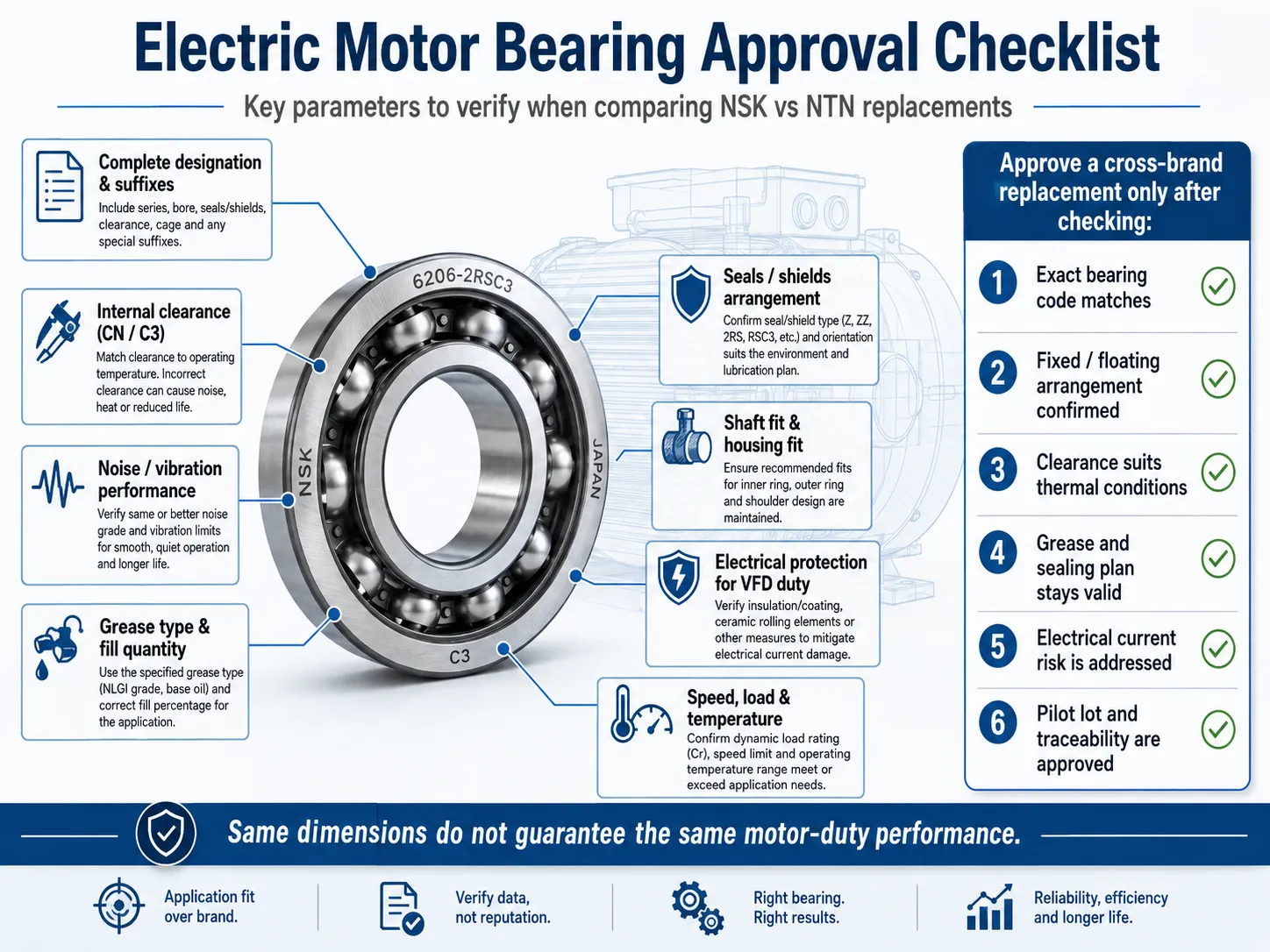
Use a pilot lot before changing every motor
For a fleet replacement, approve a small, traceable pilot lot. Record incoming markings, dimensions where appropriate, grease condition, installation details, current draw, temperature, and vibration. Compare results with the existing bearing under equivalent duty. If the pilot exposes a clearance, grease, or noise issue, correct the specification before committing the remaining quantity.
Evaluate the Distributor and Commercial Route
Confirm what the supplier is authorized to sell
A supplier may manufacture its own brand, distribute NSK and NTN, or source through another channel. Those positions are commercially different. Ask for the legal selling entity, source route, product condition, packaging status, and available traceability. A website listing alone does not prove authorization for a specific brand or order. For high-consequence motors, match the seller identity to the brand’s channel information or request additional documentation.
Shanghai Yongheshun Import and Export Co., Ltd. describes LQYS Bearings as integrating production, sales, trade, and export, with bearing categories that include ball bearings and other industrial products. Buyers can review the company profile and the electric motor bearing selection guide when preparing an RFQ. The LQYS Bearings website and these pages establish product scope; brand route, authorization, and technical fit must be confirmed for the transaction.
Make the Replacement Decision
When a cross-brand change is reasonable
A cross-brand replacement can be reasonable when the full designation, clearance, seals, grease, electrical requirements, load and speed limits, and installation method are demonstrably equivalent for the application. It is easier to defend when the motor OEM accepts the change or when a qualified engineer documents the comparison. Price should be evaluated with downtime, inspection, and maintenance consequences included.
When to hold the order
Hold the order when the supplier cannot identify the complete suffix, offers unexplained substitutions, mixes package and bearing markings, or cannot explain grease and clearance differences. Also hold when the motor has drive-related electrical risk, unusual temperature, repeated premature failures, or a safety-critical duty and the proposed change has not been piloted. A short delay is preferable to distributing an unverified specification across an entire fleet.
استنتاج
The useful NSK vs NTN electric motor bearing comparison is a verification process, not a universal ranking. Noise, clearance, grease, sealing, electrical protection, and bulk replacement controls should be checked against the exact part number and motor duty. LQYS Bearings can support sourcing discussions as a manufacturer and multi-brand bearing trading company, while buyers should confirm the specific channel, documentation, and engineering fit before approval.
contact the LQYS Bearings technical team with the motor model, original bearing marking, quantity, speed, temperature, grease practice, drive type, failure history, and delivery requirements.
الأسئلة الشائعة
Are NSK and NTN electric motor bearings interchangeable?
Only when the complete designation, clearance, seals, grease, electrical requirements, fits, and operating limits are verified for the motor. Matching dimensions alone are insufficient.
Is C3 clearance always required in an electric motor?
No. C3 may be suitable for certain fits and thermal conditions, but the required clearance depends on the motor design and operating temperature.
Which brand is quieter, NSK or NTN?
Neither brand is universally quieter. Noise depends on bearing execution, lubrication, installation, motor alignment, electrical currents, load, and measurement conditions.
Can I mix NSK and NTN bearings in one motor?
Do so only after confirming the fixed and floating arrangement, load sharing, clearance, lubrication, and OEM requirements. Avoid unreviewed mixing in paired or locating arrangements.
What should a bulk replacement RFQ include?
Include the complete bearing code, quantity, motor duty, clearance, seals, grease, electrical exposure, packaging, traceability, inspection requirements, and delivery schedule.