
What Should You Do After Receiving Suspected Counterfeit Bearings?
2026-10-15
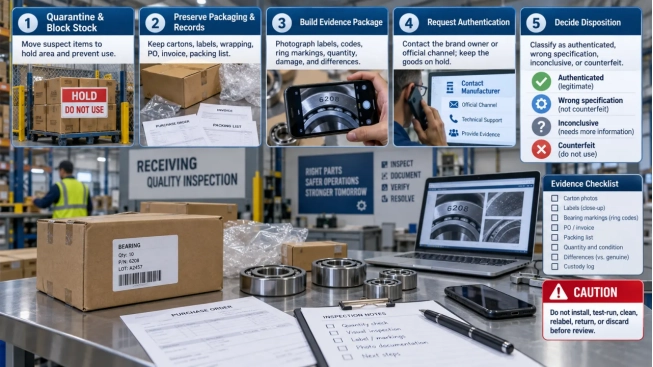
If a shipment appears to contain suspected counterfeit bearings, do not install, test-run, relabel, return, or discard them immediately. Place the affected stock on hold, preserve the packaging and transaction records, document what was received, and request formal authentication through the brand owner or an appropriate industry channel. This controlled response protects equipment, evidence, and the buyer’s options while the facts are established.
Counterfeit risk cannot be decided from one crooked label or a low price alone. Packaging can be damaged in transit, legitimate stock can be old, and product markings vary by model and production period. The practical objective is therefore not to make an instant accusation. It is to prevent questionable stock from entering service and build a traceable evidence package for a qualified review.
Assign one incident owner from purchasing, quality, or receiving before the investigation begins. That person should control communications, maintain the item list, and record decisions. A single owner reduces duplicate messages and prevents one department from returning goods while another is still requesting authentication. The response can remain proportionate: a small standard order may need a short documented review, while a safety-critical or high-value shipment may require engineering, legal, insurance, and brand-protection involvement.
Stop the Bearings From Entering Service
Move the shipment to a clearly identified quarantine area and block it in the inventory or enterprise resource planning system. Record the purchase order, supplier, receiving date, quantity, brand, full designation, batch or label codes, and storage location. If only part of a delivery is questionable, segregate the affected cartons without mixing their contents with accepted stock.
Do not rotate, wash, disassemble, mount, or run the bearings for evaluation unless the reviewing manufacturer specifically requests a controlled test. Handling can change grease condition, surface appearance, seals, or packaging evidence. For critical machines, notify maintenance and planning teams that the parts are unavailable until their status is resolved. Use a separately approved replacement rather than releasing suspect inventory to avoid downtime.
Preserve the Commercial and Traceability Record
Keep the original cartons, labels, inserts, seals, protective wrapping, and shipping materials together with the bearings. Save the quotation, order confirmation, invoice, packing list, delivery record, payment record, product listing, emails, and any promised certificate or authorization statement. Export screenshots or PDFs of online listings before they change, but retain the original files and message history when possible.
Create a simple custody log showing who received, moved, photographed, or opened the shipment and when. A formal forensic chain of custody may not be necessary for every commercial dispute, but basic control prevents mix-ups and makes the evidence more credible. If multiple cartons carry different codes, document each group separately instead of treating the entire delivery as one batch.
Build an Evidence Package Before Contacting Anyone
Photograph the sealed shipment first, then capture every side of the carton, label, barcode or data matrix, security feature, country-of-origin marking, product designation, and bearing marking. Use even lighting, include both overview and close-up images, and keep the original image files. Photograph quantity discrepancies, damaged seals, unusual grease, corrosion, inconsistent fonts, or mismatched codes without claiming that any one detail proves counterfeiting.
Compare the received designation with the purchase order and the machine requirement. Check bore, outside diameter, width, seal or shield arrangement, internal clearance, cage or lubrication suffixes, and any application-specific execution. A wrong or incomplete designation is a procurement nonconformance even when the bearing itself is genuine. Buyers can use LQY’s industrial bearing procurement checklist to structure this comparison.
Request Authentication Through the Right Channel
Send a concise evidence package first through the brand owner’s current authentication or brand-protection channel. Where counterfeiting is reasonably suspected, follow the brand owner’s or relevant authority’s instructions before alerting, confronting, or returning goods to a party that may be connected to the transaction. Premature contact or return can compromise evidence. Keep the physical bearings on hold until custody, freight, and evidence-preservation instructions are agreed in writing.
For branded products, use the brand owner’s current authentication process or the World Bearing Association anti-counterfeiting resource. Authentication methods differ by brand and may require original photographs, package codes, purchase details, or a physical inspection. A generic visual check by the buyer is useful for triage, but it should not be presented as definitive proof.
When the reviewing channel advises that supplier contact is appropriate, request a written response covering the source of the goods, upstream traceability, exact manufacturer designation, and documents promised in the order. If the supplier is a distributor, the evidence should apply to the specific brand, seller, region, and transaction. A general company registration, catalog, or quality certificate does not by itself authenticate a particular shipment. Review any inspection document against the purchase order and batch using the guide to bearing test reports and certificates before accepting it as support.
Decide the Disposition Only After Review
Classify the result in writing: authenticated, incorrect specification, inconclusive, or confirmed counterfeit. For authenticated stock, release it only after checking that quantity, condition, and specification still meet the order. For a wrong specification, follow the normal nonconforming-material and return process. For an inconclusive result, keep the stock on hold and escalate to the brand owner, purchasing management, quality team, insurer, or legal adviser as appropriate to the value and risk.
If counterfeiting is confirmed, do not place the items back into commerce. Coordinate disposition with the brand owner and applicable authorities or advisers, because reporting, retention, return, and destruction requirements can vary by jurisdiction and contract. Keep written instructions and proof of final disposition. Credit, replacement, chargeback, insurance, and legal remedies should be handled under the purchase terms and professional advice rather than improvised at the receiving dock.
Correct the Purchasing Process Before the Next Order
Close the incident with a supplier and process review. Identify how the source was approved, which documents were required, whether the full designation was captured, and why the warning signs were not resolved before shipment. Update approved-supplier rules, purchase-order language, inspection sampling, record retention, and escalation ownership. For higher-risk orders, require traceability evidence and authentication expectations before payment or dispatch.
LQY supplies its own bearing products and also provides multi-brand distribution services. Buyers can review the available bearing product categories when defining a replacement request. Product fit and authenticity should still be verified against the complete designation, operating conditions, and the documentation applicable to the quoted item.
استنتاج
The safest response to suspected counterfeit bearings is controlled, documented, and neutral: quarantine the stock, preserve evidence, verify the exact specification, seek qualified authentication, and release or dispose of the shipment only after a written decision. This protects both machinery and the integrity of any commercial or regulatory follow-up. For an RFQ or fit check, contact the LQY technical team with the full bearing designation, dimensions, application, load, speed, temperature, lubrication, quantity, photographs, and available traceability documents.
الأسئلة المتداولة
Can packaging alone prove a bearing is counterfeit?
No. Poor printing, damaged seals, or inconsistent labels are warning signs, not conclusive proof. Preserve the package and seek verification through the brand owner’s current process or a qualified industry channel.
Should suspected bearings be returned immediately?
Not before the evidence is documented and written return instructions are agreed. An immediate return can weaken traceability, create a custody dispute, or allow questionable stock to re-enter circulation.
Can a buyer test a suspect bearing by installing it?
Installation is not an appropriate authenticity test. It may expose equipment and personnel to risk and may alter the evidence. Keep the part unused unless a qualified reviewer specifies a controlled examination.
What information should be sent for authentication?
Provide clear images of the bearing and all packaging, the complete designation and codes, quantity, purchase and supplier records, delivery date, and a concise description of the concern. Keep the original files.