

Miniature Bearing High Starting Torque Caused by Grease Seals or Clearance
2026-10-16
High starting torque in a miniature bearing is rarely diagnosed from one symptom alone. Grease can create viscous drag, a contact seal can add lip friction, and insufficient operating clearance can load the raceway before the machine applies useful work. The practical answer is to compare when the torque appears: before or after installation, only at low temperature, only on sealed units, or continuously through rotation. That pattern separates a normal configuration effect from a fit, alignment, contamination, or damage problem. LQYS Bearings offers a miniature bearing range with open, shielded, and sealed options, so the complete suffix and application conditions matter as much as the basic bearing number.
What starting torque actually tells you
Starting torque, often called breakaway torque, is the moment required to begin rotation from rest. It is not the same as running torque after the lubricant has sheared, the seals have moved, and the rolling elements have established their paths. A miniature bearing makes small sources of resistance more visible because seal contact, grease distribution, and mounting distortion consume a larger share of the available motor torque. Compare readings only when temperature, dwell time, acceleration, shaft orientation, and measurement method are controlled. Finger feel is useful for detecting a gross bind, but it cannot qualify a low-torque design or compare production lots reliably.
Read the torque pattern before changing parts
The first useful clue is the shape of the resistance. Note whether torque drops after several revolutions, remains steady, changes with temperature, appears only after press fitting, or varies at one angular position. These signatures do not prove a cause, but they determine the next test.
|
Beobachtetes Muster |
Likely area to investigate |
Confirming check |
|
High at first, then falls |
Grease churning or cold lubricant |
Repeat at controlled temperature after a defined run-in |
|
Similar drag on every turn |
Contact seal or deliberate preload |
Compare the exact open, ZZ, and 2RS configurations |
|
Normal loose, high after mounting |
Reduced clearance, tight fit, or housing distortion |
Test the bearing before and after each assembly step |
|
Rough or position-dependent |
Contamination, race damage, misalignment, or burrs |
Inspect cleanliness, seats, shoulders, and rotational smoothness |
When grease is the main source of drag
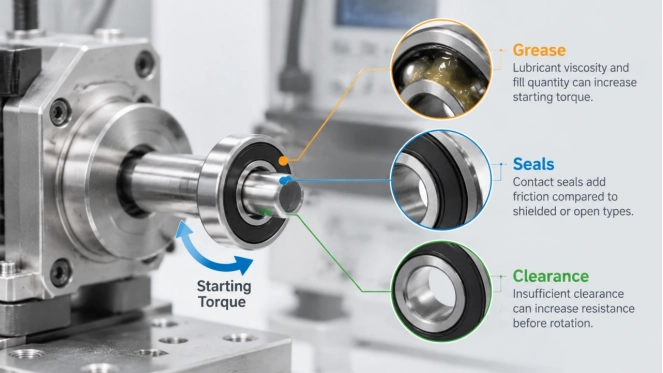
Grease affects starting torque through base-oil viscosity, thickener behavior, fill quantity, temperature, and how the lubricant is distributed inside the bearing. A grease that is appropriate for life or protection can still be too resistant for a small motor with a narrow startup margin. Excess fill may also force the balls and cage to move more lubricant during the first rotations.
Suspect grease first when torque is highest after a long dwell, rises sharply in cold conditions, or drops after a controlled run-in. Compare samples from the same bearing design and seal configuration, not a greased bearing against an unrelated open part. Do not flush or relubricate a sealed bearing simply to make it feel freer; that can remove the intended lubricant quantity or introduce contamination. For a new specification, define the operating temperature, speed, duty cycle, storage time, noise target, and allowable starting torque so lubricant choice can be evaluated together with life and protection.
When seals are responsible
A rubber contact seal normally produces more drag than a non-contact metal shield or an open bearing because the seal lip touches a rotating surface. That resistance can be stable from the first turn and may vary with seal interference, temperature, material, and assembly condition. The difference is functional: a lower-friction closure may provide less exclusion against dust or moisture in the actual machine.
The LQYS miniature bearing product information lists open, ZZ metal-shielded, and 2RS rubber-sealed configurations. Use the exact suffix when comparing samples on the miniature bearing product page. If a 2RS unit shows smooth, repeatable resistance while an otherwise equivalent ZZ unit is freer, seal drag is a plausible explanation rather than immediate evidence of damage. If the resistance is uneven, accompanied by scraping, or changes after handling, inspect for a displaced seal, contamination, or installation contact.
When clearance or mounting is the problem
Internal clearance must be judged in the operating assembly, not only in the unmounted bearing. An interference fit on the inner ring can expand it; a tight housing can compress the outer ring; temperature differences can change the relationship again. If the remaining clearance becomes too small, rolling-element contact load and starting torque rise. Deliberate preload can improve stiffness or control, but an unintended preload consumes torque and can increase heat.
Clearance is the leading suspect when the bearing turns acceptably before assembly but becomes tight after pressing, clamping, fastening a cover, or bringing two supports into alignment. Check shaft and housing tolerances, shoulder squareness, spacer length, clamp load, adhesive location, and whether a press force traveled through the balls. Rotate the shaft after each assembly stage. A housing that is out of round or two bearing seats that are not coaxial can mimic a clearance problem even when the catalog clearance was correct.
Do not overlook other causes
Grease, seals, and clearance are common explanations, but they are not the only ones. Particles, dried residue, corrosion, brinelling, cage damage, an incorrect shoulder radius, shaft rubbing, or external cable and gear loads can all appear as bearing drag. A torque peak at the same angular position suggests local interference or damage more strongly than uniform lubricant resistance. If current rises only after the belt, gear, encoder, or coupling is installed, isolate those components before rejecting the bearing.
A controlled diagnostic sequence
- Define the failure: record starting torque or motor current, temperature, dwell time, orientation, and the point in assembly where the value changes.
- Verify identity: confirm the complete model, closure suffix, lubricant specification when available, clearance designation, and production lot.
- Test the loose bearing: use a clean fixture and the same measurement method for all samples; note smoothness as well as peak torque.
- Rebuild in stages: install one fit, spacer, clamp, seal interface, or driven component at a time and measure after every step.
- Compare controlled variants: change only one factor, such as grease, closure type, fit, or clearance. A multi-variable comparison cannot identify the cause.
- Escalate abnormal units: quarantine bearings with roughness, scraping, unstable torque, visible damage, or results outside the approved drawing and test plan.
Specify the replacement around the application
A replacement request should not say only that the bearing must spin freely. State the bore and envelope dimensions, radial and axial load, speed, startup profile, temperature range, contamination, noise requirement, expected life, shaft and housing fits, closure type, and the test used to accept starting torque. For small motors, the related electric motor bearing selection guide provides additional context on load, speed, seals, and clearance.
LQYS Bearings lists miniature bearing configurations for precision instruments, micro motors, medical devices, and robots. To review a low-torque application, send the current model and suffix, drawing, fit tolerances, temperature, speed, load, closure preference, lubricant requirement, quantity, and measured startup result through the application support channel. Final suitability should be confirmed against the selected bearing specification and an application-representative sample test.
Schlussfolgerung
High miniature bearing starting torque is best diagnosed by timing and repeatability. Torque that falls with motion or temperature points toward grease; smooth continuous drag may come from a contact seal; torque that appears after assembly points toward reduced clearance, preload, or distortion. A staged test that changes one factor at a time protects both the low-torque target and the bearing’s required sealing, lubrication, and service life.
Häufig gestellte Fragen
Is a sealed miniature bearing supposed to feel tighter?
A contact-sealed bearing may have more consistent drag than an open or shielded version. Confirm the exact closure design and the approved torque requirement before calling it defective.
Can running in a bearing reduce starting torque?
It may redistribute grease and stabilize seal contact, but run-in conditions must be controlled. A rough or damaged bearing should not be accepted because its torque later falls.
Does tighter internal clearance always improve precision?
No. Reduced clearance or preload can improve stiffness in some designs, but too little operating clearance can raise torque and heat. The correct value depends on fits, temperature, and load.
Should grease be removed to solve high torque?
Not without an approved lubrication change. Removing grease can reduce drag while also reducing protection or life. Compare qualified lubricant specifications and fill quantities under the actual duty cycle.