

FYH Clean Series Bearing Units for Clean Manufacturing: What Buyers Should Check Before Selection
2026-10-23
FYH Clean Series bearing units are positioned for compact equipment and cleaner operating environments, but selection should not begin with the series name alone. Buyers need to define what “clean” means in their process, then verify load, speed, shaft size, mounting space, cover arrangement, lubrication, and maintenance expectations. The same unit that works on a light display-panel conveyor may not satisfy a classified cleanroom, a chemical washdown line, or a higher-load machine.
The purchasing goal is therefore twofold: confirm that the Clean Series configuration fits the machine, and confirm that its materials and contamination controls fit the environment. A short application checklist prevents a compact, easy-to-mount unit from being selected outside its intended operating window.
Define the Clean Manufacturing Requirement
Clean manufacturing can describe several different problems. One facility may need to limit particles released near a sensitive product. Another may need smooth, accessible surfaces for routine cleaning. A third may expose equipment to water, disinfectants, solvent vapor, or corrosive residue. These requirements are not interchangeable, so buyers should document the dominant contamination direction and the cleaning method.
Before reviewing a model, identify:
- The product or process being protected and the consequence of bearing-generated particles or lubricant leakage.
- Any room classification, internal cleanliness standard, or customer-specific acceptance requirement.
- Cleaning frequency, water pressure, chemical agents, temperature, drying method, and whether residue can collect around the housing.
- Airborne dust, liquid splash, condensation, and possible contact with process material.
- Documentation, traceability, lubricant, or material declarations required before approval.
Do not treat “Clean Series” as proof of a particular cleanroom class, washdown rating, food-contact status, or chemical resistance. Those requirements should be checked against the current FYH specification and the buyer’s own validation procedure.
Understand the FYH Clean Series Configurations
UP Pillow Type
FYH describes the UP pillow type as a compact, lightweight unit that combines a special-alloy housing with a small bearing. It uses set-screw shaft locking and is presented as a non-lubricated type intended to support equipment weight reduction. Buyers should confirm the exact model dimensions, shaft attachment, load ratings, speed limits, and what the non-lubricated description means for factory fill and field relubrication. It should not be interpreted as permission to run the rolling elements dry.
For adjacent mounted-unit options and housing formats, review the pillow block bearing range before finalizing the mounting concept.
UFL Flange Unit
The Clean Series UFL flange unit uses a cover with a rubber-coated surface. FYH states that the coating adheres to the housing and provides dust and water resistance. The flange format may suit a wall, frame, or side plate where a pillow block cannot be installed, but buyers still need to verify bolt pattern, pilot and shaft location, installation access, and the direction of the working load.
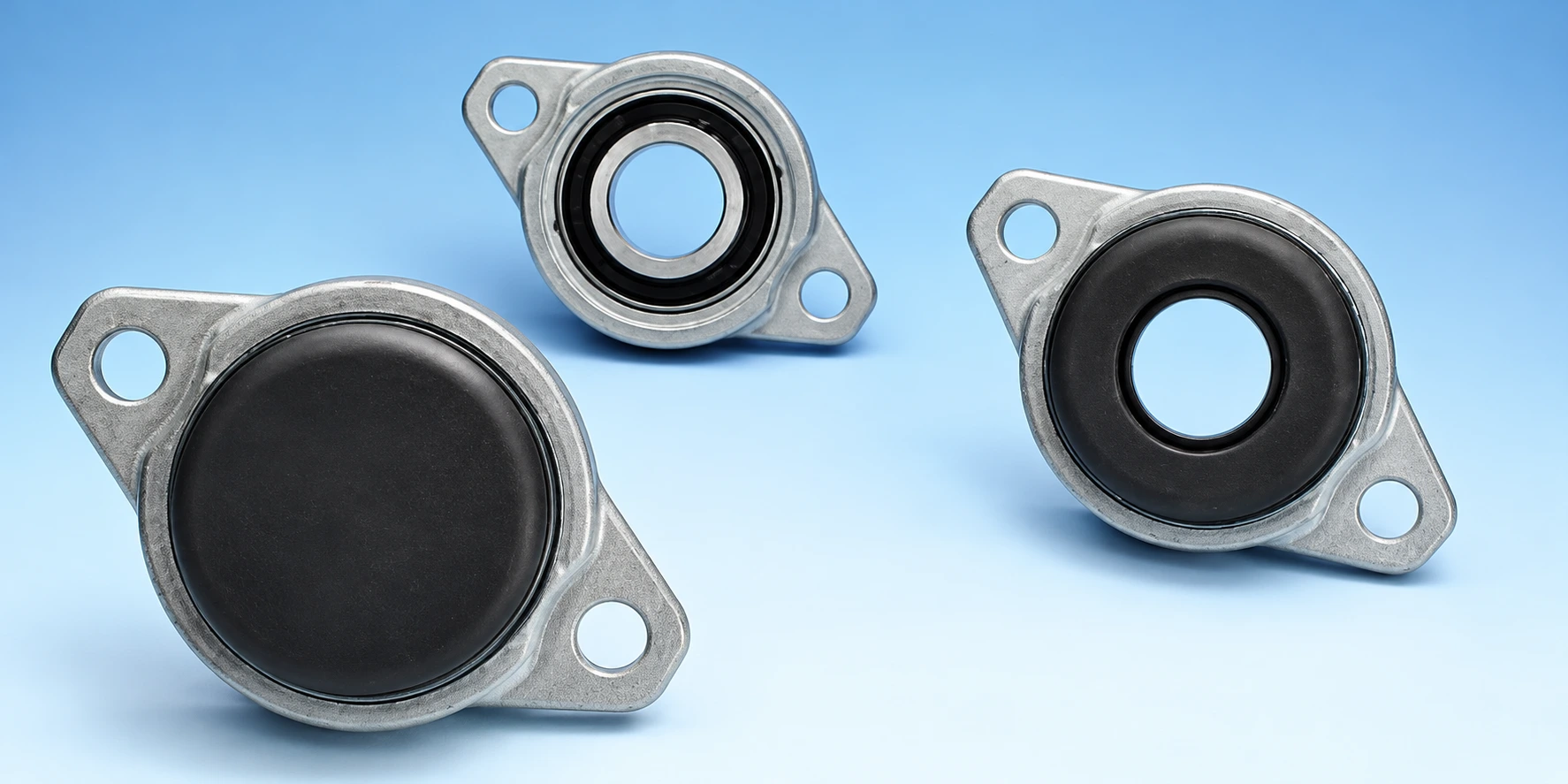
Materials Listed for the Series
The official Clean Series page lists a high-carbon chromium bearing steel (SUJ2), an NBR rubber seal, an SCM435 set screw, a ZDC2 zinc-alloy die-cast housing, and a cover using NBR with cold-rolled steel sheet. These details are useful for an initial compatibility review, but the exact purchased unit and current revision should be confirmed. Pay particular attention to cleaning chemicals that may affect NBR, the housing alloy, or exposed steel components.
Check Load, Speed, and Shaft Conditions
Quantify the Working Load
Provide radial load, axial load, load direction, shock, vibration, duty cycle, and desired life. Compact equipment does not always mean low load: belt tension, product accumulation, misalignment, or an overhung pulley can raise the reaction at the unit. Compare calculated equivalent load with the rating for the exact insert and housing, using the manufacturer’s method and appropriate safety factors for the machine.
Confirm Speed and Temperature Together
Operating speed affects heat generation, seal friction, lubricant behavior, and allowable fit. State normal and maximum rpm, start-stop frequency, reversal, ambient temperature, and heat conducted through the shaft. The selected unit’s limiting speed may change with seal arrangement, load, fit, and temperature, so a catalog family name is not enough. If the application requires a different bearing arrangement, compare available ball bearing options before forcing the Clean Series into the design.
Control Shaft Fit and Geometry
Confirm shaft diameter, tolerance, roundness, surface finish, hardness if relevant, shoulder or collar locations, and available locking length. A set-screw unit needs adequate shaft condition and access for installation. Shaft deflection and mounting-base distortion can create misalignment or uneven loading even when the nominal bore is correct. Include a drawing when the shaft is stepped, coated, hollow, or close to surrounding guards.
Verify Mounting Space and Installation Access
Check the full envelope, not only the bore. Record the housing height, centerline, base or flange dimensions, bolt size and spacing, cover clearance, tool access, and removal path. For a retrofit, compare the existing shaft center height and mounting holes rather than assuming interchangeability from a familiar model code. Ensure the machine structure is flat and rigid enough to support the unit without twisting the housing.
The cover and nearby guarding should also support cleaning. Avoid pockets that trap debris, and confirm that operators can inspect the unit without disturbing a sensitive process. If the bearing sits close to a product zone, document the orientation of the seal and cover, the path of any displaced grease, and the direction from which dust or water is most likely to arrive.
Review Lubrication, Sealing, and Maintenance
Clarify whether the exact Clean Series model is factory lubricated for its intended life, can be relubricated, or requires a defined replacement interval. Record lubricant identity and any restrictions on leakage, volatility, particle generation, or incidental contact. Maintenance planning should reflect speed, temperature, vibration, cleaning exposure, and the consequence of failure rather than relying on a generic calendar interval.
Inspect how the NBR seal and rubber-coated cover interact with the cleaning environment. NBR may be suitable for many industrial conditions, but compatibility varies with chemical type, concentration, temperature, and exposure time. Confirm resistance against the actual cleaning agent and verify whether repeated spray or immersion is within the product specification. A cover described as dust- and water-resistant should not be assumed to provide a certified ingress rating unless current documentation states one.
Build a Procurement Checklist Before the RFQ
A complete inquiry should include the FYH model or candidate series, required quantity, shaft diameter and tolerance, normal and peak loads, rpm, duty cycle, mounting drawing, space limits, cleanliness requirement, cleaning chemicals, temperature, cover preference, lubricant restrictions, maintenance policy, and required documentation. For replacements, add the existing unit’s full marking and clear photos of the housing, insert, cover, mounting holes, and shaft interface.
Use the LQYS product portfolio to compare related bearing formats before locking the equipment layout. LQYS can then evaluate the request against the supplied dimensions and operating conditions without assuming that every clean-manufacturing application needs the same material, cover, or maintenance approach.
Conclusion
FYH Clean Series selection is strongest when the environment and machine are specified separately and then reconciled. Define the contamination and cleaning requirement, choose between the UP pillow and UFL flange arrangement, verify shaft and mounting geometry, and confirm load, speed, material compatibility, lubrication, and maintenance for the exact model. Buyers who have the model marking, drawing, operating data, and required quantity can request a Clean Series fit check before issuing the purchase order.
Questions fréquemment posées
Does FYH Clean Series mean certified for every cleanroom?
No. The product is positioned for clean environments, but buyers should verify any required room class, particle limit, lubricant rule, or customer certification for the exact application.
What is the main difference between UP and UFL units?
UP is a pillow-type unit for base mounting, while UFL is a flange arrangement for mounting to a face or plate. Confirm dimensions, load direction, bolt pattern, and installation access.
Does non-lubricated mean the bearing runs without grease?
Do not assume so. Confirm the current FYH specification for the exact model, including factory lubricant, relubrication provisions, and the recommended maintenance or replacement policy.
Which data is most important for a model cross-reference?
Provide the complete model, shaft size and tolerance, mounting pattern, center height, load, rpm, temperature, cleaning exposure, cover requirement, lubricant restrictions, drawing, photos, and quantity.