

FAG 223 Series T41A and T41D Vibrating Screen Bearings
2026-11-27
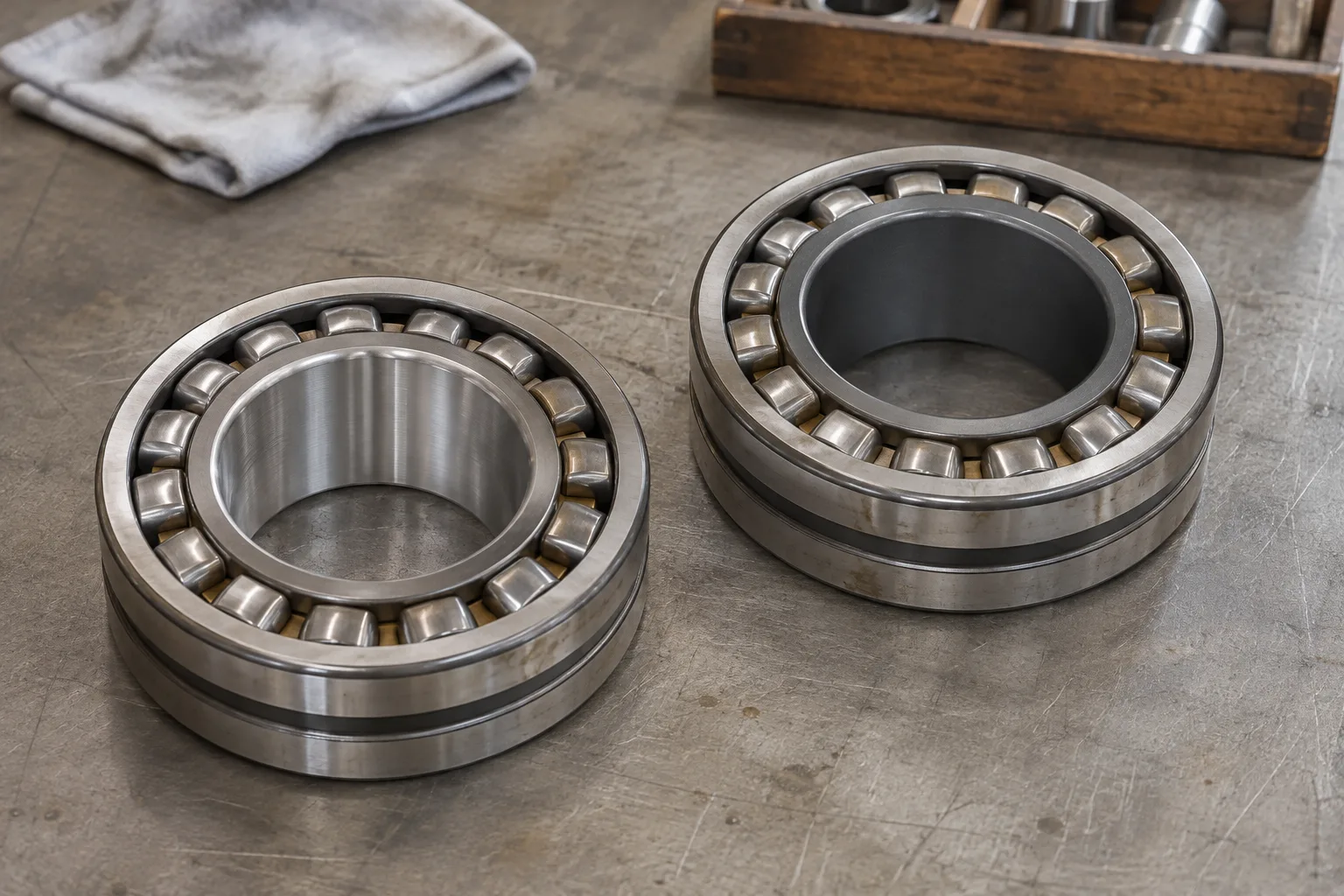
FAG 223 series bearings with T41A or T41D suffixes are special spherical roller bearings for vibratory machinery. They are designed around the loads, accelerations, fit security, contamination, and internal-clearance demands of equipment such as vibrating screens. T41A and T41D should not be replaced by a standard 223 bearing merely because the boundary dimensions match. The full designation, bore type, clearance specification, coating, cage, fits, and current product data must agree. LQYS supports industrial sourcing and replacement review through its spherical roller bearing product range.
Why Vibratory Machinery Needs a Special Bearing
A vibrating screen does not apply a smooth radial load. The bearing supports the screen mass and rotating imbalance while acceleration changes the forces acting on rollers, cage, raceways, and seats. Dust and moisture challenge sealing and lubrication. Ring creep or a loose housing seat can quickly worsen vibration and damage adjacent components.
A special vibratory-machinery bearing therefore combines internal design and manufacturing controls intended for this duty. The suffix is part of that specification. Replacing it with a general-purpose spherical roller bearing can change internal clearance, dimensional tolerances, cage behavior, bore surface, and fit performance even when bore, outside diameter, and width are identical.
What T41A and T41D Mean
FAG applies T41A and T41D specifications to spherical roller bearings for vibratory machinery. On cylindrical-bore versions, the specification narrows the tolerances for both the bore and the outside diameter. On tapered-bore versions, only the outside diameter has the narrower tolerance. C4 is the standard radial internal clearance for this vibrating-screen design.
T41D adds a cylindrical bore with a Durotect CK coating on specified 223 series sizes. The coating helps prevent fretting corrosion at the shaft seat while allowing the axial movement needed at the non-locating bearing. It does not repair an undersized, tapered, out-of-round, or damaged shaft. Not every 223 size or bore variant is covered, so the current catalogue line for the exact designation must be checked.
|
Selection point |
T41A |
T41D |
Replacement check |
|
Applicazione |
Vibratory machinery specification |
Vibratory machinery specification |
Confirm the complete FAG designation |
|
Clearance |
Specified C4 group for the design |
Specified C4 group for the design |
Do not substitute CN or C3 by assumption |
|
Bore surface |
Check the exact catalogue construction |
Durotect CK coating on the cylindrical bore on specified sizes |
Inspect shaft size, form, finish, and fretting |
|
Disponibilità |
Depends on size and bore version |
Limited to defined product ranges |
Verify current size and suffix availability |
Why C4 Clearance Matters
In a typical vibrating-screen arrangement with a cylindrical bore, the inner ring has a sliding fit on the shaft and the outer ring has an interference fit in the housing. Compression of the outer ring reduces radial clearance. A hotter inner ring can reduce it further. The specified C4 starting clearance allows for these effects. For a tapered bore, check the clearance reduction during mounting against the procedure for the exact bearing.
C4 does not mean the assembled bearing should remain visibly loose. Nor does it mean any C4 spherical roller bearing is equivalent to a T41A or T41D product. Clearance group is only one part of the special design. A replacement also has to match tolerances, internal geometry, cage, bore version, coating where specified, load rating, speed limits, and lubrication requirements.
Cylindrical and Tapered Bore Versions
A cylindrical-bore bearing mounts directly on a cylindrical shaft seat using the fit specified for the arrangement. A tapered-bore version carries K in the designation and may mount on a tapered seat or appropriate sleeve arrangement. Driving a tapered-bore bearing farther onto the taper reduces radial clearance, so mounting must be controlled by the approved reduction or drive-up procedure.
Do not assume a T41D coated cylindrical bore has a direct K-version equivalent. Record every suffix and identify whether the original bearing is cylindrical or tapered before requesting a replacement. If the old marking is incomplete, inspect the bore and shaft, measure the seat, and provide photographs. The mounting method, shaft drawing, and current manufacturer data should resolve the ambiguity before installation.
Fit and Seat Checks Before Replacement
Vibration can promote creep when a seat does not provide the required support. Measure shaft and housing seats at several axial and circumferential positions. Check diameter, cylindricity, roundness, taper, shoulder runout, surface finish, fillet radius, and evidence of fretting. A polished band, reddish debris, scoring, or heat tint can indicate relative movement or poor contact. Replacing the bearing without correcting the seat can repeat the failure.
Fits must come from the current FAG specification for the exact screen arrangement, load direction, shaft construction, and bearing size. A general spherical-roller fit chart is not enough for a vibrating screen. Housing distortion, split housings, thin walls, and mounting-bolt condition can also change outer-ring support. Confirm the final seated geometry after the housing is tightened to its operating condition.
Lubrication and Contamination Control
The lubricant must form an adequate film under oscillating load, vibration, speed, and temperature while resisting contamination and water. Too little lubricant risks surface distress; too much can increase churning and heat. Grease type, fill quantity, relubrication interval, purge path, seals, and labyrinth condition should be reviewed as one system. A bearing change is a good time to inspect blocked lines and hardened grease around the housing.
When sourcing spherical roller bearings for mining equipment, record the load, operating temperature, and contamination at the site. For a vibrating screen, also verify the full T41 designation against the machine specification.
Replacement Checklist for T41 Bearings
- Photograph the markings on the bearing and its packaging, and copy the full designation exactly. The standard C4 clearance may be omitted from the T41 designation. Record any explicit clearance suffix and verify it against the order specification.
- Confirm bore, outside diameter, width, corner radii, shoulder diameters, shaft drawing, housing type, and available axial space.
- Identify cylindrical or tapered bore and document the original mounting method, drive-up value, or measured clearance reduction.
- Measure shaft and housing seats and investigate fretting, creep, corrosion, out-of-roundness, taper, looseness, and housing distortion.
- Provide screen speed, imbalance data, radial load, acceleration, operating temperature, duty cycle, lubrication, seals, and contamination conditions.
- Compare cage, clearance, coating, tolerances, ratings, and permissible speed using current data for the proposed replacement.
- Check the packaging and traceability records required for the order.
Common Replacement Mistakes
The first mistake is ordering only 223 plus a bore code and overlooking T41A or T41D. Others include substituting C3 for C4, assuming all T41D sizes use the same bore construction, confusing cylindrical and tapered bores, reusing a fretted shaft, and applying general-purpose fit values. A visually identical bearing can create a different mounted clearance or seat condition.
Cross-brand suffixes should never be translated character by character. Decode each manufacturer’s bearing suffixes against its own catalogue, then check the proposed bearing against the machine’s functional requirements.
Information to Send for Sourcing
An effective request includes the full old designation, quantity, photographs, shaft and housing drawings, measured seats, screen model, speed, loads, acceleration, temperature, lubrication method, relubrication interval, contamination, and failure observations. State whether an exact FAG replacement is mandatory or whether an engineering-reviewed alternative can be considered.
Include your FAG bearing requirements in the quotation request and send the complete T41 designation to LQYS for an availability check. If your order requires an authorized FAG distributor, ask for current written proof of authorization before placing it.
Conclusione
FAG T41A and T41D bearings are application-specific 223 series spherical roller bearings, not standard bearings with optional marketing suffixes. T41D identifies a coated cylindrical-bore solution on specified sizes, while both designations require the approved vibratory-machinery clearance and tolerance specification. Match the full designation, bore version, seats, cage, clearance, coating, lubrication, and operating data before replacement.
Domande frequenti
Can a Standard 223 Bearing Replace T41A?
Not by dimensions alone. T41A includes vibratory-machinery tolerances and clearance requirements that a standard 223 bearing may not provide.
What Is the Main Difference Between T41A and T41D?
T41D includes a cylindrical bore with a Durotect CK coating on specified sizes. Confirm the exact current product line because coverage is size and design dependent.
Why Is C4 Used in Vibrating Screen Bearings?
C4 provides the specified initial clearance needed for the intended fit and operating effects. It remains only one part of the special bearing design.
Can LQYS Confirm a Replacement from a Photograph?
A photograph helps identify markings, but a reliable review also needs dimensions, seats, bore type, screen data, load, speed, temperature, lubrication, failure history, and quantity.
Prev: Nessuno
Prossimo : lqys-bearing-internal-clearance-guide-for-c2-cn-c3-and-c4