

Stainless Steel Bearings for Corrosive Pump Applications: How to Match Material, Seals, and Lubrication
2026-10-22
Selecting stainless steel bearings for a corrosive pump starts with the exposure, not the alloy name. Buyers should identify the pumped medium, any cleaning chemicals, ambient moisture, temperature, load, speed, and likely ingress path before comparing material grades, seals, or grease. A bearing labeled stainless can still fail early if the cage, shields, fasteners, lubricant, or adjoining housing is incompatible with the service environment.
The practical objective is to build a compatible system. Material must provide adequate corrosion resistance and mechanical capacity; the closure must control the contaminants that can reach the raceway; and the lubricant must remain stable at the actual temperature and speed. The following selection process turns those operating details into a clearer purchasing specification.
Start With the Pumped Medium and the Exposure Path
First determine whether the bearing is exposed directly to process fluid or only to the surrounding atmosphere. In a well-isolated pump, the main risks may be humid air, condensation, washdown, or leakage past a mechanical seal. In other arrangements, vapors, aerosols, or intermittent splashing may reach the bearing. The distinction matters because occasional water exposure, salt-laden air, dilute chemicals, and continuous contact with an aggressive medium do not create the same requirement.
Record the conditions that affect both corrosion and lubrication:
- Fluid chemistry, concentration, pH, dissolved salts, and whether different products are handled in the same pump.
- Normal and maximum fluid, housing, and ambient temperatures, including cleaning or sterilization cycles.
- Exposure route and duration: vapor, condensation, splash, washdown, leakage, or possible immersion.
- Contaminants such as abrasive solids, crystallized product, cleaning residue, or airborne dust.
- Required hygiene, lubricant, documentation, or traceability conditions for the end use.
If the fluid can reach the raceway, bearing selection should be reviewed together with shaft sealing, drainage, venting, and housing design. A more corrosion-resistant bearing cannot compensate for an unresolved leak or a cavity that traps contaminated liquid.
Match the Stainless Material to Corrosion and Mechanical Demand
Treat the Grade as a Starting Point
Stainless bearing offerings may use grades such as 440C, 304, or 316, but the designation alone does not confirm suitability. Grade, heat treatment, component geometry, and manufacturing route influence hardness, load capacity, wear, and corrosion behavior. A harder martensitic stainless option may suit a conventional rolling contact requirement, while a more corrosion-resistant austenitic option may be considered for a more aggressive medium. The tradeoff must be checked against the required load, speed, life, and dimensional specification rather than inferred from general corrosion tables.
Verify Every Wetted or Exposed Component
Ask what material is used for the inner and outer rings, balls, cage, shields, snap rings, seals, and any mounting hardware. A mixed-material assembly may be correct, but the most vulnerable component can control service life. Also review the shaft and housing materials. Dissimilar metals, trapped moisture, and crevices can create localized attack even when the bearing rings appear acceptable. When the medium is unusual, request a written material breakdown and confirm compatibility with the chemical supplier or the pump engineer.
Select Seals for the Real Contaminant
A shield or seal is not a universal barrier. Metal shields generally limit larger particles and help retain lubricant with relatively low running friction, but they are not intended to exclude liquid under pressure. Contact seals can improve resistance to splashing and fine contamination, yet they add friction and heat and may reduce allowable speed. Seal lip material must also tolerate the fluid, cleaning agent, and temperature.
Before specifying an open, shielded, or sealed bearing, confirm:
- Whether contamination approaches as liquid, vapor, fine powder, or abrasive particles.
- Whether the seal sees pressure, repeated washdown, reverse rotation, or shaft runout.
- The chemical and temperature compatibility of the elastomer, not only the ring material.
- The acceptable torque, heat generation, and speed after the selected closure is applied.
Where process leakage is credible, the bearing closure should be the final defense rather than the primary process seal. Confirm that the pump’s mechanical seal, labyrinth, flinger, drain, and bearing housing work together.
Match Lubrication to Chemistry, Temperature, and Speed
Lubricant selection is as important as metal selection because corrosion can begin when moisture displaces or degrades the lubricating film. Specify the grease or oil type, base-oil viscosity, thickener, usable temperature range, water resistance, oxidation stability, and compatibility with seals. If incidental product contact is possible, determine whether a regulated lubricant category is required and verify the exact product documentation.
Do not assume that a pre-lubricated bearing is suitable for every pump. The required viscosity depends on bearing size, speed, load, and operating temperature. High speed can make an overly viscous grease run hot, while a light lubricant may provide insufficient film at low speed or high load. Washdown and condensation may also shorten relubrication intervals. When changing lubricant, confirm compatibility before mixing thickeners or base oils; otherwise remove the old lubricant through an approved procedure.
Verify Load, Speed, Fit, and Pump Dynamics
Corrosion resistance does not replace the normal bearing calculation. Provide the supplier with radial and axial loads, direction and variability of load, operating and maximum speed, duty cycle, temperature at the bearing, and the required life basis. Include transient conditions such as startup, shutdown, dry running, cavitation, imbalance, belt pull, and hydraulic thrust where applicable.
Dimensions are only the first fit check. Confirm shaft and housing tolerances, internal clearance, required accuracy, axial location, thermal growth, and allowable misalignment. A fit that is too loose can creep and fret; a fit that is too tight can reduce internal clearance and raise temperature. If an existing bearing failed, document raceway appearance, corrosion pattern, lubricant condition, seal damage, vibration, and temperature before ordering the same designation again.
Use Model Data as a Starting Point
IL LQYS stainless steel bearing range identifies 440C, 304, and 316 as available material families and publishes dimensional information for models beginning with 6000 through 6006 and additional sizes. Those listings help establish bore, outside diameter, and width, but the final quotation should confirm the exact ring and rolling-element material, cage, closure, lubricant, clearance, load ratings, and speed limits for the requested configuration.
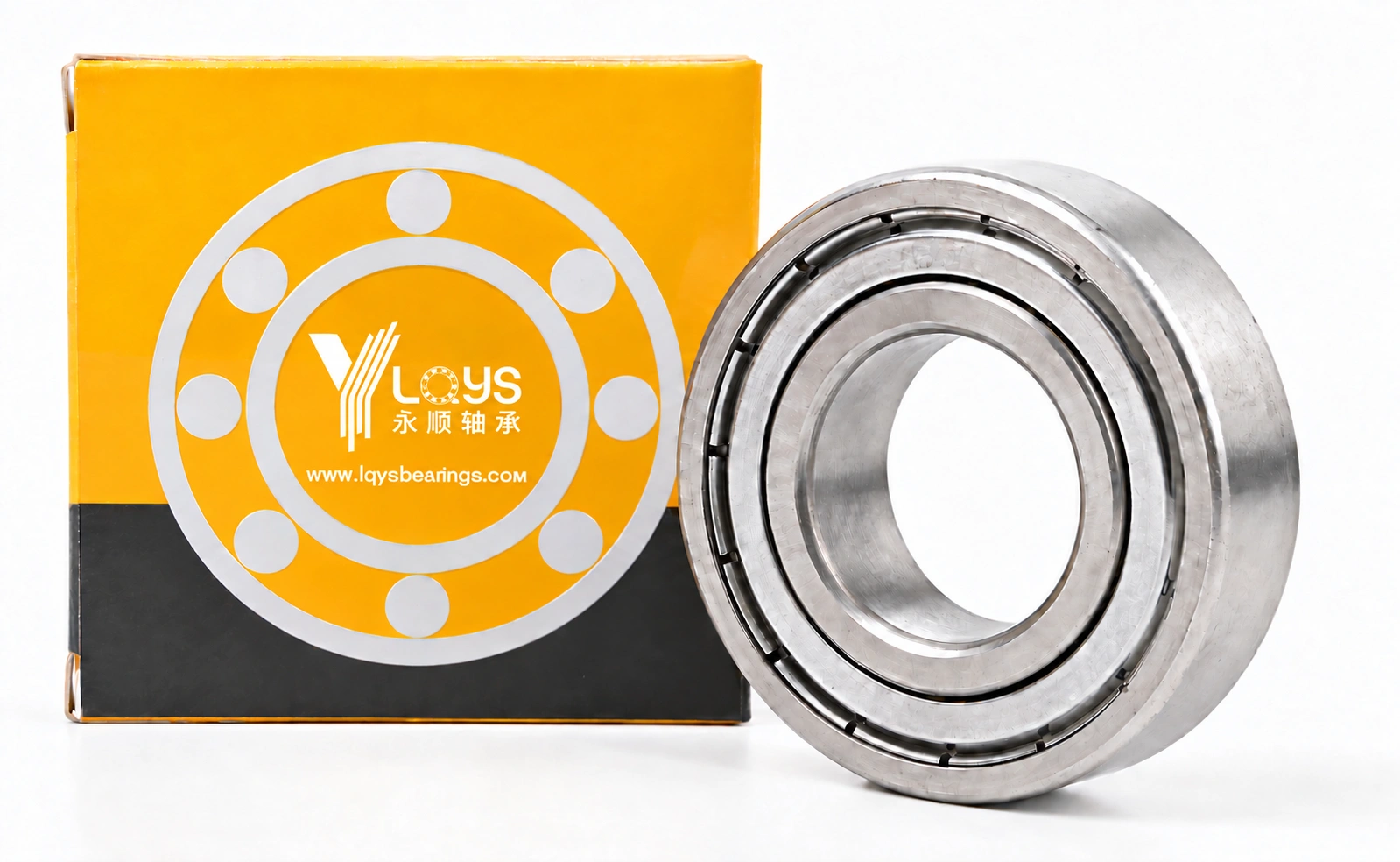
Buyers comparing nearby designs can also review the ball bearing category. For broader sourcing, the LQYS product portfolio provides context on other bearing types that may suit different load or arrangement requirements.
A useful RFQ should state the pump type, process medium and concentration, temperatures, exposure route, shaft size, current bearing designation, radial and axial load, speed, duty cycle, preferred seal arrangement, lubricant restrictions, quantity, and any drawing or failure evidence. This information allows material, sealing, and lubrication choices to be assessed together rather than selected independently.
Conclusione
The right stainless steel bearing for a corrosive pump is the configuration whose material, closure, lubricant, fit, load capacity, and speed capability match the same operating envelope. Start with the medium and ingress path, verify every exposed component, and treat catalog size data as a dimensional reference rather than a complete specification. For a model cross-check, buyers can request an application fit check with the operating conditions and required quantity.
Domande frequenti
Is 316 stainless steel always the best choice for a corrosive pump?
No. Chemical resistance is only one requirement. The bearing must also meet hardness, load, speed, wear, fit, and life requirements. Verify the complete bearing construction and application conditions.
Are sealed stainless steel bearings waterproof?
Not automatically. Seal effectiveness depends on closure design, pressure, shaft condition, speed, runout, temperature, and fluid chemistry. A bearing seal should not replace the pump’s process sealing system.
Can a standard pre-lubricated bearing be used after washdown?
Only if the lubricant, seal, and relubrication plan are suitable for the washdown chemistry and frequency. Confirm water resistance, temperature range, seal compatibility, and maintenance interval.
What information is needed to cross-reference models 6000 to 6006?
Provide the complete suffix, dimensions, material, shield or seal type, clearance, accuracy requirement, lubricant, load, speed, temperature, and corrosion exposure. The base number alone does not define the full configuration.