

NJ vs NUP Cylindrical Roller Bearings for Axial Location and Replacement
2026-11-12
NJ and NUP cylindrical roller bearings can share the same boundary dimensions, yet they do not locate a shaft in the same way. An NJ bearing provides axial location in one direction. An NUP bearing adds a loose flange ring and can locate the shaft in both directions within the bearing’s permitted axial load. That difference affects fixed-end design, mounting sequence, replacement compatibility, and operating temperature. The LQYS cylindrical roller bearing range includes single-row designs for arrangements that require high radial capacity and controlled axial location. Selection still has to be checked against the complete bearing designation and the machine arrangement.
How NJ and NUP Designs Locate a Shaft
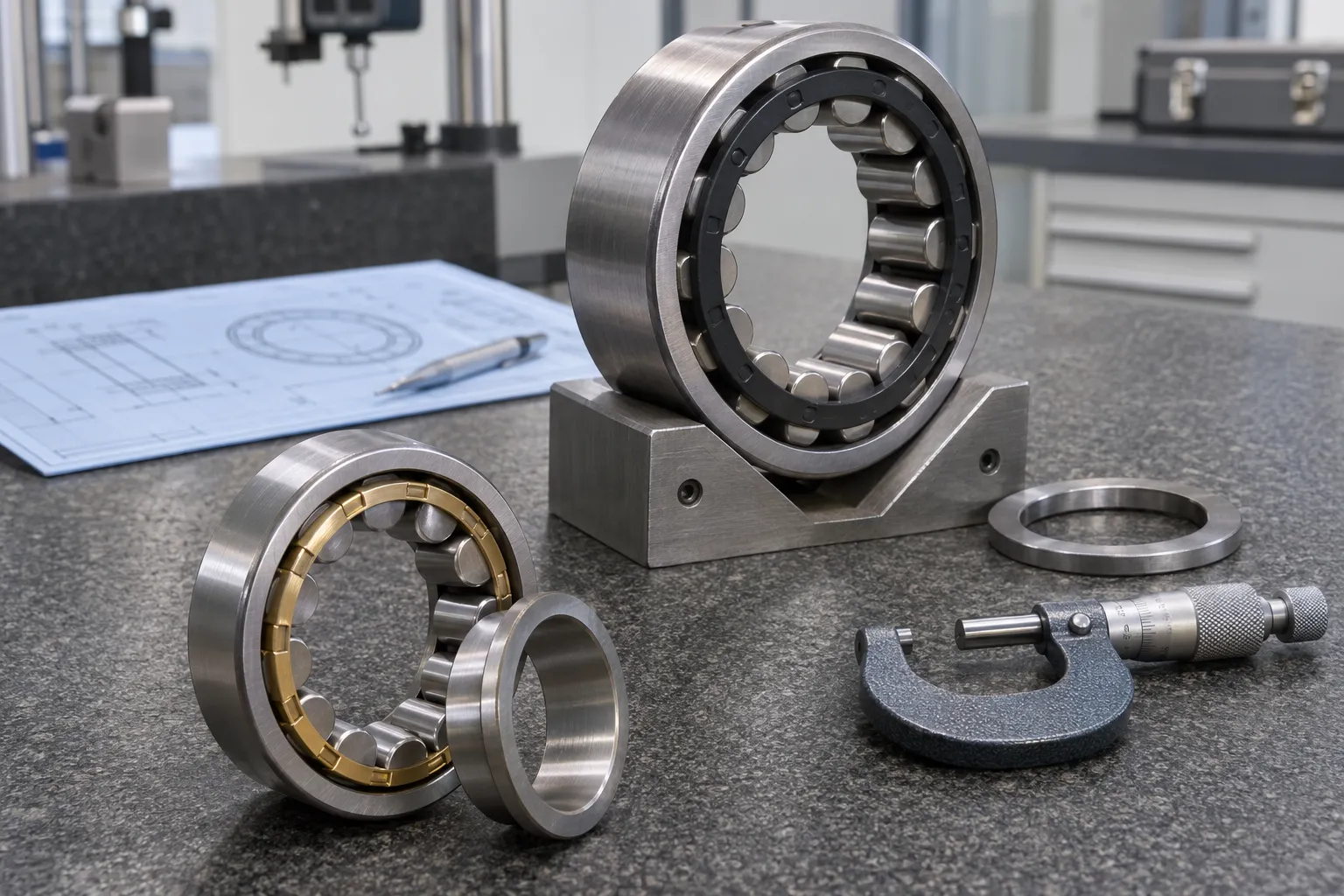
Both designs normally have two integral flanges on the outer ring and one integral flange on the inner ring. The NUP design also has a separate loose flange ring on the open side of the inner ring. This extra ring closes the second axial direction. The geometry, rather than the bore code alone, determines whether the bearing is a one-direction or two-direction locator.
|
Selection point |
NJ design |
NUP design |
なぜそれが重要なのか |
|
Inner-ring arrangement |
One integral flange |
One integral flange plus one loose flange ring |
Controls axial location and mounting sequence |
|
Axial location |
One direction |
Both directions |
Determines whether the position can serve as the locating end |
|
Separable components |
Inner ring is separable |
Inner ring and loose flange ring require correct handling |
Missing or reversed parts can change function |
|
Typical role |
Directional locating support |
Fixed-end support for limited thrust |
Must match the complete shaft system |
Using NJ as a One Direction Locator
An NJ bearing restrains the shaft toward its inner-ring flange and permits axial freedom in the opposite direction. It can work where thrust acts predictably in one direction or where another component locates the shaft from the other side. Two NJ bearings may also be arranged in opposition, but the designer must avoid creating an overconstrained system that cannot accommodate thermal growth.
Using NUP at the Fixed End
An NUP bearing can locate the shaft in both directions because rollers are bounded by an inner-ring flange on each side. It is therefore commonly considered for the locating end of a shaft. The opposite support normally needs an internal axial-displacement function, often provided by an N or NU design. The complementary NU and N type free-end bearing guide explains why the non-locating position must let the shaft expand without building unintended thrust.
Axial Load Capacity Still Has Limits
The words one-direction and two-direction location describe how the flanges control movement. They do not turn an NJ or NUP bearing into a dedicated thrust bearing. Axial capacity depends on roller-end and flange contact, lubrication, speed, temperature, surface finish, internal design, and the manufacturer’s current rating method. Continuous or heavy thrust can raise flange friction and heat even when radial load remains acceptable.
For combined loads, first determine the radial reaction and the expected thrust in each operating state, including starting, stopping, reversal, and upset conditions. If axial load is substantial, a tapered roller bearing, angular contact bearing, or a separate thrust bearing may be more appropriate. The decision should follow the machine calculation and the exact bearing specification rather than the generic type code.
Replacement Checks Before Changing the Type
A bearing that fits the shaft and housing can still be functionally wrong. Complete these checks before replacing NJ with NUP, or NUP with NJ.
- Map the locating and non-locating positions. Identify which bearing controls the shaft in each axial direction and where thermal expansion is absorbed.
- Confirm load direction. Record normal thrust, temporary reversal, external adjustment forces, and any coupling or gear forces.
- Match the full dimensions. Verify bore, outside diameter, width, corner radii, shoulder diameters, and available space for the loose flange ring.
- Read the complete suffix. Internal clearance, cage material, accuracy, heat treatment, and special design codes can prevent a nominally similar bearing from being equivalent.
- Check adjacent parts. Shaft shoulders, locknuts, spacers, seals, and housing shoulders must support the selected ring without rubbing the cage or loose flange.
- Review mounting access. The separable rings and roller assembly must be installed in a sequence that protects raceways and keeps matched components together.
Fit Clearance Cage and Mounting Checks
Fits and Thermal Expansion
Ring fit depends on which ring sees a rotating load, the load magnitude, shaft and housing material, temperature gradient, and required accuracy. A tight fit can reduce effective internal clearance. It can also make disassembly harder. The non-locating bearing must retain its intended axial-displacement path after fits, shoulders, and covers are assembled.
Internal Clearance and Cage
C3 or C4 clearance is not automatically an upgrade. Extra initial clearance may be required for interference fits or elevated operating temperature, but excessive operating clearance can increase vibration and load concentration. Steel, brass, and polyamide cages also have different speed, temperature, lubrication, and chemical constraints. Compare suffixes, not only the basic number.
Loose Flange Ring Handling
Keep the NUP loose flange ring with its supplied bearing and inspect its seating face before assembly. The ring must seat against the intended inner-ring side and adjacent shoulder without burrs or trapped debris. Apply mounting force only through the ring being fitted. Force transmitted through the rollers can mark raceways before the machine starts.
Using Size Codes Without Assuming Equivalence
A comparison such as NJ205 versus NUP205 may indicate the same nominal bore and dimension series, but it does not prove interchangeability. Width tolerances, internal geometry, capacity, speed limits, cage, clearance, and suffix conventions still require confirmation. Buyers comparing multiple series can also review single-row and double-row cylindrical roller bearings and the practical differences between cylindrical and spherical roller bearings. These distinctions help prevent a replacement decision based only on a familiar bore code.
Procurement Information for an Accurate Fit Check
An effective RFQ gives the supplier enough information to verify both dimensions and function. Include the existing full designation, manufacturer, quantity, shaft and housing dimensions, load direction, speed, operating temperature, lubrication method, and photographs of the old bearing and adjacent parts. A drawing is especially useful when a loose flange ring, spacer, or unusual shoulder controls the installation.
If the application is being redesigned rather than duplicated, state which position must locate the shaft and how the other position accommodates expansion. The single-row cylindrical roller bearing and deep groove ball bearing comparison can help clarify whether a cylindrical roller design is appropriate for the radial load and axial-location task. LQYS can review the requested NJ or NUP designation against the supplied dimensions and operating information, but final suitability remains dependent on the machine design and current product specification.
結論
Choose NJ when the bearing must locate the shaft in one axial direction and the arrangement provides the other required restraint. Choose NUP when the position must locate the shaft in both directions and the expected thrust remains within the bearing’s verified limits. Before replacement, confirm the locating scheme, full designation, fits, clearance, cage, adjacent shoulders, and mounting sequence. Those checks matter more than matching bore and outside diameter alone.
よくある質問
Can an NJ bearing replace an NUP bearing
Not automatically. NJ provides axial location in one direction, while NUP locates in both. A replacement requires another component to provide the missing restraint and a complete dimensional and suffix check.
Can an NUP bearing carry axial load
It can support limited axial load in both directions, subject to its specification. Permissible thrust depends on speed, lubrication, temperature, flange contact, size, and internal design.
Why does an NUP bearing have a loose flange ring
The loose ring creates the second inner-ring flange. It enables two-direction axial location while keeping the bearing separable for mounting.
What should an RFQ include
Provide the full old designation, required quantity, shaft and housing dimensions, speed, radial and axial loads, temperature, lubrication, drawings, and clear photographs. LQYS can use this information to narrow the replacement check and identify points that still need engineering confirmation.