

FAG Split Spherical Roller Bearings for Paper Machine Dryer Rolls Retrofit and Fit Checks
2026-10-30
A FAG split spherical roller bearing can shorten a dryer-roll bearing change because its rings and roller-cage assemblies are installed around the shaft. That advantage does not make the bearing a drop-in replacement. Before a shutdown is scheduled, the retrofit team must verify the interchange envelope, shaft and housing seats, load and speed capability, internal clearance, thermal movement, locking-ring arrangement, seals, lubrication, and installation access for the exact designation.
Paper machine dryer rolls add a demanding thermal condition to the usual retrofit problem. The shaft, bearing inner ring, housing, and surrounding structure do not necessarily stabilize at the same temperature. A successful plan therefore combines dimensional checks with a review of the locating and nonlocating positions, expected axial expansion, and the bearing manufacturer’s current application instructions.
Why a Split Bearing Can Simplify a Dryer Roll Retrofit
Split spherical roller bearings divide the inner ring, outer ring, and cage with roller set into halves. This construction allows maintenance teams to work around a shaft that would otherwise require coupling, gear, drive, or shaft-train disassembly. The arrangement is especially relevant where shafts have several supports or the dryer section provides limited axial removal space.
Compare the complete shutdown task, not only bearing price. Labor, lifting, drive removal, alignment restoration, and lost production may dominate the intervention. A split bearing also has different capacity and speed limits from an apparently equivalent unsplit design, so reduced dismantling matters only when the unit suits the duty.
Confirm the Replacement Envelope Before the Shutdown
For replacement of an unsplit spherical roller bearing mounted on an adapter sleeve, FAG guidance states that the outside diameter, outer-ring width, and shaft-seat diameter must match, and that the split bearing must be suitable for the load case. Verify all three dimensions on the current drawing and by measurement where access permits. Do not cross-reference from the bore or basic series alone.
Check housing bore and width, cover geometry, seal locations, locating rings, lubrication ports, bolt access, and radial assembly space. Confirm that the split housing suits the bearing and remains reusable. Fretting, corrosion, ovality, cracked feet, or distorted joint faces can defeat a correct cross-reference.
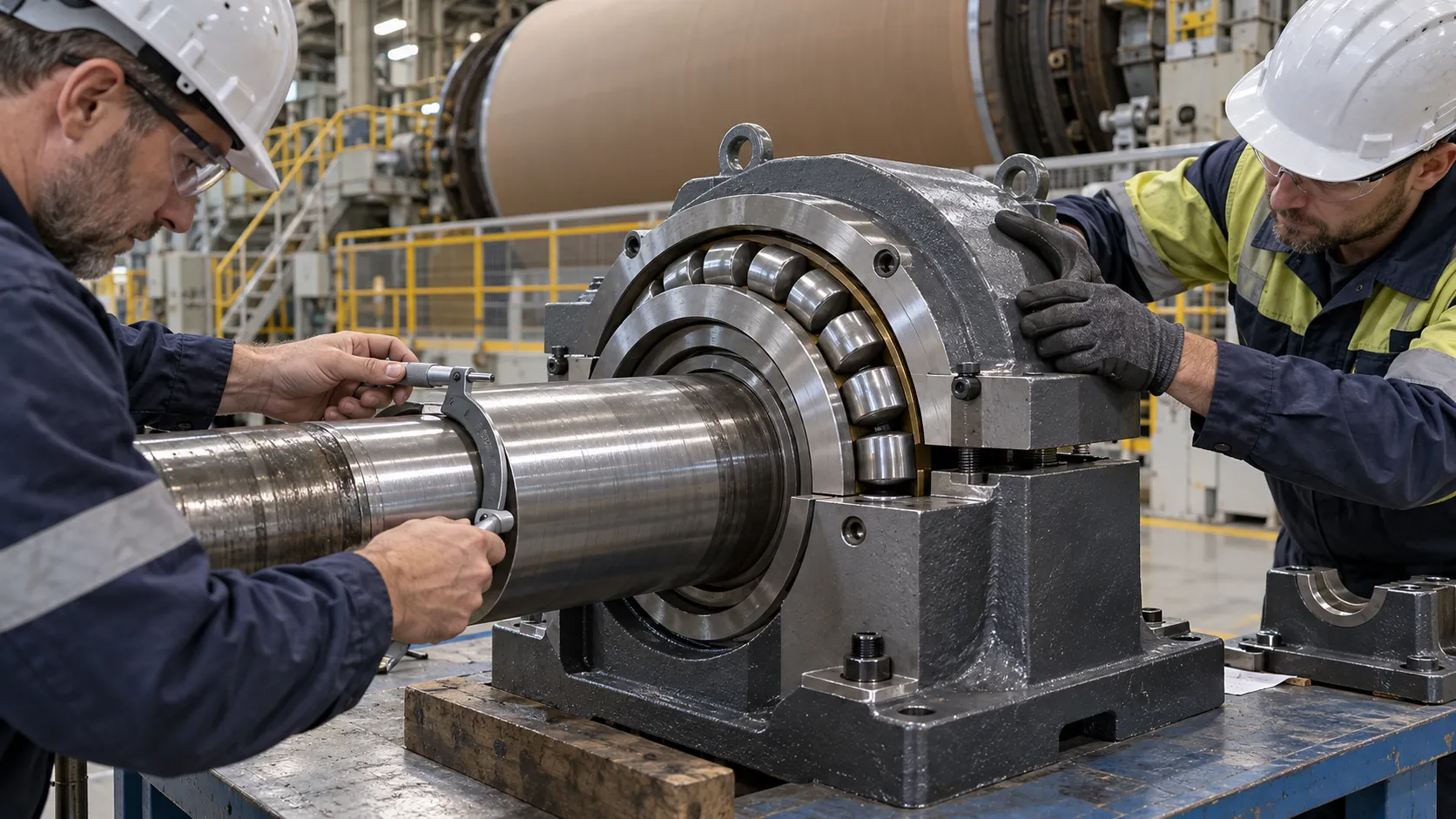
Measure Shaft and Housing Fits
Current FAG technical guidance gives a general shaft machining range of h6 to h9 so the inner-ring halves develop the required tight fit after their screws are tightened. It also identifies H7 or H8 as the normal housing-bore range. These are selection checkpoints, not universal acceptance limits. The exact bearing drawing, shaft diameter, load, temperature, housing type, and application instructions must control the final tolerances.
Measure the shaft at several axial and circumferential positions for taper, ovality, wear, fretting, corrosion, or coatings. Record surface finish and nearby steps, shoulders, keyways, or damage. Inspect both housing halves and the joint. Define any seat repair before ordering; a split bearing cannot hide an unsuitable shaft or housing.
Recheck Load Speed and Internal Clearance
FAG notes that split-bearing capacity is lower than that of a comparable unsplit bearing because the outer-ring connection reduces the roller-set pitch circle. Recalculate life and static safety with the exact designation, radial and axial loads, roll mass, fabric and drive forces, speed, shock, and duty cycle. Do not reuse the old calculation unchanged.
The joints are overrolled during operation, and the manufacturer’s limiting speed accounts for the resulting vibration as well as cage strength. Verify normal and overspeed conditions against the current data. FAG also states that most split designs use the normal internal clearance associated with unsplit spherical roller bearings having a cylindrical bore, but the selected clearance must still suit fit, temperature difference, shaft deflection, and running conditions.
Plan for Dryer Roll Thermal Movement
Confirm which bearing locates the shaft axially and which position permits thermal expansion, then verify that the housing and seals allow that movement. Review cold and operating positions, shaft growth, shoulders, cover and seal clearances, and process or drive axial load. Assess both ends as one arrangement.
FAG specifically identifies paper-machine dryer rolls as an application where large temperature differences can occur between the shaft and inner-ring halves. For that condition, designs with separate locking rings may be more suitable than versions with locking rings integrated in the inner ring. Treat this as a model-selection requirement to confirm with the current manufacturer documentation, not a field modification to a standard bearing.
Check Seals Lubrication and Contamination Control
Dryer sections combine heat, moisture, paper dust, and difficult access. Confirm the split seal design, shaft sealing surface, housing grooves, drain and vent condition, lubricant, relubrication method, line routing, and purge path. The seal halves and housing joints must assemble without steps or damage that create an ingress path. Check that nearby steam, condensate, and washdown sources cannot direct contamination into the bearing position.
FAG guidance describes grease as the normal lubricant and provides relubrication through a groove and holes in the outer ring for applicable designs. Calculate the lubricant quantity and interval for the exact bearing, speed, temperature, and environment. If an automatic system is used, verify delivery at the bearing, line condition, compatibility with the existing grease, and safe access for inspection.
Build the Installation and Verification Plan
The work pack should define roll support, old-bearing identification and removal, component cleanliness, and the specified fastener sequence. Use the mounting manual for the exact bearing. Protect open parts from dust, moisture, and impact, and never mix halves or fasteners between matched assemblies.
Before restart, document specified assembly checks, shaft freedom, axial location, seals, lubrication, fasteners, and removal of temporary supports. Establish temperature and vibration baselines at stable speed, then reinspect for leakage, noise, housing movement, or temperature divergence.
Prepare the Retrofit RFQ
Begin with the existing bearing, adapter sleeve, and housing codes, then add shaft and housing measurements, dryer-roll drawing, locating arrangement, loads, speed, temperatures, lubricant, seals, condition records, access limits, shutdown window, and quantity. The LQYS spherical roller bearing range confirms the broader product family and can serve as an internal category destination, while the exact FAG split model remains subject to designation and specification verification.
For background on the brand and product families, see the existing FAG bearing overview. Procurement teams should also use the bearing purchasing document checklist to request traceability, model confirmation, commercial terms, and acceptance documents before release.
Send LQYS Bearings clear photographs of the markings, seats, seals, and lubrication connections with the measured data. The quotation should distinguish confirmed details from items that depend on the final drawing and installation instructions.
Conclusão
A FAG split spherical roller bearing can reduce dryer-roll replacement work, but the retrofit should proceed only after the complete arrangement is checked. Match the outside diameter, outer-ring width, and shaft-seat diameter; measure the seats; recalculate load and speed capability; confirm clearance and thermal movement; and select the correct locking-ring, seal, and lubrication configuration. The shutdown plan should then follow the manual for the exact bearing.
To review a proposed cross-reference, contact the LQYS Bearings technical team with the existing codes, measurements, operating data, drawings, photographs, required documents, and quantity.
Perguntas mais frequentes
Is a split bearing a direct replacement for every adapter sleeve bearing
No. The outside diameter, outer-ring width, and shaft-seat diameter must match, and the exact split bearing must satisfy the load, speed, clearance, housing, and thermal requirements.
Why can dryer rolls require separate locking rings
Large temperature differences can develop between the dryer-roll shaft and the inner-ring halves. FAG identifies separate locking-ring designs as more suitable for such conditions, subject to model confirmation.
What shaft and housing tolerances should be checked
FAG gives general shaft tolerances from h6 to h9 and normally H7 or H8 for the housing bore. The exact bearing and application specification must govern final acceptance.
What should be measured before requesting a quotation
Record the complete bearing, sleeve, and housing codes; shaft and housing geometry; load; speed; temperatures; locating arrangement; seals; lubrication; access; condition evidence; drawing; and quantity.