

SKF YAR vs YEL vs YET Insert Bearings for Locking and Replacement
2026-11-13
SKF YAR, YEL, and YET insert bearings are designed for mounted bearing units, but they do not secure the shaft in the same way. YAR uses two grub screws and has an inner ring extended on both sides. YEL also has a wide inner ring but uses an eccentric locking collar. YET uses the eccentric collar with an inner ring extended on one side. Selection depends on rotation, shaft condition, space, load, sealing, and housing compatibility. A matching bore alone is not enough for replacement.
Quick Comparison of YAR YEL and YET
The series prefix identifies the main locking and inner-ring arrangement. Suffixes then describe seals, lubrication features, special materials, or application variants. Read the complete designation before comparing two inserts.
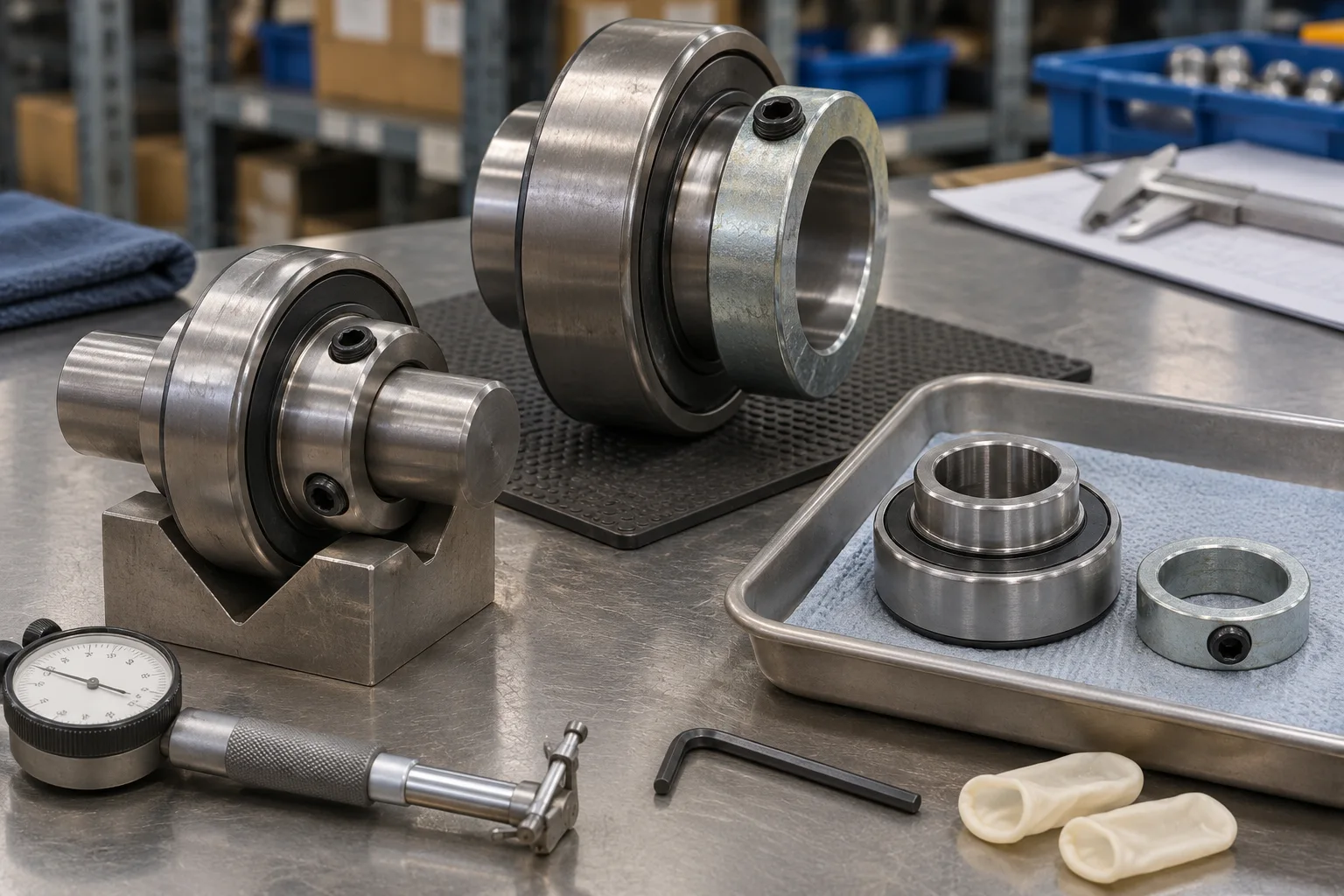
|
Sérias |
Locking method |
Inner ring |
Main selection issue |
|
YAR |
Two grub screws |
Extended on both sides |
Shaft fit, screw seating, vibration, and reversal |
|
YEL |
Eccentric locking collar |
Extended on both sides |
Rotation direction, collar engagement, and axial space |
|
YET |
Eccentric locking collar |
Extended on one side |
Rotation direction and narrower inner-ring arrangement |
|
YSP |
SKF ConCentra locking |
Series dependent |
Concentric grip and specified mounting procedure |
YAR Set Screw Locking
YAR inserts use two grub screws around the inner ring to clamp the bearing to the shaft. Performance depends on screw torque, shaft hardness, tolerance, load, and vibration. Because the screws can mark the shaft, inspect raised material or damaged seating points before reuse.
YEL Wide Inner Ring Eccentric Locking
YEL inserts have an inner ring extended on both sides and a separate eccentric collar. The collar and eccentric land on the inner ring act as mating cams. During mounting, the collar is turned in the same direction as normal shaft rotation and then secured with its set screw. The wide inner ring provides a broad mounting arrangement but requires enough axial space.
YET Narrow Inner Ring Eccentric Locking
YET uses the same basic eccentric-collar principle with an inner ring extended on one side. It may suit arrangements where the narrow configuration matches the original unit or the available axial envelope. YET should not be substituted for YEL only because bore and outside diameter match. Inner-ring width, seal position, collar location, and housing clearances still need verification.
Choose the Locking Method by Rotation and Duty
Eccentric locking is most natural in applications with a stable rotation direction because normal rotation reinforces the cam action. Reversing, oscillating, or frequently indexed shafts require additional care. If the collar repeatedly sees torque in the unlocking direction, another locking method may be more suitable. The decision must follow the current SKF instructions and the actual operating cycle.
Set screw locking is less dependent on one rotation direction, but reversing duty still requires checks for shaft fit, transmitted torque, vibration, shock, and screw retention. A concentric locking system may be considered when higher concentricity is required and the specified product is available.
Check Inner Ring Width and Available Space
A wide inner ring can improve support around the locking area and may match a housing or guard designed around that geometry. A narrow inner ring can help where axial space is restricted. Measure the total inner-ring width, extension on each side, collar width, seal position, and distance to nearby shoulders or covers. A replacement that projects farther from the housing can interfere with guards, seals, spacers, or couplings.
Verify Shaft Fit and Surface Condition
Insert bearings commonly accommodate commercial shafting, but acceptable shaft tolerance depends on load, speed, locking method, and the current product specification. An undersized, worn, polished, or scored shaft can permit creep even when screws or a collar feel tight. Excessive shaft error can also increase runout and vibration. Measure the shaft at several axial and circumferential positions, inspect keyways and previous screw marks, and correct burrs before assembly.
Do not compensate for a poor fit by overtightening the locking device. Use the specified tool and method, then rotate the shaft by hand to confirm that seals, flingers, and adjacent parts do not rub.
Read Seals Lubrication Features and Suffixes
The basic series does not describe every feature. SKF designation elements can identify flingers, seals, lubrication-groove position, anti-rotation features, materials, or special grease. For example, 2F and 2RF describe different protective arrangements, while G and GR distinguish groove positions. Check every meaning in current documentation for the exact series.
A replacement should preserve the protection required by the environment. Dust, washdown, food processing, moisture, and fine abrasive contamination can require different sealing, material, and lubrication choices. The existing SKF bearing suffix ordering guide explains why buyers should record the full suffix rather than order only the basic bore code.
Replacement Workflow for YAR YEL and YET
- Record the complete insert and housing designations. Photograph both sides of the unit and the locking device before removal.
- Confirm normal and abnormal rotation. Include reversal, inching, start-stop duty, and any oscillating movement.
- Measure the shaft and installation envelope. Check bore, inner-ring width, collar position, housing width, and nearby guards or spacers.
- Match the outside geometry. Verify the spherical outside diameter, width, lubrication-hole position, anti-rotation feature, and housing compatibility.
- Compare suffixes and environment. Confirm seals, flingers, grease, relubrication path, temperature, corrosion exposure, and cleaning method.
- Follow the specified mounting sequence. Set the collar in the correct direction or tighten grub screws to the applicable instructions, then verify free rotation.
Match the Insert Bearing to the Housing
YAR, YEL, and YET identify insert-bearing arrangements, not the complete housing style. The same insert concept may appear in pillow block, flanged, take-up, or other mounted units. Start with the LQYS pillow block bearing range when the project also requires a housing. Then compare mounting footprint and load direction using the UCP UCF and UCFL housing selection guide. Housing code, insert code, and shaft size must be checked as one assembly.
During installation, secure the housing without forcing it into misalignment, allow the insert to align before final locking, and confirm that the base or flange is flat. The pillow block bearing installation guide provides a useful general sequence, but the exact SKF unit instructions take precedence for collar direction, screw torque, and relubrication details.
Procurement and Authenticity Checks
A useful RFQ includes the complete SKF designation, housing code, quantity, shaft diameter and tolerance, rotation direction, speed, load, temperature, environment, lubrication practice, and photographs. State whether the request is an exact replacement or an application review. If the existing marking is incomplete, provide measured dimensions and images of the collar, screws, seals, lubrication holes, and housing identification.
Brand verification also matters when the application requires traceable SKF supply. Record packaging, labels, country-specific documentation, and supplier information without treating packaging alone as proof. The industrial bearing authenticity and procurement checklist outlines documents and checks that buyers can request before shipment. LQYS can use the full designation and application data to identify sourcing options and unresolved compatibility questions. It should not be assumed to be an authorized SKF distributor unless current written authorization is available.
Conclusão
Choose YAR when set screw locking and a wide inner ring fit the shaft and duty. Choose YEL when a wide inner ring and eccentric collar suit a stable rotation direction. Choose YET when the eccentric method is appropriate and the narrower one-sided extension matches the assembly. Before replacing any insert, verify rotation, shaft fit, inner-ring width, outside geometry, housing code, seals, lubrication features, and the complete suffix.
Perguntas mais frequentes
Can YAR replace YEL
Only after a full fit and duty review. Both may use wide inner rings, but their locking methods, shaft interaction, mounting steps, and some dimensions or suffix features can differ.
What is the difference between YEL and YET
Both use eccentric locking collars. YEL has an inner ring extended on both sides, while YET is extended on one side. That difference can affect axial space and replacement compatibility.
Which direction should an eccentric collar be tightened
The collar is normally turned in the same direction as normal shaft rotation before its set screw is secured. Follow the instructions for the exact unit and reconsider the method for reversing duty.
What information should be sent for a replacement check
Send the full insert and housing designations, shaft dimensions, rotation cycle, speed, load, temperature, environment, quantity, drawings, and photographs. LQYS can then compare the requested configuration without relying on bore size alone.