

How to Protect Linear Guides from Coolant and Metal Chips: A Selection Guide
2026-09-10
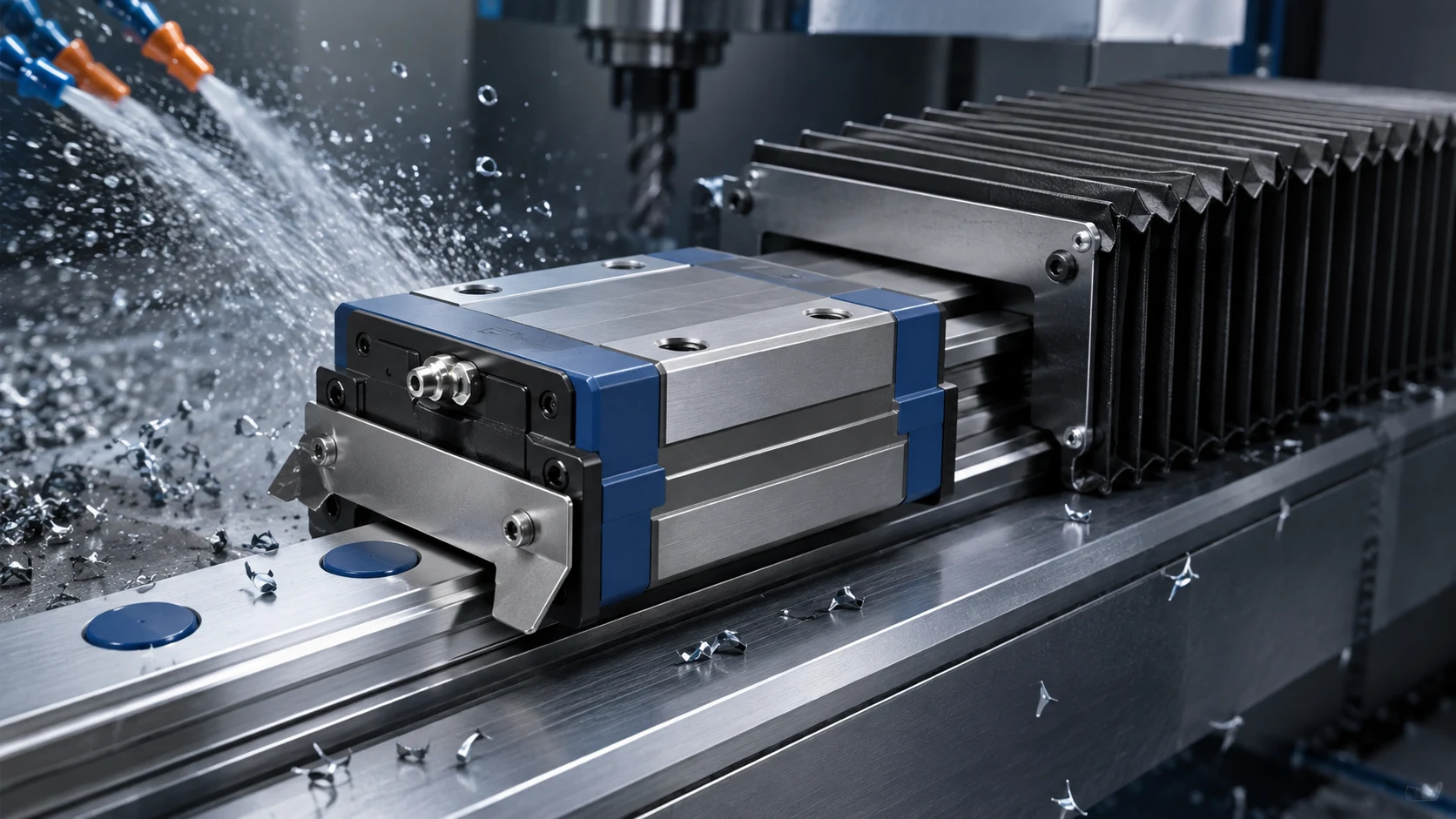
Protecting a linear guide in a machining environment starts with the contamination path, not with a generic seal upgrade. Coolant mist, direct splash, abrasive fines, and sharp chips reach the rail from different directions and place different demands on seals, scrapers, rail-hole protection, and external covers. The practical objective is to choose the lightest protection package that controls the actual exposure without creating avoidable drag, clearance problems, or maintenance difficulty. This guide explains how to make that choice and how to prepare a technically useful RFQ.
Map the Contamination Before Choosing a Part
Identify where liquid and chips enter
Inspect the complete stroke with the machine stopped and the carriage accessible. Look at both ends of the block, the underside, the rail mounting holes, and any exposed rail section outside the block. Horizontal rails often collect falling chips; side-mounted rails may receive a direct coolant jet; inverted rails can still collect liquid in pockets around fasteners. Record nozzle direction, chip trajectory, pooling points, and the position where residue appears. A protection method that closes one path can still fail if contamination enters from below or is carried along the rail by the moving block.
Separate contamination from permanent damage
A dirty guide is not automatically a failed guide. Cleaning and relubrication may be reasonable when chips remain external, the raceway has no visible scoring or dents, seals are intact, and smooth motion returns through the full stroke. Replacement evaluation becomes more important when a rough spot remains after cleaning, noise repeats at one rail position, corrosion is visible, or a seal lip is torn. A scraper can intercept debris, but it cannot restore a damaged raceway. For a safety-critical axis, stop and inspect before continuing production.
Match the Barrier to the Contaminant
Coolant mist, splash, and fine particles
Light mist may be controlled by suitable end and side seals with a disciplined inspection routine. Continuous spray, water-based residue, grinding dust, or abrasive paste generally calls for layered protection: additional contact seals, a bottom seal where the entry path is underneath, protected mounting holes, and a shield that keeps the jet away from the block. Do not describe a seal as waterproof without checking its material, geometry, coolant chemistry, concentration, temperature, and exposure time. Coolant can wash away or emulsify grease, so lubricant compatibility must be confirmed against the guide specification and the actual fluid used on the machine.
Large, sharp, or hot metal chips
Sharp swarf can cut a soft seal before the seal has a chance to wipe the rail. A metal scraper or hard protector is therefore a first-impact barrier, while a contact seal behind it handles finer particles and helps retain lubricant. They are complementary components, not substitutes. Heavy milling, turning, or drilling may require a bellows, telescoping cover, or machine way cover to intercept chips before they reach the block. Hot chips add a temperature question: verify the allowable range of every seal, scraper, adhesive, and cover material before specifying it.
| Рабочие условия | Защита для оценки | Основное ограничение |
| Небольшая пыль или мелкие сколы | Торцевые и боковые уплотнения | Ограничена в доступе к густым жидкостям или острым кускам металла. |
| Охлаждающий туман и мелкие частицы | Multiple contact seals plus lubrication control | Может увеличить сопротивление при беге. |
| Крупные или острые щепки | Metal scraper or protector with seals | Не заменяет внешнюю крышку |
| Длительное интенсивное воздействие | Сильфоны или крышка направляющей механизма | Needs compression and installation space |
| Загрязнение снизу | Bottom seal or lower shielding | Необходимо проверить наличие допуска. |
Understand What Each Protection Element Does
Block-mounted seals and scrapers
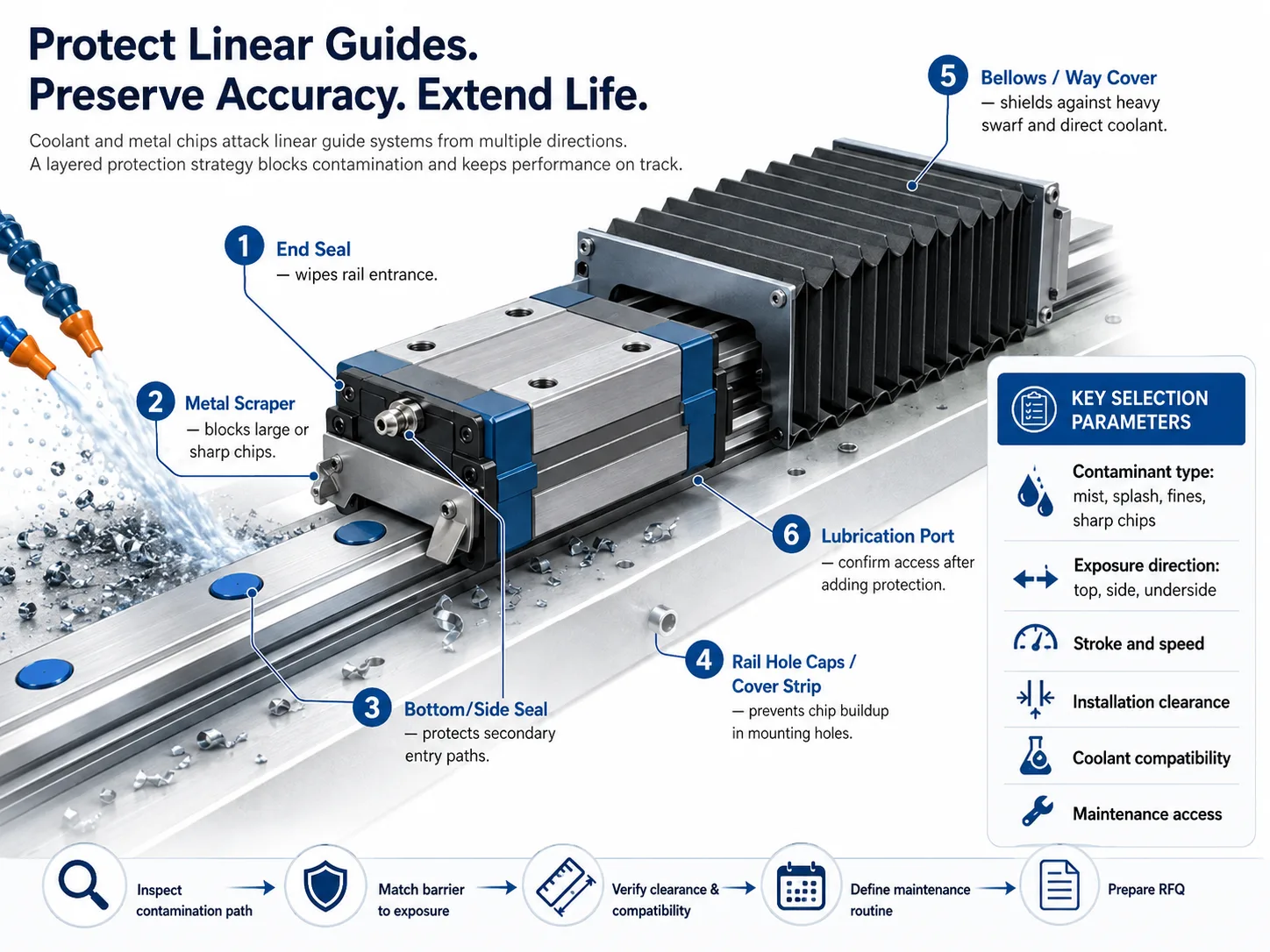
End seals wipe the rail as it enters the block. Side, bottom, or inner seals address other entry paths and help retain lubricant. A contact scraper can improve removal of fine particles, while a metal scraper intercepts harder debris before it reaches softer sealing elements. More contact is not automatically better: additional seals can increase running resistance, block length, or interference with grease fittings. Confirm overall block dimensions, seal resistance, lubrication-port location, mounting orientation, and nearby-component clearance.
Rail caps, cover strips, bellows, and way covers
Mounting-hole caps close individual counterbores where chips and liquid can collect. A continuous cover strip protects several holes and presents a smoother wiping surface, but raised or damaged caps can interfere with seals. Bellows are useful where flexible compression is practical; way covers provide a broader barrier for heavy chips or direct coolant. Specify extended and compressed length, stroke, speed, orientation, and available space. Check travel across the full stroke rather than judging the cover at one position.
Build a Maintenance Routine Around the Exposure
Clean, inspect, lubricate, then test
Follow the machine lockout procedure before servicing. Remove loose chips from surrounding surfaces before moving the block, and avoid driving contamination across a dirty rail. Use a cleaning method compatible with the guide and machine materials. Inspect seals, scrapers, caps, covers, lubrication ports, and drainage paths for cuts, deformation, blockage, rust, scratches, and dents. Relubricate only after contamination is removed, using an approved lubricant. High-pressure air can push chips toward seals, while excess grease can trap abrasive material. After maintenance, move the axis slowly through the full stroke and confirm that resistance and noise are consistent.
Prevent repeat contamination
Protection is most reliable when the machine layout supports it. Redirect coolant nozzles where practical, improve drainage, and eliminate ledges that collect chips beside rail holes. Confirm that a cover protects the complete working stroke without reaching its compression limit. Record the guide model, orientation, lubricant, coolant, protection package, and observed residue so maintenance decisions are based on a trend rather than a single visual check.
Convert the Inspection into a Sourcing Specification
Information to include in an RFQ
Provide the complete model code, rail dimensions, mounting-hole layout, block style and quantity, orientation, stroke, speed, load condition, lubrication method, and available installation space. Add photographs of the rail, block, seals, covers, contamination, and any damaged raceway. Describe coolant type, concentration if known, application method, chip size, chip temperature, and exposure direction. State whether you need a sealed block, scraper package, rail caps, external cover, replacement block, or matched guide assembly. Drawings or a sample are valuable when the installed identification is incomplete.
Check compatibility, not just availability
A useful supplier review distinguishes seals, scrapers, mounting-hole protection, and external covers instead of treating them as equivalent. It should address contaminant type, exposure direction, stroke, speed, clearance, lubrication, accuracy, and whether added protection changes block dimensions or running resistance. LQYS Bearings presents recirculating-ball linear bearing products for automation, CNC machine tools, and measuring instruments, including square and flange configurations and models with seals or self-lubricating units. Its application coverage includes automation and CNC use cases; review the Варианты линейных подшипников для работы в загрязненных средах only after the application details are defined.
Вывод
A defensible linear guide protection decision follows a simple sequence: map every contamination path, classify the exposure, assign each barrier a specific job, verify clearance and material compatibility, and then set a cleaning and inspection routine. Light dust may need only seals; sharp chips may justify a metal scraper; continuous coolant or heavy swarf can require a cover system. When roughness, scoring, corrosion, or binding remains after cleaning, compare a protection upgrade with block or matched-set replacement based on accuracy and risk.
Contact the LQYS Bearings technical team with the model, dimensions, orientation, coolant details, chip conditions, stroke, drawings, quantity, and fault photographs. LQYS Bearings operates through Shanghai Yongheshun Import and Export Co., Ltd.; company background is available in the company profile.
Часто задаваемые вопросы
Предотвращают ли стандартные уплотнения линейных направляющих проникновение охлаждающей жидкости?
They may help with light splash, but continuous exposure requires verification of seal material, configuration, exposure direction, drainage, and coolant compatibility.
В чём разница между линейным направляющим уплотнением и металлическим скребком?
A contact seal removes finer contamination and retains lubricant. A metal scraper intercepts larger or harder chips before they reach softer sealing elements.
В каких случаях для линейной направляющей станка с ЧПУ требуется защитный кожух или сильфон?
Consider one when the rail receives continuous spray, heavy chips, sharp debris, or broad exposure. Confirm stroke, compressed length, speed, orientation, and installation space.
Может ли металлическая стружка необратимо повредить линейную направляющую?
Yes. Chips can cut seals, scratch raceways, contaminate lubricant, and damage circulating components. Persistent roughness or a fixed binding point supports replacement evaluation.
Следует ли чистить или заменять загрязненную линейную направляющую?
Clean and inspect it when contamination is external and no permanent damage is visible. Consider replacement when roughness, corrosion, scoring, or compatibility uncertainty remains.