

Вибрация подшипника скольжения на конвейере: что проверить перед заменой.
2026-09-17
A vibrating pillow block bearing on a conveyor is not automatically a failed bearing. The same symptom can come from loose housing bolts, shaft runout, pulley imbalance, belt tension, misalignment, contamination, or inadequate lubrication. Before ordering a replacement, isolate the vibration source, inspect the mounting and shaft, and compare the bearing’s condition with the conveyor’s operating pattern. This sequence reduces unnecessary changes and produces better information when a new mounted unit is genuinely required.
Define the Vibration Pattern First
Locate where and when it occurs
Note whether vibration is strongest at the bearing housing, shaft, pulley, or conveyor frame. Compare drive and non-drive ends at start-up, steady speed, loaded operation, and coast-down. A once-per-revolution pulse can point toward eccentricity, imbalance, or runout; rough broadband vibration can indicate looseness, contamination, or rolling-surface damage. Record speed, belt condition, load, temperature, noise, and the exact symptom location.
Check for a system-wide source
If several supports vibrate together, inspect the frame, belt splice, pulleys, take-up, and coupling before condemning one bearing. A local symptom that increases with shaft speed deserves closer bearing and shaft inspection; a load-sensitive symptom may involve belt tracking, structure flexibility, or pulley balance. Use guarding and lockout procedures whenever access to rotating parts is required.
Inspect Mounting, Housing, and Shaft
Verify base and fastener security
A pillow block transfers rotating loads into its base. Check loose or unevenly tightened bolts, fretting under the housing, a cracked baseplate, and a surface that is not flat. Do not simply retighten a distorted assembly. Clean the base, check contact, and confirm that the housing sits without rocking. Compare the installation with the supplier’s procedure and the conveyor drawing.
Measure shaft condition and alignment
Inspect the shaft seat for scoring, fretting, corrosion, or wear from a loose inner ring. Measure runout where practical and check the common centerline. Angular misalignment can load the insert unevenly and create heat or vibration even when rolling elements are intact. Check pulley alignment, coupling condition, and belt tracking too. If the shaft seat is damaged, a new bearing alone may not remove vibration.
Check Lubrication and Contamination
Assess grease quantity and condition
Look for grease leakage, hardened grease, discoloration, or a purge pattern that suggests overgreasing. Insufficient lubrication can raise friction and temperature; excessive grease can also increase churning and heat. Use only a lubricant compatible with the bearing, seals, speed, temperature, and plant environment. Do not mix products without confirming compatibility. A temperature trend that rises with running time is useful when compared with the conveyor’s normal baseline, but a single touch check is not a substitute for controlled measurement.
Look for water, dust, and process debris
Inspect seals and nearby shields for damage, ingress paths, and buildup. Conveyors in aggregate, food, packaging, or washdown areas can expose the housing to different combinations of dust, moisture, chemicals, and product fines. Remove external contamination before opening or relubricating the unit. If the lubricant contains visible abrasive particles or water, investigate the source and sealing arrangement rather than treating grease replacement as a complete repair.
|
Observed symptom |
Check before replacement |
What it may indicate |
|
Vibration at one support |
Bolts, base flatness, shaft seat, insert fit |
Local looseness or misalignment |
|
Vibration at pulley frequency |
Pulley balance, belt splice, runout, tracking |
Rotating assembly issue |
|
Rising temperature |
Grease quantity, seal drag, load, speed |
Lubrication or overload concern |
|
Grinding or rough rotation |
Raceways, rolling elements, contamination |
Internal damage likely |
|
Vibration after washdown |
Seals, drainage, lubricant condition |
Water ingress or corrosion risk |
Decide Whether the Bearing Is Actually Failed
Use a controlled confirmation test
After correcting looseness, alignment, belt, and lubrication issues, run the conveyor under a controlled condition and compare vibration and temperature with the baseline. Where available, use a vibration meter to compare the suspect support with adjacent supports. Listen for repeatable clicking, rumbling, or grinding and note whether the symptom follows shaft speed. Persistent localized noise after external causes are corrected makes internal damage more plausible.
Know the signs that support replacement
Replacement is more defensible when the insert has persistent roughness, a repeatable damaged position, excessive radial play, visible corrosion or spalling, a loose fit on the shaft, or overheating that returns after correct lubrication and alignment. A damaged housing, distorted base, or worn shaft seat may require more than an insert change. For a conveyor that affects safety or production continuity, document the evidence and plan the intervention rather than waiting for seizure.
Select the Replacement Unit Carefully
Match the complete mounted assembly
Record the existing unit’s series, insert designation, shaft diameter, housing style, mounting-hole spacing, envelope, locking method, and seal arrangement. A replacement must fit the shaft and base while meeting load, speed, clearance, and environmental needs. Do not substitute a similar housing without checking dimensions and locking. If identification is missing, use measurements, photographs, and a drawing rather than a guess.
Use the operating environment in the specification
Include conveyor speed, radial and axial loads, shock, duty cycle, temperature, washdown, dust, moisture, and lubrication practice. Describe whether the support is fixed or take-up mounted and whether the shaft can move axially. LQYS Bearings lists UCT, UCF, UCFL, UCFC, UCFB, and UCP series with different housing arrangements. The category page also describes pre-assembled units, sealing systems, self-aligning capability, and standardized mounting dimensions; confirm each detail against the exact model and application.
Review the mounted pillow block bearing category to compare the available housing families before narrowing the RFQ to one series.
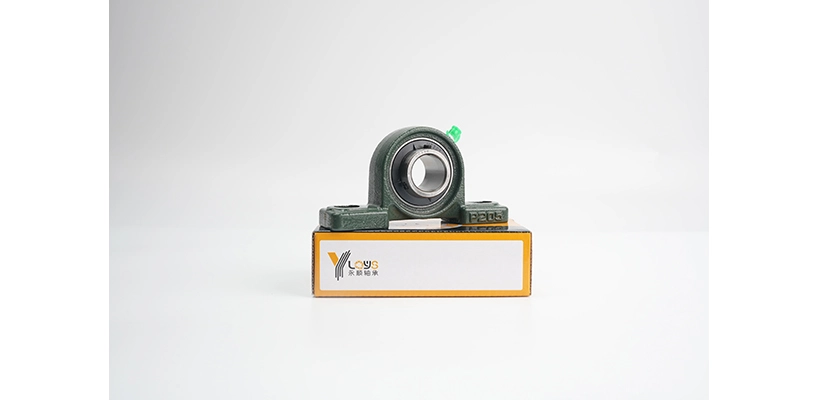
For example, the UCP series product page identifies a vertical housing family with set-screw fixation and multiple size series. That information can help organize an RFQ, but it does not replace checking the installed shaft, base, load, and speed.
Plan the Repair and Verify the Result
Prepare a replacement checklist
During installation, the pillow block installation guide can be used as a general reference, while the exact product instructions govern the final procedure.
Validate after start-up
Run the conveyor unloaded first when practical, then under a representative load. Check vibration, temperature, noise, belt tracking, and fastener security after the system reaches operating condition. Recheck alignment after the first controlled run and record the new baseline. If vibration remains, stop treating the bearing as the only suspect and return to the pulley, shaft, belt, frame, and drive train.
Вывод
Pillow block bearing vibration on a conveyor should trigger a structured diagnosis, not an automatic replacement. Start with the pattern, then inspect mounting security, shaft runout, pulley and belt behavior, lubrication, contamination, and housing condition. Replace the unit when internal damage or persistent play is supported by evidence, and specify the complete assembly against the real operating environment. This approach protects uptime and reduces the risk of installing a new bearing into the same underlying fault.
Contact the LQYS Bearings technical team with the bearing code, shaft diameter, housing dimensions, conveyor speed, load, environment, photographs, drawing, and quantity. LQYS Bearings operates through Shanghai Yongheshun Import and Export Co., Ltd. and presents bearing products for industrial applications; confirm the exact series and configuration before ordering.
Часто задаваемые вопросы
Can a loose pillow block cause conveyor vibration?
Yes. Loose mounting bolts, a rocking base, or a loose insert can create localized vibration and should be checked before replacement.
What temperature suggests a pillow block bearing problem?
A rising or abnormal temperature compared with the conveyor baseline is a warning sign, but the cause may be lubrication, load, seal drag, alignment, or internal damage.
Should I replace only the bearing insert or the complete unit?
Replace only the insert when the housing, shaft seat, locking method, and dimensions remain suitable. A damaged housing or uncertain compatibility supports evaluating the complete mounted unit.
How does conveyor belt alignment affect bearing vibration?
Poor tracking, pulley misalignment, or an uneven splice can transmit periodic forces into the bearing supports, making a healthy bearing appear faulty.
What information should accompany a pillow block bearing RFQ?
Provide the existing code, shaft diameter, housing style and dimensions, speed, loads, duty cycle, temperature, contamination, mounting orientation, photographs, drawing, and quantity.