
What Documents Should Buyers Request Before Ordering SKF, FAG, or NSK Bearings?
2026-09-25
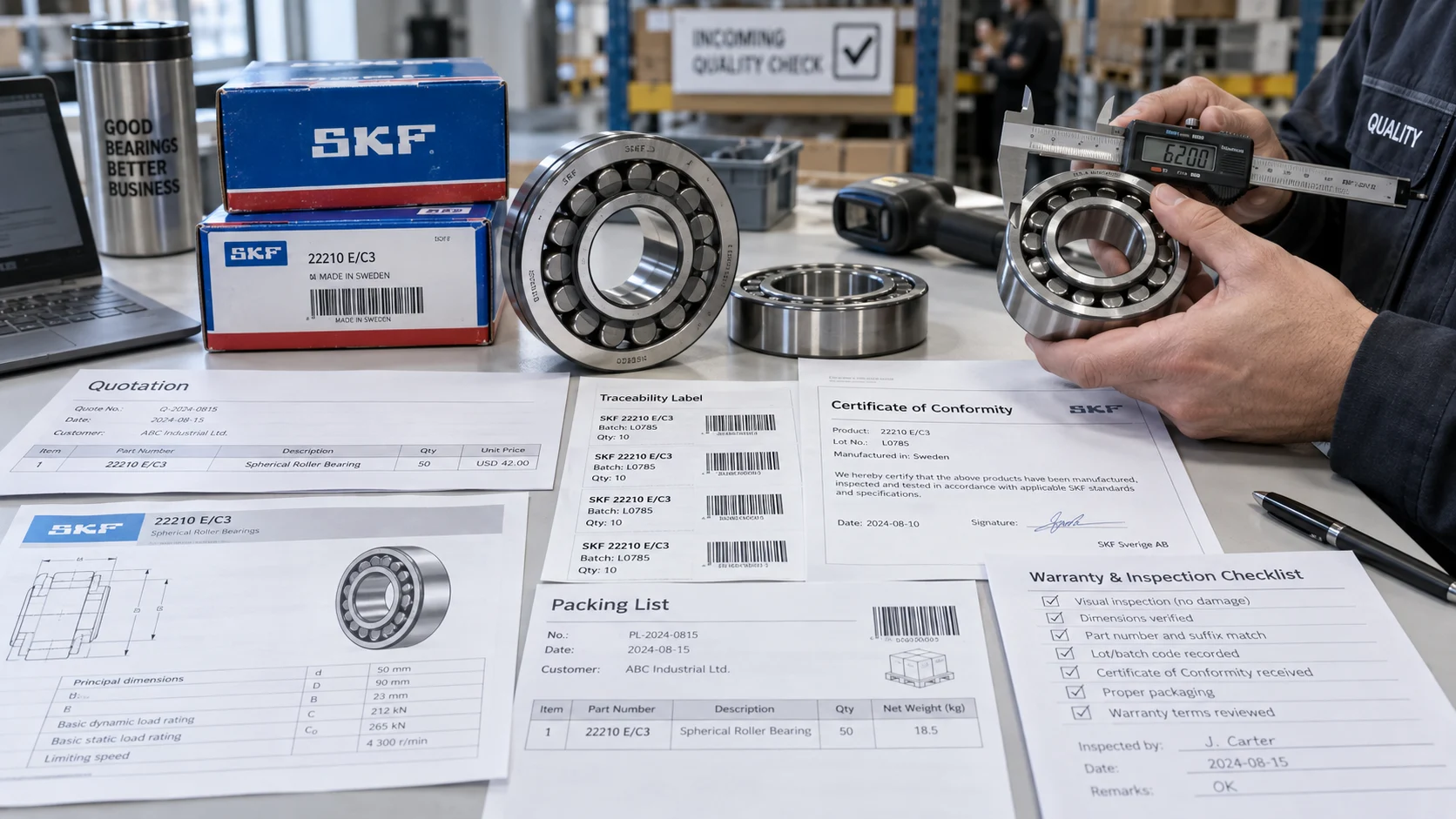
Before ordering a branded bearing, buyers should request enough documentation to verify four things: the exact part, the source, the condition, and the terms of supply. A logo or a familiar part number is not a complete verification. For SKF, FAG, or NSK bearings, the practical buyer file should connect the quotation to the manufacturer’s designation, batch or lot information, inspection evidence, shipping records, and a clear process for handling discrepancies. The document set will vary by size, application, market, and risk level, but asking for it before payment is easier than investigating a mismatch after installation.
Request a Line-Item Quotation and Exact Part Identification
Start with a formal quotation that lists the manufacturer name, full bearing designation, suffixes, quantity, unit price, currency, delivery basis, lead time, packaging, and quotation validity. Ask the seller to repeat the complete code exactly as it will appear on the bearing and box. A shortened code can hide a critical difference in clearance, seal, cage, internal design, or lubrication.
Attach the drawing, equipment position, and required quantity to the RFQ. If the bearing is a replacement, include the old marking and photographs, but treat those as identification clues rather than proof of interchangeability. A buyer should be able to compare the quotation line by line with the purchase order and later with the goods received.
Ask for the Manufacturer Data Sheet or Catalog Reference
Request the current manufacturer catalog page, data sheet, or technical reference for the quoted designation. It should support the key dimensions, load ratings, limiting speed, internal clearance or preload class where applicable, sealing arrangement, and material or cage description when those details affect the application. The document is not a guarantee of operating life; it is a controlled reference for checking that the proposed part matches the design requirement.
Do not accept a generic catalog page when the quotation uses a specific suffix. Ask the supplier to identify the exact row, drawing, or product family. For a nonstandard or modified bearing, request a drawing or written configuration confirmation before the order is released.
Request Traceability: Batch, Lot, Serial, and Supply Path
Traceability documents connect the shipped units to a production or distribution record. Depending on the item and channel, useful evidence can include batch or lot numbers, serial numbers, production date or date code, packing labels, and the seller’s purchase or transfer record. The buyer should ask how the numbers on the box correspond to the numbers on the bearing and whether mixed lots are being supplied.
Traceability is especially valuable when several brands or plants are acceptable under one sourcing program. It lets quality teams quarantine a specific shipment instead of treating every bearing in the warehouse as suspect. It also gives the seller a precise reference if a dimensional, packaging, or performance discrepancy is reported.
Ask Which Certificates Are Available for This Order
A certificate of conformity or conformance can state that the supplied goods meet the agreed purchase specification. A certificate of origin addresses where the goods were manufactured or substantially transformed for customs or commercial purposes. An inspection or test report may record measured dimensions, visual checks, or other tests performed for the order. These documents are not interchangeable, and none should be requested as a ritual without defining what the buyer needs them to prove.
-
Certificate of conformity: identify the order, part number, quantity, and declared conformity basis.
-
Certificate of origin: confirm whether customs, customer, or trade-program rules require it.
-
Inspection report: define the characteristics to be checked, sampling plan, and responsible issuer.
-
Material or heat-treatment record: request only when the application, specification, or customer standard requires it.
For standard catalog bearings, some certificates may be available only on request or may carry an administrative charge. Ask before ordering, and have the seller confirm whether the document is issued by the manufacturer, an authorized channel, or the seller’s own quality system.
Request Packaging and Shipping Evidence Before Dispatch
Packaging records help prevent a correct bearing from becoming an untraceable bearing. Ask for clear photographs of the outer carton, product box, labels, markings, quantity, and any tamper or security features before dispatch when the order is high risk. The packing list should match the quotation and purchase order, including part numbers, quantities, and lot information.
Also confirm storage and transport expectations that matter to the product, such as protection from moisture, impact, contamination, or temperature extremes. A shipping document cannot prove authenticity by itself, but it can reveal a mismatch between the seller’s description and the goods that were actually prepared.
Verify the Seller’s Brand Relationship Without Overclaiming
Buyers should ask whether the seller is a manufacturer, authorized distributor, independent distributor, importer, or broker for the quoted brand. Request the relevant authorization or supply-chain evidence when the project requires an authorized channel. Do not assume that a seller’s use of a brand name, a catalog image, or a statement such as “genuine” proves a formal authorization status.
LQYS operates as a bearing manufacturer, seller, importer, and exporter, and also distributes major bearing brands. That makes the channel question part of a responsible RFQ: ask which source will fulfill the specific SKF, FAG, or NSK line, what traceability is available, and which documents will accompany the shipment. LQYS’s bearing product categories show the broader product scope, while its company information provides context for evaluating the supplier relationship.
Put Acceptance, Warranty, and Discrepancy Terms in Writing
A quotation should state what happens if the delivered bearing does not match the order or arrives with damaged packaging. Ask about inspection time, evidence requirements, return authorization, replacement or credit process, and who pays transport for a verified discrepancy. For critical applications, define whether the buyer may inspect or test a sample before releasing the balance of the order.
Avoid vague promises such as “factory quality” unless the seller explains the measurable acceptance basis. A short written warranty or claims procedure is more useful than a broad marketing statement because it gives purchasing, quality, and maintenance teams the same decision path.
A Buyer’s Pre-Order Document Checklist
-
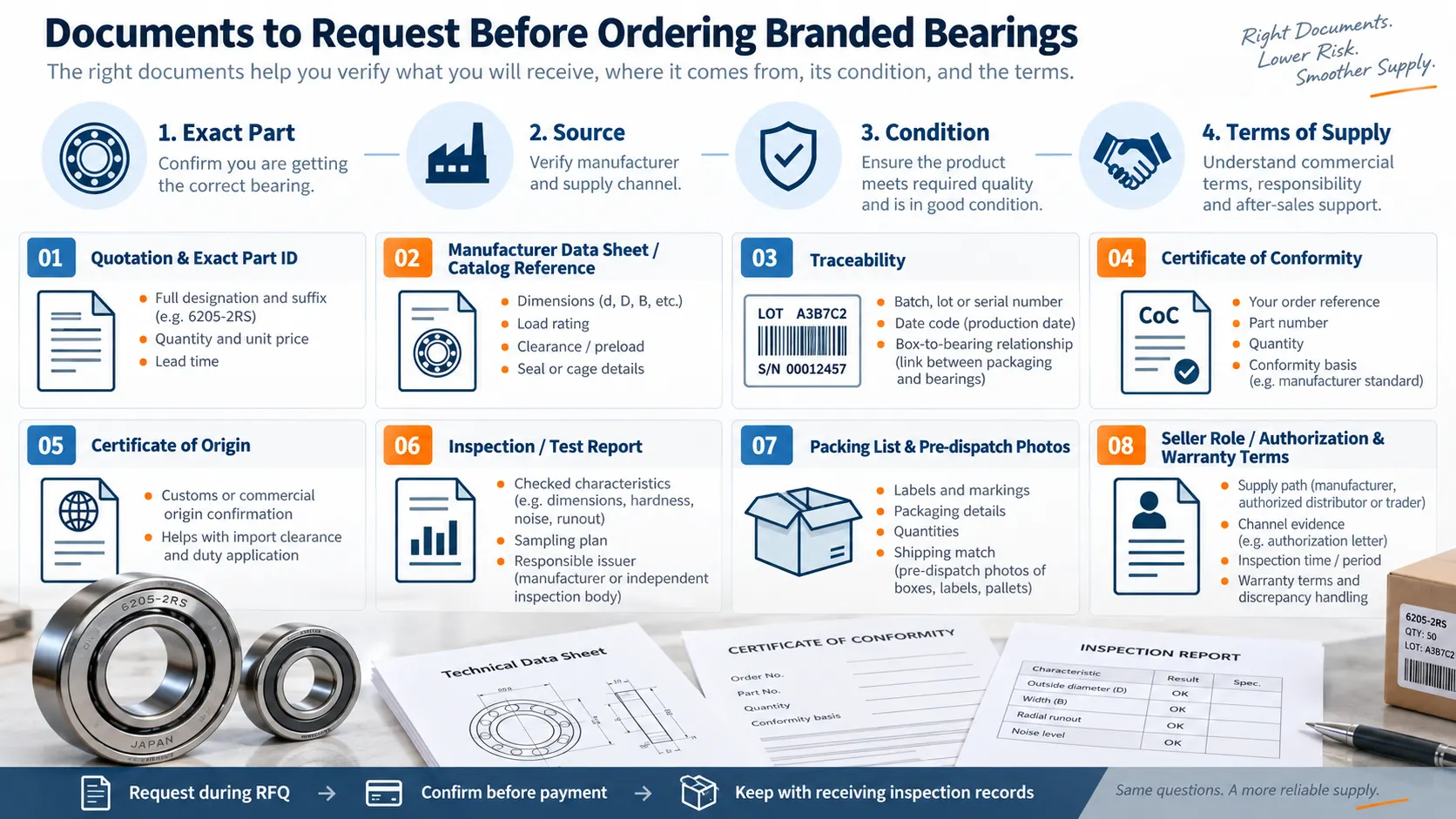
RFQ and quotation with the complete designation, suffix, quantity, price, delivery terms, and packaging.
-
Manufacturer data sheet, catalog reference, drawing, or written configuration confirmation.
-
Traceability information: batch, lot, serial, date code, and box-to-bearing relationship where available.
-
Applicable certificates: conformity, origin, inspection, material, or heat treatment, each with a defined purpose.
-
Packing list and pre-dispatch photographs for high-risk or mixed-brand orders.
-
Seller role and supply-path statement, plus authorization evidence when the project requires it.
-
Written inspection, warranty, return, and discrepancy-resolution terms.
The checklist should be attached to the purchase order or quality plan, not kept only in an email thread. Retain the final documents with the receiving inspection record so that future replenishment can be compared with the original source.
উপসংহার
The right documents turn a branded bearing purchase into a verifiable supply decision. Before ordering SKF, FAG, or NSK bearings, request exact part identification, technical references, traceability, applicable certificates, packaging evidence, seller-channel information, and written acceptance terms. The required set depends on the application and customer standard, so define what each document must demonstrate. For an RFQ or fit check, contact LQYS with the brand, complete designation, dimensions, load, operating conditions, quantity, and required documentation.
প্রশ্নাবলী
Is a certificate of origin proof that a bearing is genuine?
No. It supports origin or customs requirements. Authenticity also depends on the source, traceability, markings, packaging, and the consistency of the supplied part with the order.
Should every bearing order include a test report?
Not necessarily. Standard catalog orders may need only the agreed technical reference and traceability. Request inspection or test records when the application, customer specification, or risk level makes them relevant.
What does an authorized distributor document prove?
It can support the seller’s channel relationship for a defined brand and period. It does not replace checking the exact part, lot, packaging, and purchase documents for your shipment.
When should buyers ask for documents?
Ask during RFQ and confirm availability before issuing the purchase order. Some documents require manufacturer or inspection coordination and may not be available after dispatch.