

Guide pour les demandes de devis de roulements SKF, FAG et NSK : Éléments à inclure pour obtenir un devis précis
2026-08-06
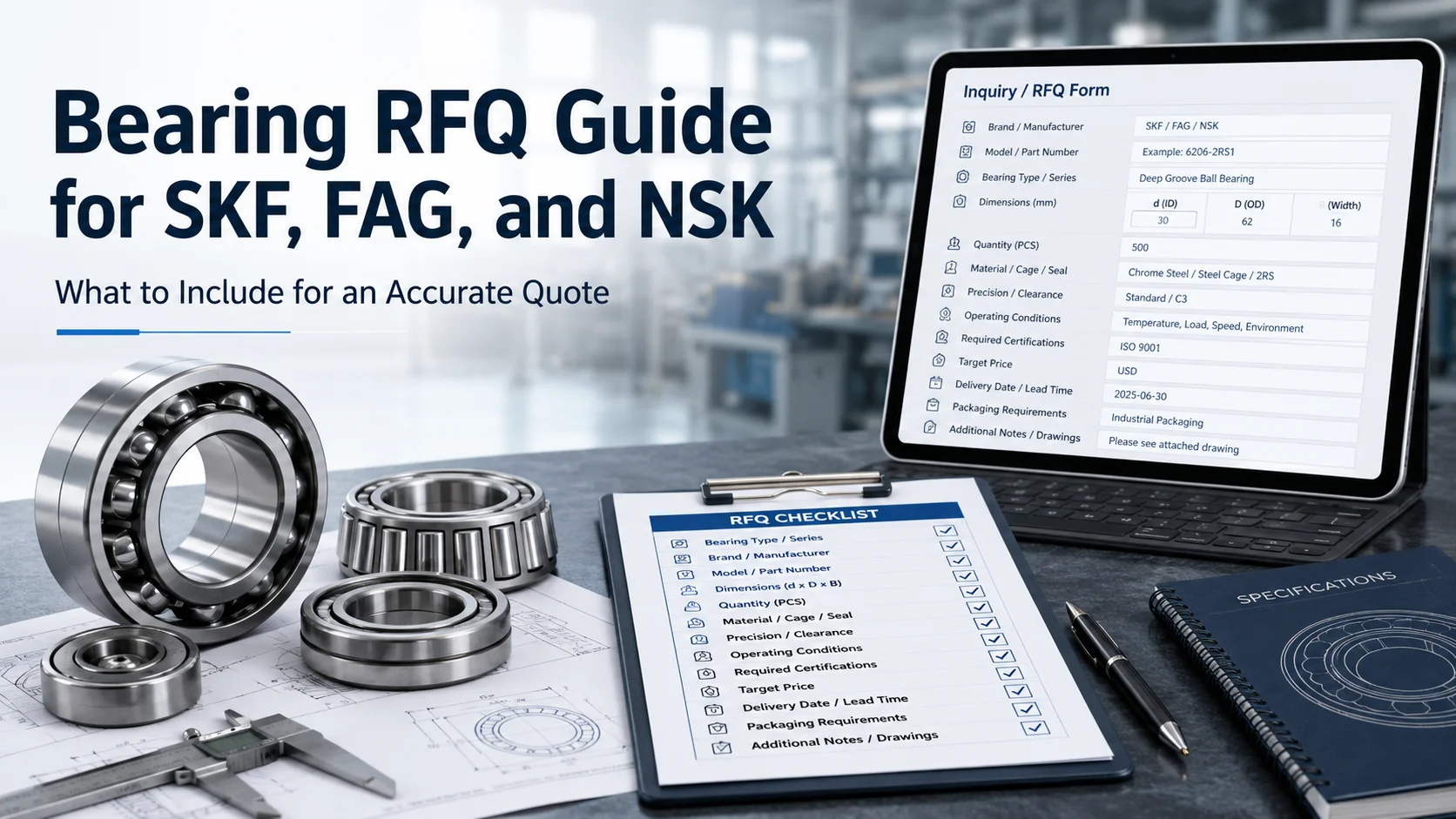
Un devis précis pour des roulements commence par une demande de devis précise. Pour les commandes récurrentes, il suffit généralement d'indiquer la référence complète et la quantité. En revanche, pour les demandes de remplacement, les commandes OEM, les commandes urgentes ou les demandes multimarques, il est également nécessaire de préciser les conditions de fonctionnement, les délais de livraison, l'emballage, les documents et les règles de substitution. Sans cela, les fournisseurs peuvent proposer des produits portant le même numéro de base, mais différant par leur jeu, leurs joints, leur cage, leur lubrification ou leur compatibilité.
Pourquoi les demandes de devis pour les roulements produisent-elles des devis inexacts ou tardifs ?
Une référence de pièce incomplète peut modifier le roulement réel.
Les codes tels que 6205, NU208 ou 22220 n'identifient qu'une partie du produit. Les suffixes peuvent préciser le jeu interne, les joints d'étanchéité, les flasques, la conception de la cage, l'alésage conique, la lubrification ou la précision. Des roulements présentant les mêmes dimensions principales peuvent donc ne pas être interchangeables.
Reproduisez l'intégralité du marquage figurant sur le roulement, l'emballage, le schéma ou le bon de commande précédent. Si un code est illisible, joignez des photos en gros plan plutôt que de laisser le fournisseur deviner. Les acheteurs qui doivent interpréter les codes C3, 2RS, ZZ, DDU, K, W33, M, TVP ou similaires doivent consulter le manuel d'utilisation. désignation complète du roulement et suffixe avant d'envoyer la demande.
L'absence de données applicatives et commerciales engendre des hypothèses différentes.
Un nombre complet peut néanmoins s'avérer insuffisant en cas de vitesse élevée, de chaleur, de choc ou de contamination, car ces conditions peuvent affecter le jeu, la fermeture, la cage et le lubrifiant.
Les omissions commerciales faussent également les comparaisons. Un fournisseur peut proposer un prix départ usine, un autre peut inclure l'emballage pour l'exportation, et un autre encore peut supposer que des alternatives sont autorisées. Indiquez la quantité, la destination, la date de livraison souhaitée, la devise, l'Incoterm, l'emballage, la validité et la politique de substitution.
Choisissez le chemin de demande de prix approprié en fonction des informations dont vous disposez.
Demande de devis pour une marque connue et une référence complète
Pour un réapprovisionnement ou un remplacement approuvé, veuillez indiquer la marque, la désignation complète, la quantité, les exigences de livraison, l'emballage et les documents. Assurez-vous que les exigences actuelles respectent toujours les mêmes tolérances, joints, lubrifiants, niveaux de précision et restrictions d'approvisionnement.
Le fournisseur doit répéter le code complet, identifier une correspondance exacte et séparer le stock disponible de tout solde nécessitant un approvisionnement ultérieur.
Demande de devis pour un roulement de remplacement illisible ou non identifié
Lorsque les marquages sont illisibles, notez l'alésage, le diamètre extérieur, la largeur, la structure du palier, le type de fermeture, le profil de l'alésage, les rainures, les brides, les manchons et les éléments de positionnement. Joignez des photographies des deux faces, du marquage latéral, du siège d'arbre, du logement et de la position du palier.
Décrivez la machine, sa vitesse, le sens de la charge, la température, la lubrification, la contamination et le motif du remplacement. Les dimensions pouvant être modifiées par les dommages, les mesures doivent étayer l'identification et ne pas la déterminer à elles seules. Si plusieurs produits sont possibles, fournissez un échantillon ou un schéma et exigez une identification confirmée ou provisoire.
Demande de devis pour un nouveau projet de conception ou OEM
Avant de pouvoir établir un devis fiable pour une nouvelle conception, il est nécessaire de fournir des données d'application. Veuillez préciser la configuration de l'arbre et du carter, l'espace disponible, les charges radiales et axiales, la vitesse nominale et maximale, la température, le cycle de service, l'alignement, la lubrification, la contamination, l'étanchéité et l'objectif de service.
SKF considère la charge, la vitesse, la température de fonctionnement, la lubrification, les interfaces des roulements, la conception et l'étanchéité comme des facteurs de sélection interdépendants. La demande de devis doit également préciser la quantité de prototypes, l'étape de validation, la demande annuelle, la date de production cible et indiquer si le fournisseur propose un roulement spécifique ou une solution globale.
Informations techniques à inclure dans une demande de devis pour un roulement
Charge, vitesse, température, cycle de service et environnement
Indiquez la vitesse nominale et la vitesse maximale, le type de charge et si le sens de la charge change. Si les valeurs exactes ne sont pas disponibles, indiquez une plage réaliste et décrivez l'équipement entraîné.
Distinguez la température ambiante de la température de fonctionnement prévue du roulement. Précisez le cycle de service et indiquez la présence de poussière, d'eau, de produits chimiques, de lavage, de corrosion, de courant électrique, de vide ou de chaleur externe. Ces détails permettent de déterminer si le produit demandé nécessite une étude technique.
Jeu, ajustements, joints, cage, précision et lubrification
Indiquez le jeu interne lorsqu'il est connu. Si le jeu installé est important, précisez les tolérances de l'arbre et du logement, les matériaux et les températures plutôt que de demander au fournisseur de choisir entre une version normale et une version C3 en fonction des seules dimensions.
Identifiez la construction (ouverte, blindée ou étanche) et précisez si la protection contre la contamination, la rétention du lubrifiant, le faible frottement ou la vitesse sont prioritaires. La haute vitesse, la chaleur, les charges importantes ou les produits chimiques peuvent nécessiter une confirmation de la cage et du lubrifiant. Indiquez la classe de précision lorsque la précision de fonctionnement est essentielle, mais évitez les exigences particulières qui ne répondent pas à un besoin de l'application.
Informations commerciales et logistiques nécessaires pour des prix comparables
Quantité, demande annuelle, stade de l'échantillon et date requise
Distinguez les besoins immédiats des demandes à long terme, car les remplacements d'urgence, les échantillons d'homologation et les commandes de production annuelles peuvent avoir des prix et des délais de livraison différents.
Précisez si la date concerne l'expédition ou la livraison, si une livraison partielle est acceptable et si la quantité est destinée à la maintenance, à la validation ou à la production. En cas d'incertitude quant à la demande, demandez des quantités dégressives. Même les demandes de devis urgentes nécessitent des spécifications complètes.
Devise, Incoterms, emballage, validité du devis et destination
Demandez à vos fournisseurs d'utiliser la même devise et le même Incoterm. Indiquez la destination et précisez si l'emballage d'exportation, le fret, l'assurance, les taxes et les documents sont inclus.
Exigences réglementaires relatives aux emballages de marque, aux conditionnements individuels ou en vrac, à la protection contre la corrosion, au reconditionnement et aux lots mixtes. Exiger une période de validité et comparer la couverture totale, et non seulement le prix unitaire.
Comment demander des marques originales ou des alternatives équivalentes
| Instructions RFQ | Utilisation appropriée | Réponse du fournisseur |
|---|---|---|
| Marque originale uniquement | Commandes de marques approuvées | Indiquez la marque et le code complet. |
| Même marque préférée | Des alternatives peuvent être examinées. | Séparer l'original et les alternatives |
| Équivalents approuvés autorisés | L'acheteur possède une liste approuvée | État marque, code et différences |
| Alternative demandée | Produit obsolète ou indisponible | Fournir une comparaison technique |
| Aucune substitution sans accord. | Commandes urgentes ou répétées | Obtenir une approbation écrite |
Une référence croisée n'est qu'un point de départ. Avant d'approuver un équivalent, vérifiez les dimensions, les caractéristiques, la vitesse, le jeu, les fermetures, la cage, la précision, le lubrifiant et les conditions d'installation.
Que doit contenir un devis utile pour un roulement ?
Correspondance exacte, alternative et écart technique
Chaque ligne doit être étiquetée comme correspondance exacte, alternative proposée ou option techniquement différente. Une alternative doit mentionner le fabricant, la désignation complète et les différences nécessitant un examen.
La réponse doit mentionner les informations manquantes et les hypothèses. Les acheteurs ne peuvent approuver un « équivalent » de manière responsable si le code, le jeu, le joint, la cage ou les limites de fonctionnement indiqués sont omis. Tout écart affectant l'ajustement ou le fonctionnement doit être examiné par l'ingénieur responsable.
Prix, disponibilité, délai de livraison, documents et exceptions
Un devis utile indique le prix unitaire, la devise, la quantité, le stock disponible, le délai de production, l'emballage, la validité et les exceptions. « En stock » doit signifier une quantité et un emplacement précis, et non une possibilité non confirmée de se procurer l'article ultérieurement.
Les photographies, certificats, rapports d'inspection ou documents de traçabilité requis doivent être confirmés avant toute commande. Une fois que les fournisseurs auront répondu de manière exhaustive, les acheteurs pourront… Comparez les devis de roulements selon le prix, le délai de livraison et l'authenticité. au lieu de comparer des offres incompatibles.
Liste de contrôle des demandes de prix pour roulements
Avant d'envoyer une demande de renseignements concernant des roulements, les acheteurs doivent préparer les informations techniques, commerciales et documentaires susceptibles d'influencer l'identification du produit et la précision du devis. La liste de contrôle ci-dessous récapitule les informations clés que les fournisseurs doivent généralement examiner.
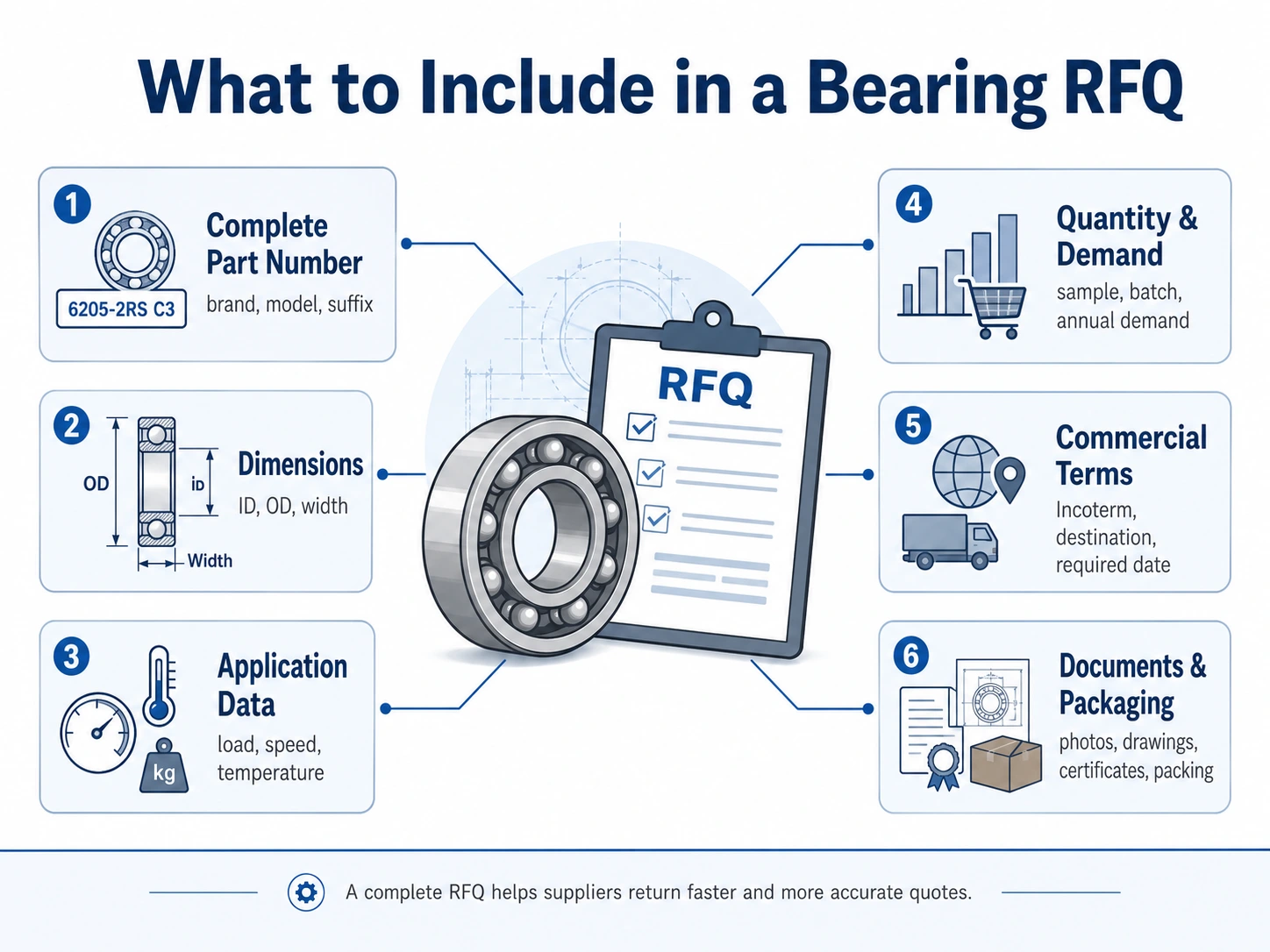
Une demande de devis complète aide les fournisseurs à comprendre si la demande concerne un remplacement exact, une alternative approuvée ou une nouvelle exigence d'application.
Inclure:
-
Marque, désignation complète, quantité et demande annuelle
-
Photographies, dessin, dimensions ou échantillon
-
Équipement, position, charge, vitesse et température
-
Cycle de service, détails de l'arbre et du carter, et environnement
-
Jeu, fermetures, cage, précision et lubrification
-
Police d'assurance de marque originale ou alternative
-
Date, destination, devise et Incoterm obligatoires
-
Exigences en matière d'emballage, de lots, de photographies et de documents
-
État des stocks, délai de livraison, hypothèses et validité du devis
Comment choisir un fournisseur pour les demandes de devis SKF, FAG et NSK
Des précisions techniques devraient précéder le prix final.
Un fournisseur compétent devrait repérer les suffixes manquants, les dimensions contradictoires, les données d'exploitation incomplètes et les règles de substitution imprécises. Les questions techniques apportent une réelle valeur ajoutée lorsqu'elles permettent de lever un risque de sélection réel.
Shanghai Yongheshun Import and Export Co., Ltd. présente LQYS Bearings comme une entreprise intégrant la production, la vente, le commerce et l'exportation de roulements, tandis que son site web présente également des produits de marques internationales en plus des produits LQYS. Les acheteurs qui en font la demande Roulements SKF, FAG et NSK Il convient toujours d'exiger une confirmation spécifique à la commande concernant la marque, le code complet, la quantité, les conditions d'approvisionnement, la documentation et l'étendue de la livraison.
Comparez l'exhaustivité des réponses, et pas seulement leur rapidité.
Une réponse rapide n'est utile que si elle répond à la demande de devis. Comparez si chaque fournisseur confirme le produit exact, identifie les alternatives, explique les écarts, indique la quantité disponible, donne un délai de livraison réaliste et aborde les questions d'emballage et de documentation.
Pour les commandes répétées ou OEM, évaluez si le fournisseur peut préserver la configuration approuvée de l'échantillon au lot et conserver les enregistrements pour le réapprovisionnement.
Conclusion
Pour obtenir un devis précis pour un roulement, il est essentiel de connaître l'identification complète du produit, les données d'application pertinentes, les conditions commerciales et les règles de substitution clairement définies. Choisissez la procédure de demande de devis appropriée, fournissez la désignation complète ou les éléments permettant d'identifier le roulement, et exigez des fournisseurs qu'ils distinguent les roulements identiques des alternatives.
À demander un devis précis pour les roulements, veuillez soumettre à LQYS Bearings le code du roulement, des photographies ou un dessin, les conditions de fonctionnement, la quantité, la date requise, la destination, l'emballage et la politique de marque d'origine ou alternative.
Questions fréquemment posées
Quelles informations sont nécessaires pour un devis de roulement ?
Veuillez indiquer la marque, la désignation complète, la quantité et la date souhaitée. Pour les pièces de rechange, les pièces d'origine ou les applications spéciales, des photos, les dimensions, la charge, la vitesse, la température, le jeu, les fermetures, la lubrification, l'environnement, la destination et les documents nécessaires peuvent également être requis.
Puis-je demander un devis pour un roulement sans numéro de pièce ?
Oui. Veuillez envoyer les dimensions, des photos nettes, les informations sur l'équipement, les détails de l'arbre et du carter, les conditions de fonctionnement et un échantillon si possible. Le fournisseur doit préciser si l'identification est confirmée ou provisoire.
Dois-je inclure le suffixe complet SKF, FAG ou NSK ?
Oui. Le suffixe peut indiquer le jeu, les joints, les écrans, la cage, l'alésage, la précision, la lubrification ou toute autre caractéristique. Son omission peut entraîner un devis pour une configuration incorrecte.
Pourquoi les devis de roulements des différents fournisseurs varient-ils autant ?
Les conditions peuvent varier en termes de suffixes, de sources, de quantités, d'emplacements de stock, d'emballage, de délais de livraison, de devises, d'Incoterms, de documents ou d'hypothèses de remplacement. Il est recommandé de standardiser le périmètre de la demande de devis avant de comparer les prix.