

Angular Contact vs Tapered Roller Bearings: A Field Guide for Combined Loads
2026-06-04In industrial sourcing and equipment service, bearing selection for combined radial and axial loads is a practical issue rather than a classroom topic. It often appears when a gearbox runs above its normal temperature, a pump shaft shows unwanted movement, a wheel hub needs firmer support, or a spindle begins to lose accuracy after long operation. Angular contact ball bearings and tapered roller bearings can both work under combined load conditions. However, their internal structures and operating behavior are not the same. For buyers, distributors, repair teams, and OEM engineers, the right choice depends on speed, load ratio, axial force direction, mounting layout, lubrication, and expected service life.
Shanghai Yongheshun Import and Export Co., Ltd., through the LQYS bearing supply platform, provides angular contact ball bearings, tapered roller bearings, automobile bearings, cylindrical roller bearings, thrust ball bearings, and other industrial bearing products. These products serve machinery, automotive systems, power transmission units, construction equipment, and general industrial applications. In B2B purchasing, a dependable bearing decision is not made by model number alone. It comes from matching the bearing type with the real working load and machine condition.
What Combined Radial and Axial Loads Mean in Real Equipment
A radial load acts across the shaft. An axial load, also known as a thrust load, acts along the shaft. In actual machines, these two forces often appear at the same time. Gearboxes receive radial force from gear engagement and axial thrust from helical gear movement. Pumps may face hydraulic thrust during continuous operation. Automotive wheel hubs carry vehicle weight, side force during turning, and road impact. Machine tool spindles need stable rotation as well as controlled axial positioning.
When the selected bearing does not match the combined radial and axial load, failure may begin slowly. The first warning signs are often rising temperature, unstable vibration, darkened grease, raceway marks, unusual noise, or reduced positioning accuracy. In a plant or repair workshop, these problems can turn into unplanned downtime, repeated maintenance, and higher spare parts cost. This is why combined load bearing selection should start from the working condition, not only from bearing size.
Quick Comparison for Buyers and Engineers
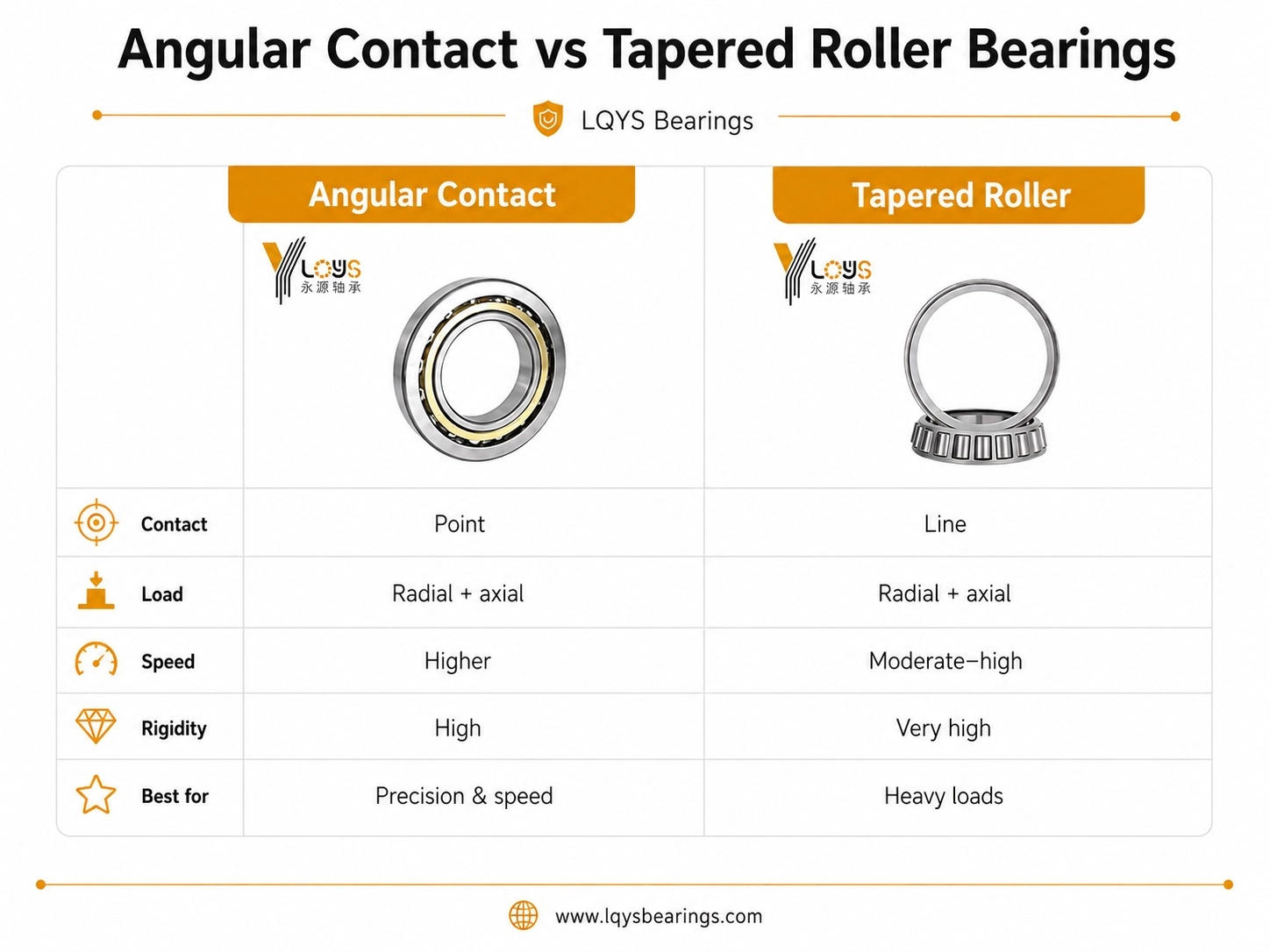
The table below gives a practical reference for comparing angular contact ball bearings and tapered roller bearings.
| Selection Factor | Angular Contact Ball Bearing | Tapered Roller Bearing |
|---|---|---|
| Main advantage | High speed and running accuracy | Heavy load capacity and strong stiffness |
| Suitable load type | Combined radial and axial load | Combined radial and axial load |
| Axial load direction | Mainly one direction in single-row design | Mainly one direction in single-row design |
| Contact form | Point contact | Line contact |
| Friction level | Lower friction and lower heat tendency | Higher friction than ball bearing designs |
| Speed capability | Better for high-speed operation | Better for moderate-speed heavy-duty operation |
| Rigidity | High with proper preload | Very high under heavier load |
| Typical applications | Machine tools, pumps, compressors, robotics, motors | Automotive hubs, gearboxes, construction machinery, mining equipment |
| Buying focus | Speed, precision, low vibration | Load capacity, shock resistance, shaft support |
This comparison helps avoid a frequent purchasing error. Some bearings look similar in bore size, outer diameter, or width, but they may behave very differently under axial thrust, vibration, and continuous load. A small dimensional match does not always mean a safe technical match.
When Angular Contact Ball Bearings Are the Better Fit
Angular contact ball bearings are commonly used when a machine needs speed, accuracy, and stable axial positioning. Their raceway geometry forms a contact angle, so the bearing can carry radial load and axial load together. Common contact angles include 15°, 25°, 30°, and 40°. A larger contact angle usually supports stronger axial load. A smaller contact angle is often chosen when higher speed is the main requirement.
In machine tool spindles, high-speed motors, compressors, pumps, and robotic joints, heat control and rotational accuracy are critical. Angular contact ball bearings use ball-to-raceway point contact. This structure helps reduce friction compared with roller bearing designs. As a result, they are often selected for equipment that needs smooth running, lower vibration, and steady positioning.
For applications where axial force acts in both directions, single-row angular contact ball bearings are usually installed in pairs. Back-to-back and face-to-face arrangements are common in precision machinery because they help control shaft movement and improve rigidity. Double-row angular contact ball bearings may also be used when space is limited and two-direction axial load support is required.
Before placing a wholesale order, buyers should confirm precision grade, preload, clearance, cage material, seal type, lubrication method, and working temperature. These details have a direct effect on bearing life. They become especially important in continuous high-speed operation.
When Tapered Roller Bearings Are the Better Fit
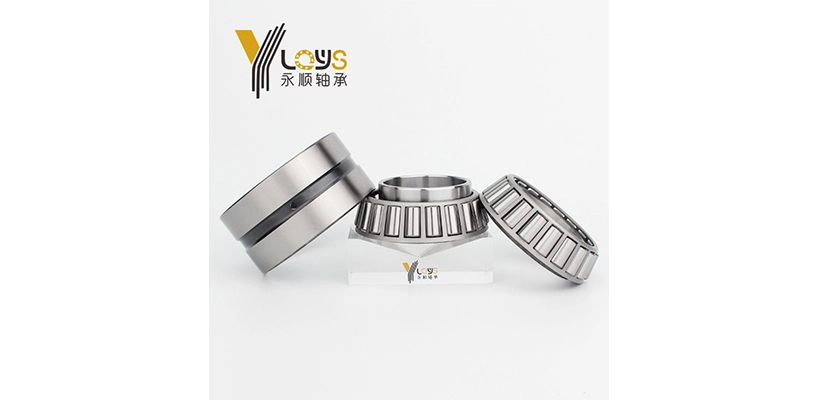
Tapered roller bearings are designed for heavier combined loads. Their tapered rollers and raceways create line contact, which spreads the load over a larger contact area. This gives the bearing strong radial load capacity, high axial load capacity in one direction, and excellent rigidity. For equipment exposed to shock load, vibration, or changing force, this design is often more dependable than a ball bearing structure.
Automotive wheel hubs, gearboxes, agricultural machinery, construction equipment, mining machinery, and conveyor drive systems often use tapered roller bearings. These applications need firm shaft support and reliable load carrying. In a gearbox, for example, the bearing must carry radial load from gear rotation and axial thrust from gear engagement. A tapered roller bearing helps keep the shaft aligned under heavier force.
Single-row tapered roller bearings are often used as matched pairs when axial load works in two directions. Double-row and four-row tapered roller bearings are preferred in heavier machinery where load capacity and stability matter more than compact high-speed performance. Correct mounting is essential. Too much preload can create heat. Too much clearance can cause vibration, edge stress, and uneven wear.
For wholesale bearing buyers, tapered roller bearing selection should include cup and cone dimensions, load rating, clearance setting, lubrication condition, hardness, surface finish, and application environment. In dusty, wet, or impact-heavy working areas, sealing and grease selection also become important purchasing details.
How to Make a Practical Bearing Selection
A sound decision starts with the load profile. If the application has moderate combined load but requires high speed, low friction, and accurate positioning, angular contact ball bearings are usually the better starting point. If the equipment carries heavy radial and axial loads, works under impact, or needs firm shaft support, tapered roller bearings are usually a stronger choice.
The next point is axial load direction. Many single-row designs mainly carry axial load in one direction. When thrust force changes direction, paired bearings, double-row bearings, or another bearing arrangement may be needed. Speed must also be checked. Higher speed creates more heat, so lubrication, cage design, and preload become more sensitive. In heavy-duty systems, the priority often moves toward stiffness, load rating, and resistance to shock.
Shanghai Yongheshun Import and Export Co., Ltd. supports B2B customers with a broad LQYS bearing range for industrial distributors, repair companies, machinery manufacturers, and equipment service teams. For procurement projects involving several machines, sourcing angular contact ball bearings and tapered roller bearings from one bearing supplier can reduce communication cost and keep specifications more consistent across the order.
Conclusion
Angular contact ball bearings and tapered roller bearings both work in combined radial and axial load applications, but they are built around different priorities. Angular contact ball bearings fit high-speed, precision, low-friction, and low-vibration systems. Tapered roller bearings fit heavy load, high rigidity, shock resistance, automotive hubs, gearboxes, and heavy industrial equipment. The most reliable bearing selection comes from reading the actual working condition: load direction, speed, stiffness, installation space, lubrication, temperature, and maintenance access.
FAQs
Q1: How do I choose a bearing for combined radial and axial loads?
A1: Choose the bearing according to load ratio, speed, axial load direction, rigidity, and working environment. Angular contact ball bearings are usually used for high-speed and precision applications. Tapered roller bearings are more common in heavy load, shock load, and high-rigidity equipment.
Q2: Which is better for axial load, angular contact or tapered roller bearing?
A2: Both bearing types can handle axial load, but the better choice depends on the machine. Angular contact ball bearings are preferred when speed and accuracy are important. Tapered roller bearings are preferred when axial load is heavier and the equipment also needs strong radial load support.
Q3: Can a single angular contact ball bearing handle axial load in both directions?
A3: A single-row angular contact ball bearing normally supports axial load mainly in one direction. When axial force acts in both directions, paired angular contact bearings or double-row angular contact ball bearings are commonly used.
Q4: Why does a tapered roller bearing run hot after installation?
A4: A tapered roller bearing may run hot when preload is too high, clearance is too small, lubrication is not enough, or alignment is poor. In heavy-duty applications, mounting accuracy and grease condition have a strong effect on operating temperature.
Q5: What bearing is commonly used for automotive hubs and gearboxes?
A5: Tapered roller bearings are commonly used in automotive hubs and gearboxes because they offer high load capacity, firm rigidity, and stable support for combined radial and axial loads. Angular contact ball bearings may be selected where higher speed and precision are the main requirements.