

How to Select Bearings for Robot Joints: Angular Contact, Four-Point, Needle Roller, and Crossed Roller Bearings Compared
2026-06-25Robot joint bearing selection should be handled as a mechanical system decision, not a simple bearing catalog match. In robotic arms, cobots, rotary actuators, reducers, wrist modules, and end effectors, one bearing position may need to carry radial load, axial load, moment load, bearing preload, bearing stiffness, speed, lubrication demand, and robot bearing service life requirements at the same time. If these conditions are checked separately, the selected bearing may pass a basic load review but still create heat, vibration, unstable repeatability, or early wear after installation.
For OEM engineers, automation equipment manufacturers, and industrial bearing buyers, the main task is to match bearings for robot joints with the actual joint structure. A base axis, shoulder joint, elbow joint, wrist joint, gearbox shaft, and gripper axis rarely share the same load path. This comparison explains how angular contact, four-point contact, needle roller, and crossed roller bearings fit different robotic joint applications.
Why Bearing Selection Matters in Robot Joints
Robot joints work under repeated acceleration, braking, reversing, and holding loads. Unlike a standard motor shaft, a robotic joint often carries overhung weight from the arm, reducer, tool, or gripper. This creates combined radial, axial, and moment loads, especially in shoulder joints, wrist axes, rotary tables, and precision manipulators.
When robotic joint bearings are chosen only by bore size, outside diameter, or dynamic load rating, problems usually appear after assembly. The joint may rotate smoothly at low speed but lose positioning accuracy under cycle load. In other cases, excessive bearing preload raises torque and temperature, while insufficient stiffness causes backlash and tool center point deviation.
For this reason, many equipment builders prefer to work with a precision bearing manufacturer for automation that can review load direction, clearance, mounting accuracy, lubrication, and expected service life before production purchasing begins.
Key Loads in Robot Joints: Radial, Axial, and Moment Loads

A practical robot bearing review starts with load direction. Radial load acts across the shaft and is commonly caused by arm weight, gear mesh force, belt tension, or shaft support. Axial load acts along the shaft axis and may come from thrust force, screw mechanisms, reducers, or compact rotary units. Moment load is the tilting force created when the working load is offset from the bearing centerline.
Moment load is often the most underestimated factor in robot arm bearing selection. A bearing can have enough radial load capacity but still allow deflection under an overhung wrist, tool, or gripper. In precision automation, small bearing deflection may become visible positioning error at the end of the robotic arm.
Before selecting bearings for robot joints, engineering teams should review combined radial axial moment loads rather than checking radial load rating alone. This step helps prevent low rigidity, short fatigue life, poor repeatability, and unexpected maintenance during continuous production.
Bearing Types for Robot Joints Compared
Angular Contact Ball Bearings for Speed and Combined Loads
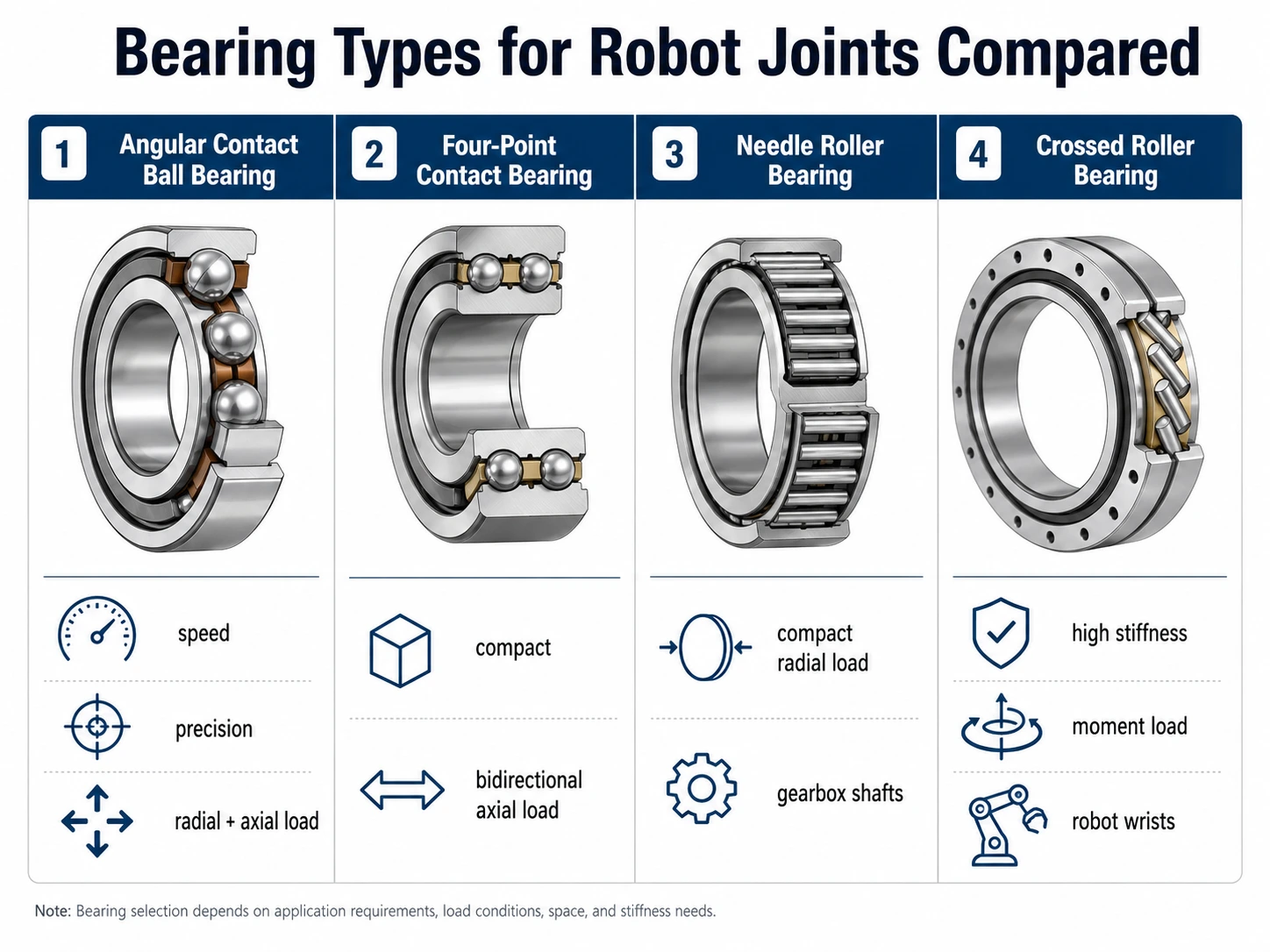
Angular contact ball bearings are widely used where radial and axial loads appear together. Their contact angle allows better axial load support than standard deep groove ball bearings, making them suitable for high-speed shafts, gear supports, rotary actuators, and compact joint structures.
Angular contact bearings for robot joints are often installed in matched pairs or preloaded arrangements when higher rigidity is required. Proper bearing preload helps reduce internal clearance and improves positioning stability. However, too much preload can increase friction, heat, and fatigue risk, so preload control should be treated as an important design and purchasing requirement.
LQYS supplies angular contact ball bearing options for combined load applications, making the company a relevant angular contact ball bearing supplier for automation manufacturers, repair suppliers, and industrial distributors comparing precision, availability, and cost stability.
Four-Point Contact Bearings for Compact Bidirectional Axial Support
A four-point contact bearing can support axial loads in both directions within a compact single-bearing arrangement. This makes it useful for compact rotary modules, light-duty robot axes, indexing units, and positioning equipment where the housing does not allow two separate angular contact bearings.
A four-point contact ball bearing should still be selected according to the full working condition. Radial load level, axial load direction, shaft fit, housing accuracy, lubrication method, and mounting control all affect final performance. It is not always the best solution for heavy moment-load robot joints, but it can reduce assembly size when bidirectional axial support is the main requirement.
For buyers working on compact robotic mechanisms, four-point contact bearings can provide a practical balance between space saving and axial load control.
Needle Roller Bearings for Compact Radial Load Support
Needle roller bearings for robotics are commonly used where high radial load capacity is needed in a small cross-section. Typical locations include gearboxes, shafts, cam mechanisms, oscillating parts, reducers, and end effector assemblies.
Their limitation is also clear. Needle roller bearings mainly support radial load, so they should not be treated as a complete bearing solution for high axial load or large moment load unless another bearing structure carries those forces. In many robotic systems, needle roller bearings work as part of a complete support arrangement rather than as the only bearing position.
For wholesale buyers and OEM purchasing teams, needle roller bearings can help reduce package size while maintaining radial load capacity. Shaft hardness, surface finish, alignment, sealing, and lubrication should be checked carefully, particularly in compact automation equipment running long shifts.
Crossed Roller Bearings for High Stiffness and Moment Loads
Crossed roller bearings for robot joints are often used when high rigidity, high rotational accuracy, and strong moment-load resistance are required in limited space. Their crossed roller arrangement allows one bearing to carry radial, axial, and moment loads, which is why they are commonly considered for robot wrists, collaborative robot joints, rotary tables, inspection equipment, and precision manipulators.
The main advantage is bearing stiffness under combined load. The main challenge is mounting accuracy. Crossed roller bearings usually require accurate housing shoulders, controlled preload, clean assembly, and even bolt tightening. If the mounting surface is inaccurate, the expected running accuracy may not appear in the completed joint.
For high-stiffness robot joint bearing applications, crossed roller bearings should be reviewed early in the design stage, before the reducer, shaft, and housing layout are finalized.
How to Choose the Right Bearing for a Robot Joint
A useful selection process begins with the joint position. The base joint usually faces heavier moment load, while the wrist joint may require compact size, low friction, and high running accuracy. Gearbox shafts often need radial load support, while end effectors may require miniature bearings with low noise and stable starting torque.
After the joint position is clear, the next step is to confirm radial load, axial load, moment load, speed, acceleration, duty cycle, shock load, allowable deflection, temperature, lubrication method, and target service life. Accuracy requirements should be based on the equipment type. A palletizing robot, packaging robot, welding robot, semiconductor handling unit, and medical automation system may each require different levels of runout, rigidity, noise, and maintenance interval.
For B2B sourcing, consistency across batches is also important. Shanghai Yongheshun Import and Export Co., Ltd. operates with a 12000m² factory area, more than 40 employees, modern testing equipment, and export experience in over 30 countries. For buyers sourcing precision bearings for robotics, this background helps evaluate product range, inspection capability, communication efficiency, and long-term supply support.
Which Bearing Type Should Be Chosen?
Angular contact ball bearings are suitable when a robot joint needs speed, precision, and combined radial and axial load support. Four-point contact bearings are a practical option when the design needs bidirectional axial load support in a compact space. Needle roller bearings are better suited for compact radial load support in shafts, reducers, gearboxes, and end effectors. Crossed roller bearings are usually preferred when high stiffness, high rotational accuracy, and moment-load resistance are critical.
Miniature bearings may be considered for small robot wrists, sensors, light-duty grippers, and compact end effector modules. Cylindrical roller bearings can support high radial loads in heavier transmission sections or rigid drive structures. The correct choice depends on the complete mechanical system, not a single catalog value.
When drawings, load data, speed, accuracy grade, installation space, and robot bearing service life targets are available, purchasing teams can request a robot bearing recommendation before confirming mass orders. This reduces the risk of selecting a bearing that fits the catalog but does not fit the actual robotic joint.
Conclusion
Robot joint bearing selection requires a clear balance between load capacity, stiffness, accuracy, preload, space, lubrication, mounting condition, and service life. Angular contact, four-point contact, needle roller, and crossed roller bearings each solve different problems inside robotic equipment. For OEMs, distributors, and automation machinery manufacturers, the right bearing is not simply the largest, smallest, or highest-priced option. It is the bearing that matches the joint load path, precision target, assembly method, and maintenance expectation. With a broad bearing product range and experience in precision applications, LQYS supports practical bearing solutions for robotic systems, automation equipment, and industrial machinery.
FAQs
Q1: What type of bearing is used in robot joints?
A: Robot joints may use angular contact ball bearings, four-point contact bearings, needle roller bearings, crossed roller bearings, miniature bearings, or cylindrical roller bearings. The correct bearing type depends on radial load, axial load, moment load, speed, bearing stiffness, installation space, and accuracy requirement.
Q2: How do I choose a bearing for a robotic arm joint?
A: Start by confirming the joint position, then calculate radial, axial, and moment loads. After that, review speed, acceleration, duty cycle, allowable deflection, bearing preload, lubrication, sealing, and robot bearing service life. For robotic arm bearing selection, stiffness and backlash control are often more important than radial load rating alone.
Q3: Are angular contact bearings good for robot joints?
A: Angular contact bearings are suitable for robot joints that need combined radial and axial load support, accurate rotation, and relatively high speed. In applications with higher stiffness requirements, paired or preloaded angular contact bearings can help reduce internal clearance and improve positioning stability.
Q4: What is the difference between crossed roller bearings and angular contact bearings?
A: Crossed roller bearings are usually selected for high stiffness, compact structure, and moment-load support. Angular contact bearings are often selected for speed, precision, and combined radial and axial loads. The better choice depends on load direction, mounting space, preload requirement, rotational accuracy, and service life target.
Q5: Why does a robot joint bearing fail early?
A: A robot joint bearing may fail early because of the wrong bearing type, excessive preload, poor lubrication, contamination, housing misalignment, shock load, or underestimated moment load. Reviewing the full working condition before purchase is one of the most reliable ways to extend robot bearing service life.