

NSK vs NTN Electric Motor Bearings: How to Verify Equivalent Specs Before Bulk Replacement
2026-09-04
An NSK and an NTN electric motor bearing may share the same basic number and principal dimensions without being functionally equivalent for a motor application. Internal clearance, grease, seals or shields, noise requirements, speed capability, and operating temperature can all affect what happens after installation. NSK’s own product data illustrates this clearly: a designation such as 6205 can be followed by codes identifying seals, C3 clearance, noise class, or special temperature features.
For a maintenance department replacing one failed bearing, a mismatch may create one additional repair. For an OEM, repair shop, distributor, or industrial buyer replacing dozens or hundreds of bearings, the same mismatch can become a batch-level problem. The right question is therefore not “Is NSK better than NTN?” but whether the proposed NSK-to-NTN or NTN-to-NSK replacement is equivalent for the actual motor duty.
Can an NSK Electric Motor Bearing Be Replaced With an NTN Bearing?
In many cases, a cross-brand replacement is possible, but the basic bearing number alone is not enough to approve it. NTN’s Bearing Finder, for example, provides dimensional and technical specifications as well as part-interchange data, while NSK product documentation separates bearing series from clearance, sealing, noise, and other configuration details.
Before comparing brands, first establish what the original motor actually requires. Industrial buyers can review the relevant deep groove ball bearings as a product-family reference, but the final replacement still needs to be checked against the complete original specification and application conditions. LQYS lists ball bearings among its industrial bearing categories, while the company website identifies machinery and electrical applications within its broader industrial market coverage.
Why the Same Base Bearing Number Does Not Prove Equivalence
A number such as 6205 identifies a bearing family and size, but suffixes and associated specifications can materially change the product. NSK, for example, publishes a 6205 DDU7 C3 E X26 configuration in which the additional codes identify sealing, radial internal clearance, noise class, and a special heat-treatment specification.
That is why an NSK 6205 and an NTN 6205 should not be treated as automatically interchangeable just because the bore, outside diameter, and width match. Before approving a replacement, buyers should compare the complete designation, clearance, closure type, lubricant requirements, motor speed, temperature conditions, and any specified noise or vibration requirement.
This becomes especially important when a quotation describes a bearing as an “equivalent.” Equivalent dimensions are only one part of functional equivalence. A proposed alternative should be supported by product specifications rather than by a simplified cross-reference based solely on the base number.
What Specifications Must Match Before an NSK-to-NTN Replacement?
A useful replacement review separates the characteristics that must match exactly from those that must be suitable for the same application. Dimensions normally need to fit the existing shaft and housing, but clearance, seals, grease, and operating limits need engineering compatibility rather than superficial code similarity.
Buyers who are uncertain about codes such as C3, ZZ, DDU, seals, shields, or lubrication-related suffixes can first review the complete bearing designation and suffix before comparing the two brands. The LQYS ordering guide notes that suffixes can specify clearance, sealing, shields, cages, bore arrangements, lubrication, and other application information.
Check Internal Clearance, Fit, and Operating Temperature Together
Internal clearance is one of the most common sources of confusion during motor bearing replacement. A C3 bearing is not simply a “better” motor bearing, and C3 is not a shaft or housing fit. NTN specifically defines C3 as an internal-clearance designation and distinguishes it from the mechanical fit between the bearing, shaft, and housing. NTN also notes that C3 may be suitable in many electric-motor rebuild applications while recommending engineering review for other applications.
The practical issue is that the clearance marked on an unmounted bearing is not necessarily the clearance that exists when the motor reaches operating temperature. Interference fits can reduce internal clearance, while temperature differences between the inner and outer rings can change the effective operating condition.
For a bulk replacement, record the original clearance designation and confirm the shaft and housing fits, motor duty, and normal temperature conditions before approving a different configuration. If a replacement motor bearing becomes noisy or runs hotter after installation, insufficient operating clearance, an unsuitable fit, lubrication, or another installation condition may need investigation before the bearing brand is blamed.
Match Grease, Seal Type, and Noise Requirements as One Package
Grease, closures, and noise performance should be reviewed together because changing one can affect another operating characteristic.
NSK publishes bearing configurations for electrical applications in which grease, sealing, clearance, and noise class form part of the total specification. Its high-temperature sealed deep-groove example combines C3 clearance, high-temperature grease, seals, and an E noise class rather than treating those features as unrelated purchasing options.
NTN likewise offers different seal arrangements. Its technical FAQ identifies LB as a non-contact seal suited to higher speeds and LU as a contact seal intended to provide stronger protection against contaminant ingress. This illustrates why two bearings described simply as “sealed” may not impose the same drag or have the same speed considerations.
The same caution applies to suffix translation. An NSK closure code should not be assumed to equal an NTN closure code because the letters appear similar or because a distributor’s informal cross-reference says they fit the same dimensions. For noise-sensitive motors, fan motors, pumps, or OEM assemblies, the purchasing specification should state the required performance or approved configuration rather than relying on a brand suffix alone.
How Should Buyers Check Speed and Temperature Rise Before Approval?
A replacement can fit correctly and still perform poorly under the actual motor duty. Speed capability is influenced by the specific bearing design, lubrication, seals, and operating conditions. NTN’s own item-level data, for example, publishes limiting speed alongside seal type, radial internal clearance, and temperature range rather than treating speed as a dimension-only property.
Validate the Replacement Under the Actual Motor Duty
A trial should represent the motor’s real operating conditions as closely as practical. Record the original bearing’s normal behavior before changing brands when that baseline is available. Useful observations can include motor speed, stabilized bearing-area temperature, audible noise, vibration behavior, and operating condition after the machine reaches its normal duty.
A short no-load spin confirms that the bearing can rotate; it does not necessarily demonstrate suitability for continuous service. If the replacement runs materially hotter, becomes noticeably noisier, or changes vibration behavior, pause the approval process and review clearance, fit, grease, closure type, mounting condition, and alignment.
There is no useful universal temperature-rise limit for every motor bearing replacement. The acceptable condition depends on the motor, bearing specification, lubrication, ambient environment, load, and equipment requirements. The comparison should therefore use the applicable motor or bearing specification and a documented baseline rather than an arbitrary temperature number.
Why Bulk Replacement Needs More Than a One-Piece Fit Check
The financial and operational risk changes when a replacement moves from one bearing to a full production or maintenance batch. A minor specification mismatch that appears manageable in one test motor can become repeated noise complaints, elevated temperatures, additional labor, or rejected assemblies when multiplied across a larger quantity.
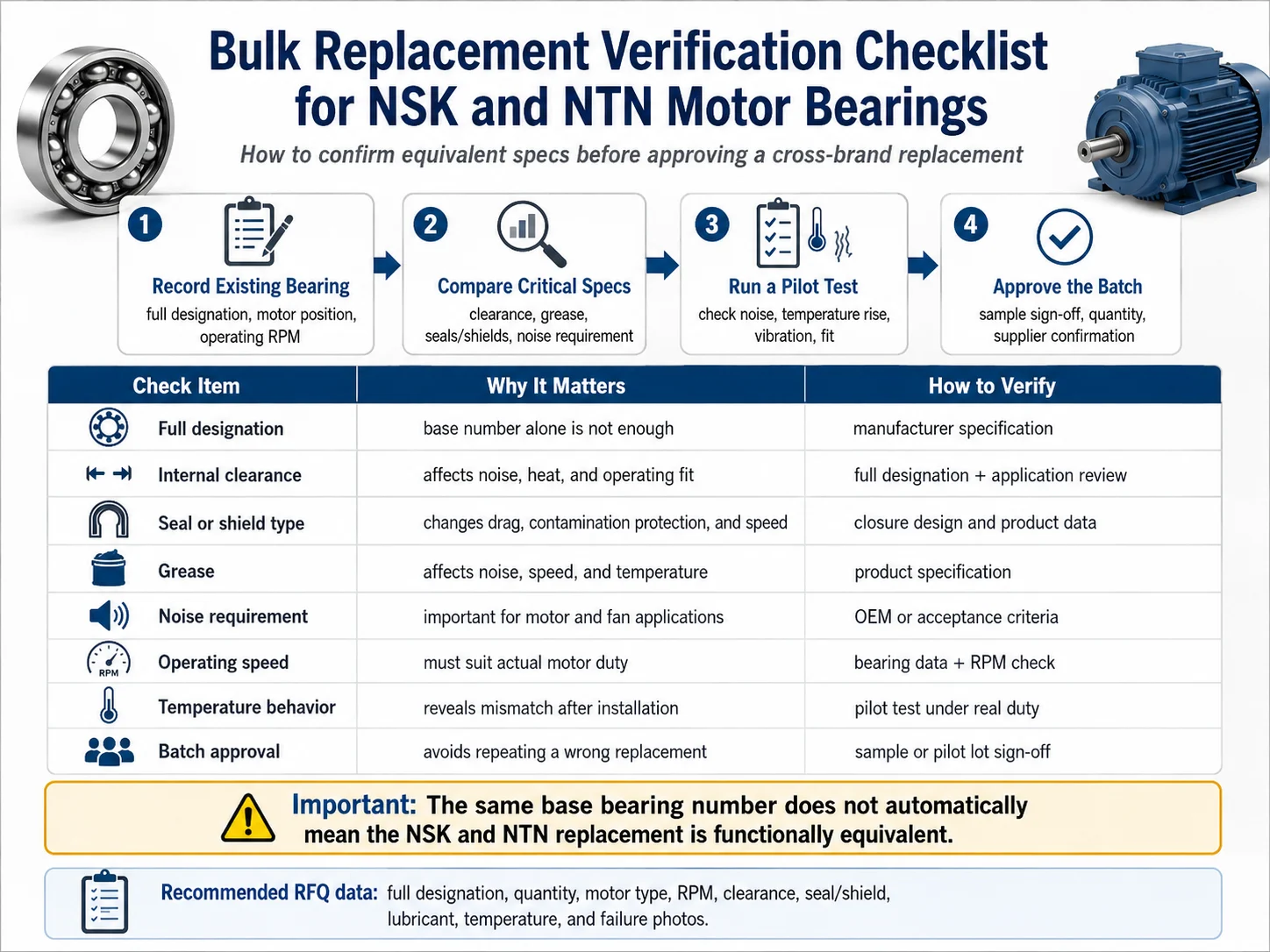
Approve a Sample or Pilot Lot Before Full-Batch Replacement
When changing from NSK to NTN or from NTN to NSK in a specification-sensitive motor application, a sample or controlled pilot lot provides an opportunity to verify the proposed replacement before committing to the full quantity.
The trial should reproduce the key acceptance conditions that matter to the buyer. A motor manufacturer may emphasize noise and temperature consistency. A repair operation may focus on fit, running temperature, vibration, and repeatability. A distributor fulfilling an OEM specification may need to verify the exact designation and supporting product documentation before accepting an alternative.
The important point is to define what “approved” means before testing starts. If the original motor runs quietly at its normal duty, a proposed replacement that produces a clearly different sound or temperature pattern deserves investigation even if the bearing dimensions are correct.
Define Batch Acceptance Criteria Before the Purchase Order
Use a documented comparison before approving the bulk order:
| Check | Existing Bearing | Proposed Replacement | Verification Method |
|---|---|---|---|
| Full designation | NSK or NTN | Proposed NTN or NSK | Manufacturer specification |
| Principal dimensions | Existing data | Replacement data | Drawing or catalog |
| Internal clearance | Existing specification | Proposed specification | Full designation/product data |
| Seal or shield | Existing closure | Proposed closure | Contact/non-contact design |
| Grease | Existing requirement | Proposed lubricant | Product specification |
| Noise requirement | Existing/OEM requirement | Proposed configuration | Application acceptance criteria |
| Operating speed | Actual motor duty | Bearing capability | Manufacturer data |
| Temperature behavior | Existing baseline | Trial result | Pilot operation |
| Batch approval | Current product | Replacement lot | Sample/pilot review |
This matrix prevents a common purchasing error: treating every characteristic as either “same” or “different.” Dimensions may need an exact match, while grease or seal design may be acceptable if the proposed configuration meets the application requirement. Conversely, a dimensionally identical bearing may still be unsuitable if the closure, clearance, or lubricant changes the motor’s operating behavior.
What Should Buyers Include in an NSK-to-NTN Replacement RFQ?
A replacement RFQ should give the supplier enough information to check the proposal instead of guessing from a base number.
Include:
-
Existing full bearing designation
-
Proposed replacement number, if already identified
-
Motor or equipment application
-
Drive-end or non-drive-end position, where relevant
-
Motor RPM
-
Shaft and housing information when available
-
Internal-clearance requirement
-
Seal or shield configuration
-
Lubricant requirement, if specified
-
Noise or vibration requirement
-
Typical operating temperature
-
Current failure symptoms, if the replacement follows a problem
-
Required production or maintenance quantity
-
Sample or pilot quantity
-
Required delivery date
-
Clear photographs of the old bearing marking when identification is uncertain
The LQYS bearing RFQ checklist provides a broader format for replacement, OEM, and multi-brand inquiries and specifically notes that incomplete part numbers can lead to quotations for bearings that share a basic number but differ in clearance, seals, cage, lubrication, or suitability.
How to Evaluate a Supplier for Bulk Motor Bearing Replacement
A supplier handling a cross-brand motor bearing replacement should be evaluated on the quality of the specification review, not simply on how quickly a price is returned.
What Should a Supplier Verify Before Recommending a Cross-Brand Replacement?
A useful supplier review should start with the complete existing designation. The supplier should identify whether the proposed item is an exact specified match or an alternative that still requires application approval. Questions about internal clearance, seals or shields, lubrication, noise requirements, speed, temperature, and quantity are signs that the supplier is treating the inquiry as a technical replacement rather than a dimensional lookup.
LQYS Bearings is operated by Shanghai Yongheshun Import and Export Co., Ltd., whose website lists bearing production, sales, trade, and export activities and includes ball bearings among its industrial product categories. LQYS Bearings can therefore serve as a sourcing point for bearing inquiries, while the suitability and availability of a specific NSK or NTN replacement should be confirmed for each requested designation and application.
For a large order, ask the supplier to identify any unverified assumption. If noise class, lubricant, seal design, or another specification cannot be confirmed, it is better to label the item as a proposed alternative requiring validation than to present it as automatically interchangeable.
Conclusion
NSK vs NTN electric motor bearing replacement should be decided by functional specification, not by brand reputation or base bearing number alone. A reliable bulk-replacement process compares the full designation, internal clearance, fit, grease, seal or shield, noise requirement, speed, and temperature behavior, then verifies the candidate in a sample or pilot lot before expanding the change across the full batch.
For an NSK-to-NTN or NTN-to-NSK replacement inquiry, LQYS Bearings can review the purchasing information provided for the requested bearing. Buyers can request a bearing replacement review with the full designation, motor speed, quantity, operating conditions, photographs, drawings where available, and any noise, temperature, vibration, or failure observations. The more complete the specification, the easier it is to distinguish an exact requirement from an alternative that still needs application validation.
Frequently Asked Questions
Can I replace an NSK electric motor bearing with an NTN bearing?
Possibly, but matching the basic number and dimensions is not enough. Compare the complete designation, internal clearance, seals or shields, grease, motor speed, noise requirement, and operating conditions. For bulk replacement, validate the proposed alternative before approving the full quantity.
Does C3 mean the same thing on NSK and NTN motor bearings?
C3 refers to greater-than-normal radial internal clearance, but it does not prove that two complete bearing configurations are equivalent. NTN specifically distinguishes C3 clearance from shaft or housing fit. Other specifications such as seals, lubricant, noise requirements, and the resulting operating clearance still need review.
Why does an electric motor run hotter after a bearing replacement?
Possible causes include changed operating clearance, a tighter fit, different seal drag, unsuitable or excessive grease, mounting problems, alignment, or changed operating conditions. If the temperature behavior changes after a cross-brand replacement, investigate the complete installation and bearing specification rather than assuming the new brand is the cause.
Should buyers test replacement bearings before placing a bulk order?
For motor applications with defined noise, temperature, speed, vibration, or production-consistency requirements, a sample or pilot lot can reduce the risk of multiplying a specification error across the complete order. Acceptance criteria should be established before the trial so engineering and purchasing teams use the same basis for approval.