

SKF Explorer Spherical Roller Bearings: What “Explorer” Means and When a Higher-Spec Version Is Worth It
2026-08-28
SKF Explorer spherical roller bearings are sometimes discussed as if “Explorer” were a separate premium option beside a standard SKF bearing. That is no longer the most useful way to make a purchasing decision. SKF states that its current spherical roller bearings are made to Explorer performance-class specifications, so the practical question is usually which execution fits the operating conditions: open, sealed, or an application-specific variant such as VA405 or VA406.
For engineers, maintenance teams, OEM buyers, and industrial purchasers, selection should start with the operating risk rather than the product label. An under-specified bearing may fail early, while an unnecessarily specialized version may add cost without addressing the actual problem.
What Does “SKF Explorer” Mean for Spherical Roller Bearing Selection?
SKF uses Explorer as a performance-class concept for its current spherical roller bearing range. Buyers therefore should not assume there is a simple current choice between “standard SKF” and “SKF Explorer.” The more useful comparison is between the required bearing execution and the conditions in which it must operate.
Are All SKF Spherical Roller Bearings Explorer Today?
SKF’s current product information states that all SKF spherical roller bearings have been upgraded to Explorer specifications. This matters when replacing an older bearing, reviewing an old equipment manual, or comparing quotations that use different terminology.
The full designation still matters. Bore design, internal clearance, cage, sealing arrangement, lubrication features, and application-specific suffixes can change what the bearing is intended to do. A buyer should therefore verify the complete specification rather than order from the word “Explorer” alone.
The spherical roller bearing range can help establish the correct bearing family before moving into variant selection. LQYS product information describes spherical roller bearings for heavy loads, misalignment, shock and vibration, including applications in heavy machinery, mining equipment, and industrial gearboxes.
Why Do Spherical Roller Bearings Fail Early—and When Does a Higher-Spec Design Help?
A higher-spec bearing creates value only when its design addresses a real operating risk. Premature spherical roller bearing failure can be associated with contamination, inadequate lubrication, excessive vibration, unsuitable fit or clearance, damaged shaft or housing seats, or an operating condition that was never corrected during replacement.
Contamination, Grease Loss, and Difficult Relubrication
Sealed SKF Explorer spherical roller bearings are intended for applications where keeping lubricant in and contaminants out is important. SKF positions sealed spherical roller bearings as a way to reduce failure risk in demanding operating conditions.
A sealed design deserves consideration in dusty or wet environments, dirty process areas, hard-to-reach lubrication points, or equipment where frequent regreasing is difficult. It is not automatically the better choice for every machine. Speed, temperature, lubricant, seal execution, dimensions, and application limits still need verification.
If an open bearing is failing because of contamination, inspect the housing seals and lubrication system before assuming a sealed bearing alone will solve the problem. Dirt or moisture can also enter through damaged external seals, poor mounting practice, or contaminated lubricant.
High Vibration, Acceleration, and Fretting Risk
Vibrating screens, feeders, and similar equipment can impose much stronger acceleration than ordinary rotating machinery. SKF identifies VA405 spherical roller bearings for vibratory applications. VA406 is based on VA405 but adds a PTFE-coated cylindrical inner-ring bore intended to reduce fretting corrosion between the shaft and bearing bore.
Not every vibrating machine requires VA405 or VA406. Acceleration, shaft fit, internal clearance, speed, load, and failure evidence should be reviewed first. If fretting is visible on the bore or shaft seat, VA406 may become relevant, but a damaged shaft seat or unsuitable fit still requires correction.
Open vs Sealed vs VA405/VA406: Which SKF Explorer Design Should You Choose?
Selection becomes clearer when the operating condition is matched to the risk each design is intended to manage. SKF provides open and sealed spherical roller bearings, while VA405 and VA406 are specific executions for vibratory service.
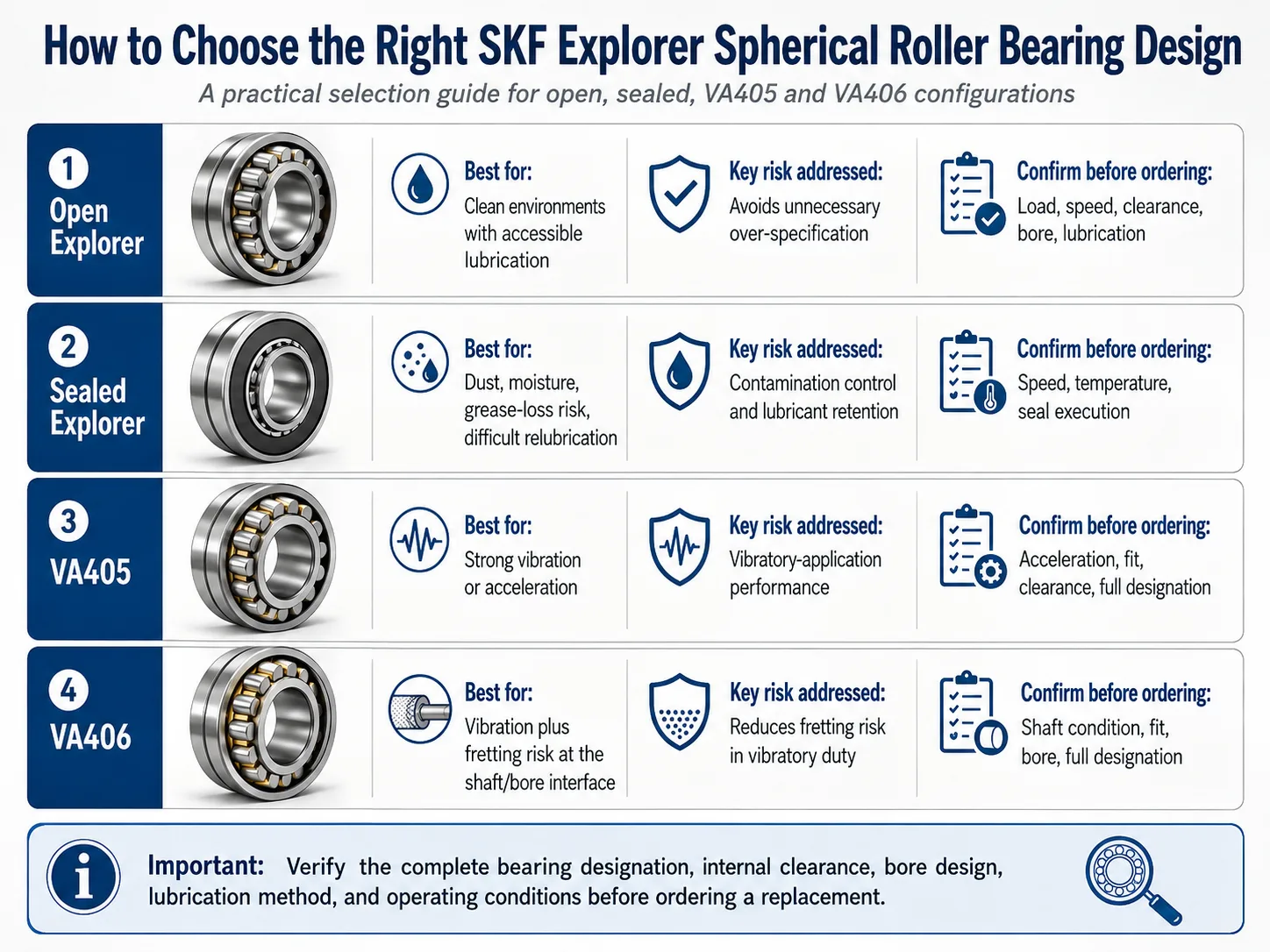
| Operating Condition | First Design to Evaluate | Main Reason | Confirm Before Ordering |
|---|---|---|---|
| Clean environment and accessible lubrication | Open Explorer | Avoid unnecessary specialization | Load, speed, clearance, bore, lubrication |
| Dust, moisture, grease-loss risk, or difficult relubrication | Sealed Explorer | Contamination control and lubricant retention | Speed, temperature, seal execution |
| Strong vibration or acceleration | VA405 | Vibratory-application design | Acceleration, fit, clearance, full designation |
| Vibration plus fretting risk at the shaft/bore interface | VA406 | Vibratory design with PTFE-coated bore | Shaft condition, fit, bore, full designation |
Open vs Sealed SKF Explorer Bearings
An open design can be appropriate where external sealing controls contamination and the lubrication system is accessible and dependable. A sealed bearing becomes more attractive where contamination exclusion and grease retention are difficult to manage externally. SKF specifically describes sealed Explorer spherical roller bearings for operating challenges that can include high loads, misalignment, poor lubrication, contaminants, and moisture.
The common purchasing mistake is treating “sealed” as a universal upgrade. The exact bearing still needs to be checked against speed, temperature, dimensions, lubricant, and the relevant product specification.
VA405 vs VA406 for Vibratory Applications
VA405 is an SKF designation for spherical roller bearings developed for vibratory applications. VA406 shares the VA405 application concept but adds a PTFE-coated cylindrical bore.
For buyers, the practical questions are whether the machine truly needs a vibratory-duty execution and whether fretting at the shaft-to-bore interface is a significant risk. Inspect the removed bearing, shaft seat, and wear pattern, then provide the complete designation and operating conditions with the RFQ. Equipment type alone is not enough to confirm the correct variant.
When Is a Higher-Spec Bearing Actually Worth the Cost?
A higher-spec execution is easier to justify when bearing failure creates significant maintenance labor, difficult access, repeated lubrication work, production interruption, or costly unplanned replacement.
Compare Total Cost of Ownership, Not Bearing Unit Price
A useful comparison includes bearing acquisition cost, lubrication, scheduled maintenance, replacement labor, planned shutdown time, and the consequences of unplanned failure. SKF’s sealed-bearing information emphasizes reliability and maintenance considerations rather than unit price alone.
No fixed ROI should be assumed without application data. Duty cycle, maintenance practice, bearing size, accessibility, and failure history can change the economics substantially. A higher purchase price is easier to justify when the selected execution addresses a documented failure mechanism rather than a hypothetical risk.
When Standard/Open Explorer Is Already Enough
A specialized execution is not justified simply because it is available. Open Explorer can remain appropriate in clean, controlled conditions with suitable external sealing and dependable lubrication. Likewise, VA405 or VA406 should not be specified merely because a machine produces normal operating vibration.
If failures continue after repeated replacement, review fit, alignment, lubrication, contamination, operating clearance, shaft and housing condition, and actual load or vibration. A more expensive bearing will not correct an unresolved installation or system problem.
How to Prevent Premature Failure When Replacing a Spherical Roller Bearing
Verify Designation, Clearance, Bore, Fit, and Lubrication as One System
A replacement bearing should not be selected from bore, outside diameter, and width alone. Bearings with similar principal dimensions may differ in internal clearance, bore design, cage, sealing, lubrication features, and application-specific suffixes. The LQYS complete bearing designation and suffix guide explains why these codes should be treated as part of the specification rather than optional ordering information.
Before ordering, record the full marking on the removed bearing and photograph the bearing and shaft seat. Confirm machine position, speed, temperature, lubrication, contamination, vibration, and failure symptoms. If the original bearing failed prematurely, inspect the shaft and housing before installing an identical replacement. A correct part number cannot compensate for a damaged seat or unresolved lubrication problem.
How to Choose an SKF Spherical Roller Bearing Supplier
A B2B bearing supplier should do more than quote a base number. A useful technical review should ask for the complete designation, quantity, application, operating conditions, and delivery requirements and identify missing information that could change the required configuration.
What Should a Supplier Verify Before Recommending a Bearing?
For replacement and OEM inquiries, the review should distinguish an exact match from a proposed alternative and confirm clearance, bore, sealing, cage, lubrication, and application-specific execution where relevant. Two bearings should not be assumed interchangeable simply because their principal dimensions match.
Shanghai Yongheshun Import and Export Co., Ltd. presents LQYS Bearings as a business integrating bearing production, sales, trade, and export, while its website includes spherical roller bearings among its industrial product categories. Order-specific product and supply details should still be confirmed for each inquiry.
Before requesting pricing, prepare the full bearing designation and quantity, equipment type and bearing position, speed, load information where available, temperature, vibration, lubrication, contamination conditions, and any failure photographs. Drawings or a sample can help when identification is uncertain. Required delivery date, destination, and documentation requirements should also be stated.
The bearing RFQ checklist provides a more detailed structure for replacement, OEM, and specification-driven bearing inquiries.
Conclusion
SKF Explorer spherical roller bearing selection is no longer a simple “standard versus Explorer” choice. A stronger purchasing approach is to identify the operating risk first and then select the execution that addresses it: open for controlled conditions, sealed where contamination and lubrication are significant concerns, and VA405 or VA406 where vibratory service creates specific requirements.
LQYS Bearings can be considered when an industrial buyer needs to identify a spherical roller bearing requirement and prepare a sourcing inquiry. For a replacement or new application, use the request a bearing quote channel with the full designation, quantity, machine information, operating conditions, drawings or photographs, and observed failure evidence. Providing that information allows the specification to be clarified before price becomes the deciding factor.
Frequently Asked Questions
Are all SKF spherical roller bearings Explorer?
SKF states that all of its spherical roller bearings are made or upgraded to Explorer performance-class specifications. Buyers should focus on the complete designation, execution, sealing, clearance, bore, and application requirements rather than treating Explorer as a separate current product tier.
Is a sealed SKF Explorer spherical roller bearing always better than an open bearing?
No. Sealed bearings can be useful where contamination exclusion and lubricant retention are important, but the correct choice depends on speed, temperature, lubrication, sealing arrangement, dimensions, and operating environment. Open bearings can remain appropriate where external sealing and maintenance are well controlled.
What is the difference between SKF VA405 and VA406 spherical roller bearings?
Both are intended for vibratory applications. SKF’s designation information states that VA406 is based on VA405 but includes a PTFE-coated cylindrical inner-ring bore. Selection should still be verified against the machine, shaft fit, vibration conditions, and complete bearing specification.
What information is needed to order an SKF Explorer spherical roller bearing?
Provide the complete bearing designation, quantity, application, speed, available load information, temperature, vibration, lubrication, contamination conditions, and delivery requirements. For an unclear replacement or premature failure, include clear photographs, dimensions, drawings, or a sample when available.