

THK Linear Guide Replacement: Rail Accuracy, Block Fit, Seals, and Supplier Checks
2026-07-10A THK linear guide replacement usually starts with a practical problem: a CNC machine becomes noisy, an automation line loses smooth travel, a guide block feels tight on the rail, or the original part becomes difficult to source on time. For B2B buyers, the risk is not limited to finding a rail or block with a similar model number. Rail accuracy, block fit, preload, mounting hole spacing, seals, lubrication, and contamination protection all affect whether the replacement linear guide will run properly after installation.
Why Linear Guide Replacement Fails Even When the Model Looks Similar
Same Size Does Not Always Mean Same Running Behavior
A linear guide replacement may appear simple when the rail width, block size, and mounting space look close to the original unit. In actual maintenance and OEM purchasing, that is not enough. Rail profile, raceway geometry, block preload, mounting hole pitch, block height, lubrication access, and seal structure can all affect running behavior.
This is why a linear guide block replacement can fail even when the part slides onto the rail. The guide may feel rough at one end of travel, produce abnormal noise, or create positioning errors after installation. In CNC machine tools, automation equipment, measuring instruments, packaging systems, and production fixtures, those small differences can lead to repeated adjustment work and machine downtime.
Common Symptoms After a Poor Replacement
Several warning signs should be checked before blaming the machine itself. A replacement block that feels too tight may point to preload mismatch, rail wear, or an incompatible rail profile. Noise after installation may come from contamination, dry running, poor alignment, or a damaged rail surface. A guide that moves smoothly by hand but loses accuracy under load may have a rail accuracy or mounting base problem.
These symptoms show why THK linear rail replacement should be treated as a complete system check, not only a purchasing task.
Rail Accuracy and Mounting Dimensions Buyers Must Confirm

Rail Length, Width, and Mounting Hole Pitch
Before ordering, buyers should confirm rail width, total rail length, mounting hole pitch, end distance, bolt size, and whether the rail uses top mounting or bottom mounting. A rail that is only a few millimeters different in end distance or hole spacing can create installation delays, especially when the machine base has already been drilled.
For repair teams, photos and measured drawings are useful when the original rail marking is unclear. For OEM buyers, confirmed mounting dimensions help prevent batch assembly issues. A supplier cannot reliably review a THK linear guide alternative supplier request without these details.
Accuracy Grade and Running Parallelism
Linear guide rail accuracy affects travel smoothness, repeatability, and machine alignment. Precision applications, such as CNC machining, inspection equipment, measuring instruments, and positioning tables, require closer attention than general handling equipment. The required accuracy level should be verified against the machine’s design and the expected operating condition.
A lower-suitability replacement may move, but it may not hold the machine’s required repeatability. A higher-specification guide may also be unnecessary for non-critical fixtures. The right choice depends on load, speed, stroke length, installation base, and positioning requirements.
Rail Surface Condition and Installation Base
Replacing only the block may not solve the problem if the existing rail is worn, scratched, rusted, dented, or contaminated. Metal chips, coolant residue, abrasive dust, and poor lubrication can damage the rail surface and ball circulation path. In that case, a new block installed on an old rail may become noisy quickly.
The installation base should also be checked. A bent mounting surface, burrs around bolt holes, poor alignment, or uneven tightening can distort the rail and create rough travel even when the replacement guide is suitable.
Block Fit, Preload, and Interchange Risk
Why Block and Rail Matching Matters
Linear guide block fit depends on more than the external size of the block. Raceway geometry, preload, ball circulation structure, block style, and rail profile must work together. A block that appears to fit may still fail to deliver the required motion quality or accuracy.
This is the main risk in linear guide rail and block replacement. Buyers should avoid assuming that a similar-looking block is a direct replacement. The original model number, rail dimensions, block type, preload requirement, and application should be reviewed together.
When to Replace the Rail and Block as a Set
Replacing only the linear guide block may be acceptable in some maintenance situations when the rail is clean, unworn, and not accuracy-critical. However, when the rail has visible wear, corrosion, dents, contamination damage, or unknown service history, replacing the rail and block as a set can reduce assembly risk.
For OEM projects or repeat replacement programs, set-based sourcing also helps keep preload, motion smoothness, and mounting consistency under better control. This is especially useful when equipment is produced or repaired in batches.
Block Type and Space Constraints
Square blocks, flange blocks, long blocks, short blocks, and different mounting directions can affect whether the replacement fits inside the machine. A flange block may be easier to mount in one design, while a square block may suit a compact machine structure. Buyers should confirm block height, mounting hole layout, grease nipple position, and nearby space before approving an order.
Seals, Scrapers, and Contamination Protection
When Standard Seals May Not Be Enough
Contamination is one of the most common reasons linear guides fail in CNC machines and automation equipment. Coolant, metal chips, wood dust, packaging debris, and fine abrasive particles can enter the block area and damage rolling surfaces. A linear guide seal for CNC machine applications should be selected with the working environment in mind, not only the original model number.
Standard seals may be enough for clean automation equipment, but exposed cutting, milling, drilling, woodworking, or coolant-heavy environments often need stronger protection. If contamination caused the original failure, ordering the same structure without reviewing protection may repeat the problem.
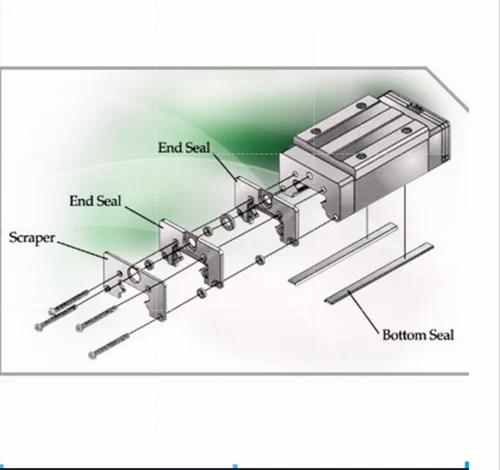
What Protection Details Buyers Should Ask About
Buyers should ask whether the replacement can support end seals, side seals, inner seals, metal scrapers, rail caps, cover strips, bellows, lubrication units, or grease nipples where the application requires them. These details should not be treated as accessories after the order is placed. They affect block dimensions, installation space, maintenance access, and service behavior.
Corrosion resistance should also be reviewed when equipment works in humid, wet, washdown, or coolant-heavy environments. Material and surface protection may vary by size, load, and configuration, so the selection should be checked against the real application.
Lubrication and Maintenance Checks Before Replacement
Check Lubrication Before Blaming the Guide
A linear guide block noisy after replacement may be caused by insufficient lubrication, incorrect grease, blocked lubrication paths, or dry running. Some machines use centralized lubrication, while others depend on manual greasing or self-lubricating units. If lubrication access is poor after installation, maintenance may be skipped, and the guide may wear early.
Before ordering, buyers should confirm grease nipple position, lubrication method, maintenance interval, and available space around the block. A replacement that fits mechanically but cannot be maintained properly may create a new failure point.
Supplier Checks Before Ordering a THK Linear Guide Alternative
When the Original Specification Should Be Followed
The original specification should be followed for warranty-controlled equipment, high-precision CNC machines, measuring instruments, high-speed automation, or machines where testing time is limited. In these cases, a replacement decision should be conservative because the cost of downtime may exceed the savings from a lower-cost alternative.
When an Alternative Supplier Can Be Evaluated
An alternative supplier may be evaluated for standard automation equipment, non-critical fixtures, maintenance stock, batch replacement, or long-term sourcing plans. The evaluation should confirm rail dimensions, block type, preload, accuracy grade, seals, lubrication method, mounting details, and working environment before purchase.
The safest inquiry includes the original model number, rail length, rail width, block photos, mounting hole pitch, end distance, accuracy requirement, preload requirement, machine type, environment, drawings, sample parts, and target quantity.
How LQYS Bearings Can Support Linear Guide Replacement Sourcing
For buyers sourcing replacement guides in volume, supplier support matters as much as product similarity. A qualified supplier should review the full model, dimensions, photos, block type, rail material, seal requirements, quantity, and application conditions before quotation.
LQYS Bearings supplies linear bearings for applications such as CNC machine tools, automation equipment, and measuring instruments. The linear bearing product range includes options related to square and flange types, seals or self-lubricating units, and guide arrangements that should be selected according to the working environment and purchasing requirements.
Shanghai Yongheshun Import and Export Co., Ltd. integrates production, sales, trade, and export. For OEM buyers, distributors, and maintenance teams, this background supports practical communication around product review, sourcing requirements, and replacement details. Buyers can request linear guide replacement support by sending model numbers, rail dimensions, block photos, drawings, working conditions, target quantity, and replacement purpose for product suggestions, samples, quotations, or sourcing support.
Conclusion
A THK linear guide replacement should not be decided by model similarity alone. Rail accuracy, block fit, mounting hole spacing, preload, seals, lubrication, contamination protection, and supplier confirmation all affect whether the guide will run smoothly after installation.
Before confirming an order, buyers should collect the full model number, rail dimensions, block type, photos, drawings, machine type, operating environment, and target quantity. This gives the supplier enough information to review compatibility and reduce the risk of wrong parts, repeated installation work, or early guide failure.
FAQs
Q1: Can I replace only the linear guide block without changing the rail?
A1: Sometimes, but it depends on rail wear, rail accuracy, block compatibility, preload, and application precision. If the rail is damaged, contaminated, rusty, or accuracy-critical, replacing the rail and block together may be safer.
Q2: Why is my linear guide block noisy after replacement?
A2: Noise after replacement may come from preload mismatch, rail wear, poor alignment, contamination, insufficient lubrication, or a block that does not properly match the rail profile. The rail surface and installation base should be checked before ordering another block.
Q3: What should I check before ordering a THK linear guide replacement?
A3: Check rail width, rail length, mounting hole pitch, end distance, block type, preload, accuracy grade, seals, lubrication method, machine type, working environment, and target quantity. Photos or drawings can help the supplier review the request more accurately.
Q4: What seal is needed for a linear guide in CNC machines?
A4: CNC machines often need stronger contamination protection because coolant and metal chips can enter the guide block. Buyers should review end seals, side seals, scrapers, rail caps, covers, or bellows based on the machine environment.
Q5: Can an alternative supplier provide a linear guide replacement?
A5: An alternative supplier can be evaluated when dimensions, accuracy, preload, block type, seals, lubrication, and application conditions are confirmed. Critical machines may still require the original specification or testing before batch use.