
Bearing Test Reports and Certificates: What Industrial Buyers Should Review Before Shipment
2026-07-30

A bearing inspection report should not be approved simply because it carries a supplier logo and a PASS result. Before releasing an industrial bearing shipment, buyers must identify the document type, confirm who issued it, match it to the purchase order and shipment batch, and review the actual inspection scope. A certificate that is useful for one standard replacement order may be insufficient for a precision spindle, critical gearbox, continuous-duty motor, or high-value project bearing. The required documents should therefore be defined before the order is placed—not requested for the first time when the goods are ready to ship.
Why a “Bearing Test Report” Is Not One Standard Document
Industrial buyers often use “test report,” “inspection report,” and “certificate” interchangeably, but the documents may provide very different levels of evidence. The document title alone does not reveal whether the bearing was measured, whether the results relate to the shipment, or whether the issuer is the manufacturer, supplier, or an independent inspection company.
Inspection Report vs. Certificate of Conformity vs. Material Certificate
A bearing quality inspection report normally records selected inspection results. Depending on the order, it may include dimensions, internal clearance, running accuracy, appearance, markings, packaging, or other agreed characteristics.
A certificate of conformity, or CoC, is generally a declaration that the supplied product conforms to specified requirements. It may be acceptable for a standard catalog order, but buyers should not assume it contains individual measurements.
A material certificate focuses on material-related information. It does not automatically verify the finished bearing’s dimensions, clearance, noise, vibration, or rotational accuracy.
| Document | What it may support | What buyers should not assume |
|---|---|---|
| Inspection report | Results from specified checks | That every bearing was inspected |
| Certificate of conformity | Declaration of compliance | That actual measurements are included |
| Material certificate | Material or batch information | That finished-bearing performance was tested |
| Manufacturer data | Product-specific factory records | That all products and orders include the same data |
| Supplier QC report | Checks performed by the supplier | That it is an original manufacturer report |
An ISO 9001 certificate is also not a substitute for an order-specific bearing test report. ISO describes ISO 9001 as a quality management system standard rather than certification that an individual product meets its technical specification.
Manufacturer Data vs. Supplier QC Report vs. Third-Party Inspection
Manufacturer data originates from the bearing producer and may be linked to a particular product, serial identifier, batch, or special order. Availability depends on the brand, series, packaging, and purchasing agreement.
A supplier QC report records checks performed by a distributor, trading supplier, or sourcing company. It can provide useful evidence for quantity, markings, dimensions, packaging, or visible condition, but it should be clearly identified as supplier inspection rather than manufacturer data.
Third-party pre-shipment inspection can add independence when the order is valuable, technically critical, supplied by a new source, or divided across multiple brands and batches. These inspections normally follow the buyer’s inspection plan, specification, or applicable standard and may verify quality, quantity, packaging, documentation, and agreed tests. They do not automatically verify every internal material or fatigue-life characteristic.
How to Verify That the Report Matches the Actual Bearing Shipment
A detailed report has little value if it belongs to a different model, an earlier batch, or a sample that is unrelated to the goods being shipped.
Match the Brand, Full Designation, Quantity, and Batch
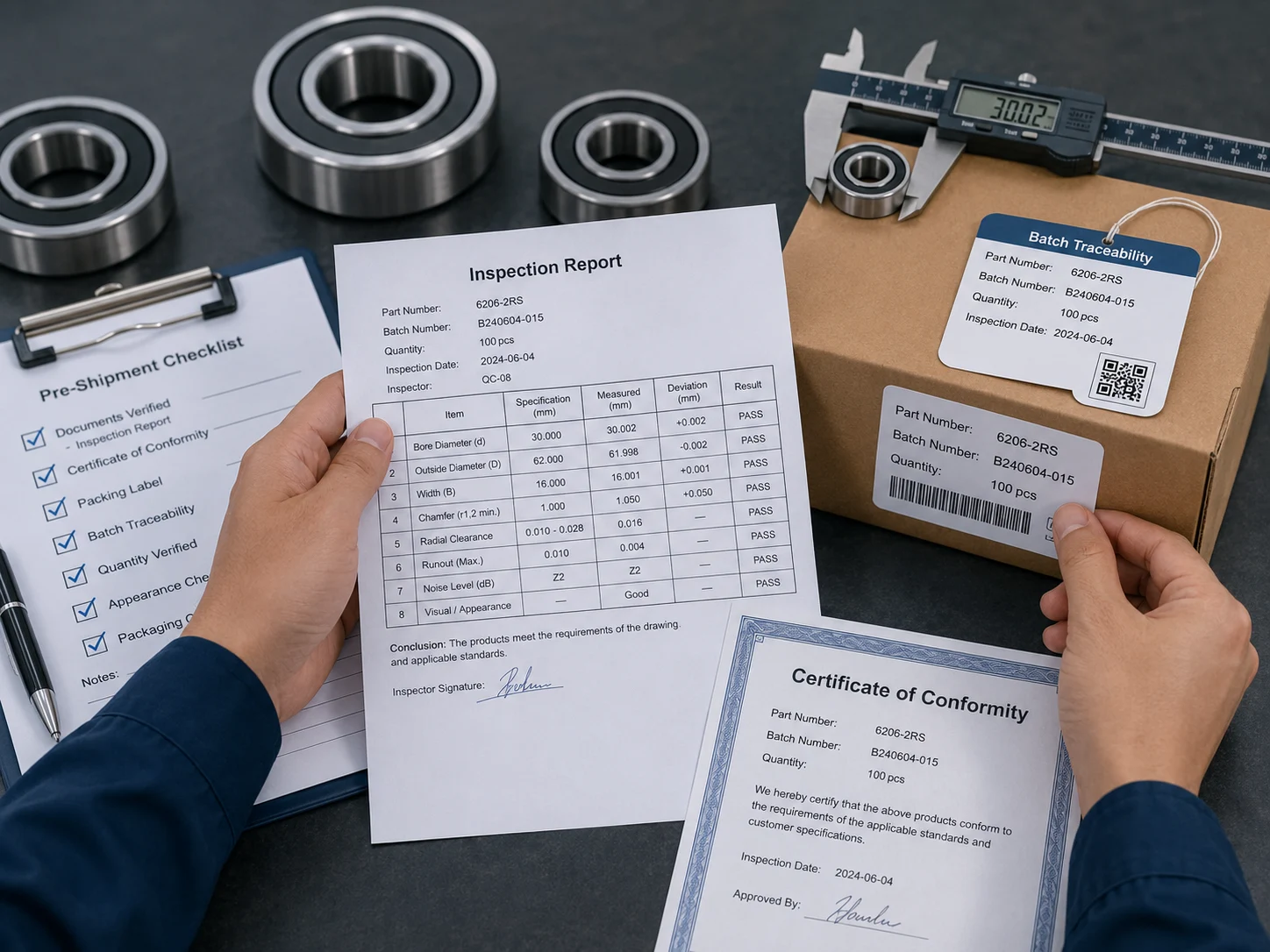
Compare the report with the purchase order, quotation, individual boxes, outer cartons, packing list, and shipment photographs. The following information should agree:
-
Required brand
-
Complete bearing designation
-
Clearance, seal, shield, cage, bore, precision, or lubrication suffixes
-
Ordered and inspected quantity
-
Batch, lot, serial, or traceability identifier where available
-
Packaging type
-
Shipment reference
A basic bearing number does not fully identify the supplied configuration. Bearings with the same principal dimensions may differ in internal clearance, closures, cage design, bore form, lubrication features, or other details. Buyers reviewing SKF, NSK, or FAG codes can use a complete bearing designation and suffix guide when the report or packaging includes unfamiliar suffixes. LQYS has separately documented how suffixes such as C3, 2RS, ZZ, DDU, K, W33, M, and TVP can change the ordered configuration.
If the shipment contains split boxes, repacked items, mixed batches, or partial quantities, the report should explain how the inspected samples relate to each group. Unexplained mismatches should result in HOLD status until corrected.
Check the Issuer, Date, Sample Size, and Inspection Method
A usable bearing inspection report should identify who performed the inspection and who approved the result. The report date should also make sense in relation to production, packing, and the planned shipment date.
Buyers should determine whether the report represents:
-
One reference sample
-
A defined random sample
-
One sample from each batch
-
A larger risk-based sample
-
Inspection of every bearing
No single sampling percentage is suitable for all bearing orders. The appropriate scope depends on quantity, product value, application risk, batch structure, supplier history, and contractual requirements.
The report should also state the inspection method or reference specification. A result such as “bore: PASS” is less useful than a record showing the requirement, tolerance, actual value, sample identification, and decision. If sample size, method, date, or issuer is missing, the buyer should request clarification rather than assume the whole shipment has been tested.
Which Bearing Measurements Should Buyers Review Before Shipment?
The inspection scope should reflect the bearing type and the intended application. Requiring every possible test adds cost without necessarily reducing the relevant risk, while a generic visual inspection may be inadequate for a precision or safety-critical order.
Dimensions, Running Accuracy, and Internal Clearance
Boundary dimensions such as bore, outside diameter, and width are common inspection items, particularly for replacement orders where installation space is fixed.
Running accuracy or runout may be important for machine-tool spindles, precision equipment, high-speed assemblies, or applications with strict shaft-positioning requirements. Internal clearance may require confirmation where the ordered suffix, shaft fit, housing fit, temperature, or operating speed makes working clearance critical.
For each required characteristic, the report should ideally show:
-
Inspection item
-
Reference drawing or specification
-
Required value or tolerance
-
Actual result
-
Sample or bearing identification
-
Acceptance decision
NSK provides a useful example of product-linked inspection data. For supported bearings and applicable 2D-coded packaging, the NSK Verify service can provide a unique identification number, dimensional measurements, and running-accuracy data, with information exportable in PDF or CSV format. The service is limited to supported products, so its availability should be confirmed before ordering.
Noise, Vibration, Grease, Appearance, and Packaging Checks
Noise or vibration data may be relevant for low-noise motors, fans, machine tools, medical equipment, or other precision rotating systems. It may have little purchasing value for an ordinary low-speed heavy-duty application unless the order includes a specific acceptance requirement.
For prelubricated or sealed bearings, buyers may also need confirmation of the ordered grease or closure configuration. Appearance inspection can identify rust, contamination, impact damage, damaged seals, altered markings, or poor packaging, but manually rotating a bearing is not a substitute for an agreed noise, vibration, or running-accuracy test.
Packaging and label review can reveal mismatched models, quantities, batches, or configurations. It cannot by itself prove that a branded bearing is genuine. Questions about source transparency, abnormal prices, labels, and authenticity should be handled through a separate genuine branded bearing procurement process.
What SKF, NSK, and FAG Buyers Can Realistically Request
Documentation availability should be confirmed by product and order. Buyers sourcing SKF, NSK, and FAG bearings should not assume that all three brands provide identical certificates or individual test reports for every catalog item.
NSK Inspection Data for Supported Bearings
For supported NSK products, inspection information may be accessed through the NSK Verify application by scanning the applicable code on the bearing box. Available information can include product identification, dimensional measurement, and running-accuracy data.
Buyers should still match the data with the complete purchase-order designation and the physical packaging. A box without supported data does not automatically indicate nonconformity because the service does not cover every NSK product or package. The required report availability should be confirmed at the quotation stage.
FAG Reports and EN 10204 Certificates for Applicable Orders
Detailed measuring reports and EN 10204 certificates are more likely to appear in special, engineered, or large-bearing projects than in ordinary stock orders.
In one published Schaeffler case involving very large FAG bearings, the documentation included a quality inspection plan, production progress report, measuring report, and an EN 10204-3.1B test certificate. This demonstrates what may be available for a special project, but it should not be interpreted as the standard documentation supplied with every FAG bearing.
Buyers requiring this level of documentation should define it during RFQ review and confirm whether it affects price, manufacturing arrangements, or delivery.
Confirm SKF Documentation by Product and Order
SKF technical papers, quality-system certificates, development test information, supplier-quality documents, and shipment-specific bearing records serve different purposes. A general SKF certificate or technical test publication should not be treated as evidence that a specific batch has passed the buyer’s order requirements.
Public SKF supplier-quality requirements, for example, refer to inspection reports and traceability in defined supplier approval processes. That does not establish a universal report package for every SKF catalog bearing sold through every supply route.
Before approving an SKF quotation, buyers should ask what document is available, who issues it, whether it includes measured values, and whether it is connected to the actual product or shipment batch.
How to Decide Whether the Shipment Can Be Released
Document review should end with a clear disposition rather than an informal “looks acceptable” comment.
Use PASS, HOLD, REWORK, and REINSPECTION Decisions
Use PASS when the product identity, inspection scope, measured results, batch information, packaging, and required documents meet the purchase order.
Use HOLD when information is missing or inconsistent but the issue has not yet been confirmed as a product defect.
Use REWORK when a correctable matter—such as labels, packaging, quantity separation, or documentation—must be resolved before shipment.
Use REINSPECTION after rework, batch replacement, repacking, or an expanded sampling decision.
Use REJECT when a critical designation, dimension, configuration, or requirement is wrong and the risk cannot be closed through an approved corrective action.
The supplier’s overall PASS statement should not override an individual failed result. Final shipment release should remain with the buyer or the authorized quality representative named in the purchasing process.
When Third-Party Inspection Is Worth the Cost
Third-party bearing inspection is most useful for first orders, high-value bearings, critical equipment, unclear batch structures, or orders combining several brands and models.
It may not be proportionate for a small, standard replacement order from an established supply route. The inspection level should match the commercial and operational risk.
The buyer should provide the third party with the bearing list, approved specification, tolerances, sampling instructions, packaging requirements, and required tests. Otherwise, the inspector may complete a generic quantity and appearance check while missing the bearing characteristics that matter to the application. Third-party PSI reports typically give a detailed result and pass/no-pass conclusion based on the agreed inspection scope.
Bearing RFQ and Pre-Shipment Document Checklist
Before issuing the purchase order, specify:
-
Brand and complete bearing designation
-
Quantity and application
-
Required inspection items
-
Drawing, catalog, or reference specification
-
Required tolerances
-
Document type and issuer
-
Sampling scope
-
Batch and traceability requirements
-
Product, label, and packaging photographs
-
Report submission deadline
-
Approval required before shipment
-
Rules for substitutions, mixed batches, or repacking
-
Corrective-action and reinspection process
The supplier should confirm which documents are available, whether they contain actual measurements, whether they relate to the shipment batch, and whether additional testing affects cost or delivery.
How to Choose a Supplier That Supports Documented Bearing Orders
Verify Documentation Capability Before Comparing Price
A reliable supplier should distinguish manufacturer data, a certificate of conformity, an internal QC report, and a third-party inspection report. Statements such as “all certificates available” are not enough without identifying the document, issuer, product coverage, and inspection scope.
Shanghai Yongheshun Import and Export Co., Ltd. operates LQYS Bearings as a business integrating bearing production, sales, trade, and export. Its website also positions the company as a sourcing partner for international bearing brands alongside LQYS products. Documentation availability should still be confirmed by brand, full designation, quantity, and order requirement rather than assumed from a general supplier description.
Confirm Sample-to-Batch Consistency and Record Retention
An approved sample report does not automatically cover later batches. The production shipment should match the sample in brand, complete designation, suffix, packaging, and agreed configuration.
For repeat orders, confirm whether the supplier is using the same source and documentation route. A new batch, changed packaging method, alternative source, or revised specification may justify a new report.
The supplier should also retain enough order information to support traceability if a dimensional dispute, packaging mismatch, or quality complaint appears after delivery. This is especially important for multi-brand orders and shipments divided across several batches.
Conclusion
A bearing inspection report is useful only when its purpose, issuer, product identity, batch, inspection scope, and acceptance criteria are clear. Define the required documents during the RFQ, match every report to the full order code and shipment batch, review actual values rather than only PASS statements, and close all exceptions before release.
Buyers can request bearing documentation before shipment by submitting the brand, complete designation, quantity, application, required report type, inspection items, drawing or tolerance, batch requirements, and delivery date to LQYS Bearings.
Frequently Asked Questions
What should a bearing inspection report include?
It should identify the product, complete designation, order or batch, sample size, inspection items, requirements or tolerances, actual results, inspection method, date, issuer, and final decision.
Is a certificate of conformity enough for an industrial bearing order?
It may be sufficient for a standard, low-risk order if the purchasing agreement accepts it. Precision, high-value, critical, or specially manufactured bearings may require measured data, traceability, or independent inspection.
Do all SKF, NSK, and FAG bearings come with test reports?
No common report package should be assumed. Availability depends on the brand, series, packaging, order type, supply route, and agreed purchasing requirements.
When should buyers request third-party bearing inspection?
Consider it for a first order, critical application, high-value shipment, mixed-brand order, unclear batch structure, or supplier with limited previous performance data.
Can a supplier QC report prove that a branded bearing is genuine?
Not by itself. It may record dimensions, appearance, packaging, or other checks, but authenticity also depends on source verification, traceability, purchasing records, and applicable official authentication channels.