

Needle Bearing Inner Ring Size Guide: Dimensions, Fit and Selection
2026-07-31

Selecting a needle bearing inner ring requires more than matching shaft diameter. The replacement must also match the bearing’s roller-set bore, raceway diameter, width, shaft fit, axial location, and operating clearance. Missing one check can cause difficult assembly, looseness, overheating, noise, or repeat failure. This guide gives B2B buyers, engineers, maintenance teams, and distributors a practical method for identifying an inner race and preparing an accurate RFQ.
When Is a Separate Needle Bearing Inner Ring the Right Solution?
A separate inner ring is normally considered when a needle roller bearing needs a hardened, ground raceway but the shaft cannot provide one. It can also simplify maintenance when replacing a worn ring is more practical than remachining the shaft.
A bearing without an inner ring saves radial space when the shaft is already suitable as the raceway. LQYS notes that no-inner-ring designs use the shaft surface directly and therefore require appropriate hardness and grinding accuracy.
| Application condition | Suitable direction | Main purchasing check |
|---|---|---|
| Shaft cannot provide the raceway | Separate ring or complete bearing with inner ring | Shaft size, bearing series, radial space |
| Complete-unit replacement is preferred | needle roller bearings with inner rings | Full designation and installation dimensions |
| Shaft is already a qualified raceway | needle roller bearings without an inner ring | Raceway quality, geometry, and clearance |
| Axial travel or a seal needs a running surface | Extended-width inner ring | Travel, seal position, adjacent space |
For a complete shaft-condition assessment, see needle roller bearings with or without an inner ring. LQYS describes complete inner-ring needle bearings as suitable where shaft hardness is insufficient or frequent disassembly is expected.
How to Read Needle Bearing Inner Ring Dimensions and Part Numbers
What Do d, F, and B Mean in an IR Inner Ring Number?
A common metric designation such as IR 20 × 25 × 18 is read as bore diameter d, raceway diameter F, and ring width B.
The 20 mm value relates to the shaft seat, 25 mm is the precision surface contacted by the needle rollers, and 18 mm is the total width. F is therefore a controlled raceway diameter, not simply the outside diameter of a general-purpose sleeve. Needle-bearing catalogs specify F to a defined tolerance so the ring can operate with the intended bearing.
For an unidentified replacement, record d, F, B, and the complete part marking, including suffixes. A worn raceway may no longer represent its original nominal size, so physical measurements should support catalog or drawing verification rather than replace it.
Metric IR inner rings and inch-series products may also use different designation systems. Buyers should avoid assuming that similar-looking codes from different product families describe the same dimensions or features.
Why Identical d × F × B Dimensions Do Not Guarantee Interchangeability
Nominally identical needle roller bearing inner rings may differ in raceway tolerance, chamfer geometry, width tolerance, running accuracy, lubrication features, or machining allowance.
Extended designs can provide a longer running surface for axial displacement or a contact seal. Some rings also include lubrication holes. The ring must be axially retained by an appropriate shoulder, snap ring, or other locating feature.
For a replacement or cross-reference, confirm:
-
The complete designation and suffixes
-
Bearing series and roller-set bore
-
Raceway diameter tolerance
-
Ring width and chamfer dimensions
-
Lubrication-hole or groove requirements
-
Shaft fit and axial locating method
-
Any seal running-surface requirements
Interchangeability based only on three nominal dimensions does not address internal clearance or installation risk.
How to Match an Inner Ring to the Needle Bearing and Shaft
Match Raceway Diameter F to the Bearing Fw Dimension
Start with the bearing, not the shaft.
Identify the complete bearing designation and locate its roller-set bore, commonly shown as Fw. Select the specified inner ring whose raceway diameter F is intended to operate inside that roller set. Then match the inner-ring bore d to the shaft seat.
The illustration below shows the basic matching relationship between shaft diameter d, inner ring dimensions F and B, and needle bearing roller-set bore Fw.
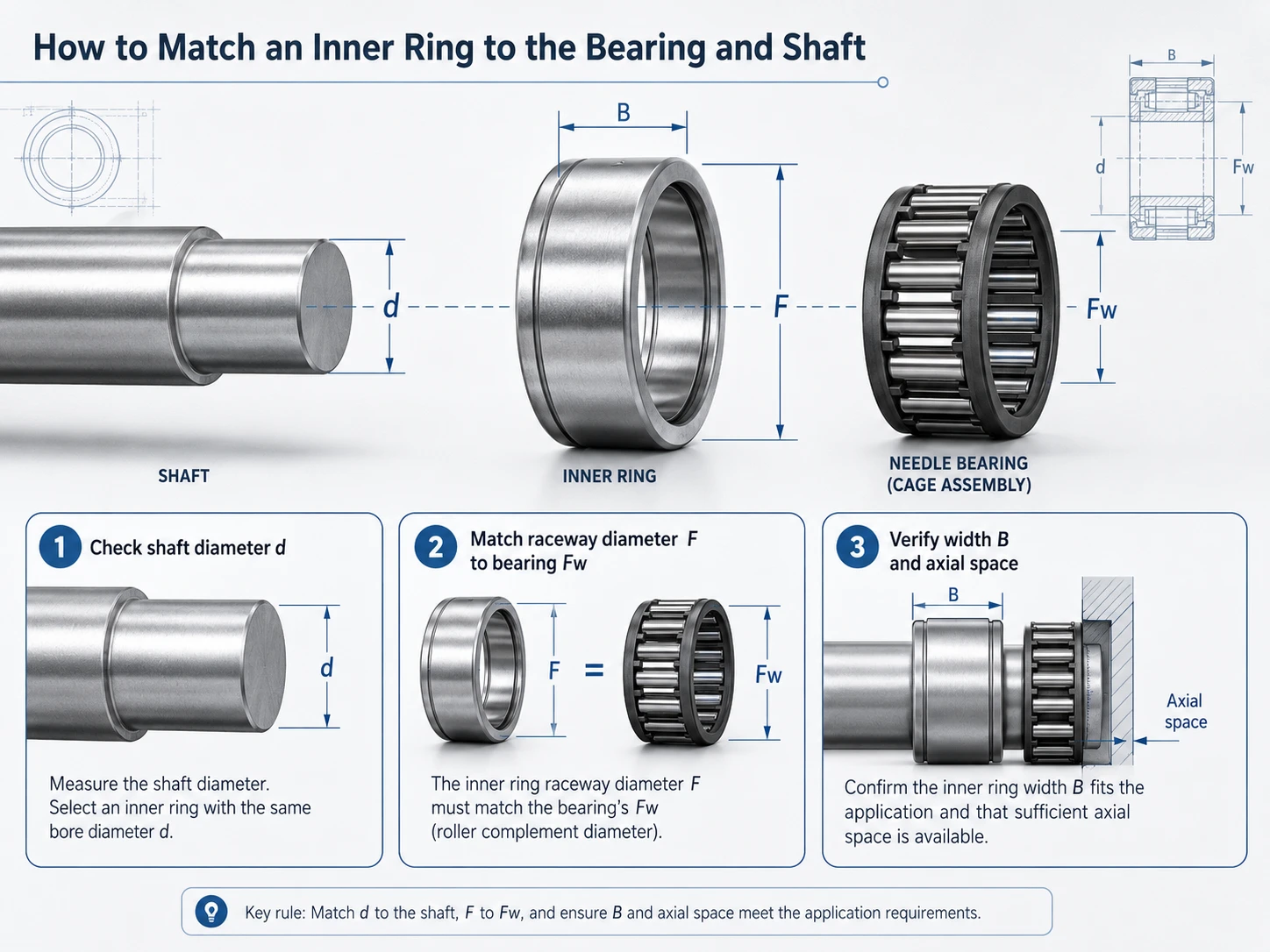
After confirming the basic dimensions, buyers should also verify width, chamfer geometry, axial space, lubrication features, and the final operating clearance before ordering.
Cataloged inner rings provide the opposing raceway when the shaft cannot meet the required hardness, surface finish, roundness, or dimensional accuracy.
This sequence prevents a common purchasing error: choosing an inner ring because its bore fits the shaft while ignoring whether its raceway matches the bearing.
Use the cataloged matching inner ring where one is specified. When no direct pairing is available, send the complete bearing number, ring marking, and measured dimensions to the supplier instead of selecting the nearest size.
Select the Correct Width, Chamfer, and Lubrication Features
Standard-width rings suit arrangements with limited axial movement and full roller contact on the raceway.
A wider needle bearing inner ring may be needed when the shaft moves axially relative to the housing or when a contact seal requires a continuous running surface. Extended inner rings are designed for these conditions.
Extra width is not automatically an advantage. It may interfere with:
-
Shaft shoulders
-
Snap rings
-
Spacers
-
Seal positions
-
Adjacent gears or housings
Confirm the available installation space, expected axial travel, seal position, chamfer clearance, and whether the lubrication path requires a hole or groove.
Verify Shaft Fit, Internal Clearance, and Axial Location
An inner ring that slides onto the shaft is not necessarily correctly fitted.
The required fit depends on load direction, rotation, shaft accuracy, operating temperature, and bearing arrangement. Excessive interference may reduce operating clearance. A loose fit may permit creep, fretting, or unstable axial location.
Recommended fits and radial internal clearance vary by bearing design and application. Final values should be checked against the relevant product specification rather than taken from a universal tolerance chart.
Before approving the assembly, verify:
-
Shaft diameter and geometry
-
Shoulder squareness
-
Axial retaining method
-
Installed ring runout
-
Bearing internal clearance
-
Expected temperature differences
Press fits and operating temperature can both change the working clearance after installation.
Why Needle Bearing Inner Rings Fail, Wear, or Do Not Fit
Wrong Raceway Diameter or Fit Changes Bearing Clearance
Overheating, tight rotation, abnormal noise, looseness, or early raceway marking may indicate an incorrect ring, shaft fit, or assembled clearance.
An incompatible F and Fw combination can create too little or too much roller clearance. A loose shaft fit can allow movement on the seat, while poor axial retention can move the active raceway away from the intended roller contact zone.
Do not automatically reorder the same needle bearing inner ring after a failure. Measure the shaft and ring, confirm the bearing designation, inspect the wear pattern, and review operating temperature, speed, load, and lubrication.
The damaged ring may be the result rather than the original cause.
Shaft Damage, Misalignment, and Contamination Cause Repeat Failure
A new inner race cannot correct a bent shaft, out-of-round seat, damaged shoulder, or misaligned housing.
These conditions may produce edge loading, an offset wear band, ring creep, or recurring raceway damage. Contamination, deteriorated lubricant, or damaged seals can also mark a new inner ring shortly after installation.
Before replacement:
-
Clean the assembly
-
Inspect the needle rollers and cage
-
Measure the shaft seat
-
Check axial locating surfaces
-
Examine the old ring for pitting, scoring, discoloration, fretting, or uneven contact
-
Review the lubrication and sealing condition
Correct the source of the failure, not only the most visible damaged component.
What Should Buyers Confirm Before Ordering a Replacement Inner Ring?
A useful RFQ should include the old bearing designation, complete inner-ring marking, measured d × F × B dimensions, shaft diameter and tolerance if available, and photographs of the ring, shaft, bearing, and damaged area.
State whether the application uses a drawn-cup bearing, needle roller and cage assembly, machined bearing, or complete NA-type bearing.
Also provide:
-
Load direction
-
Rotational or reciprocating speed
-
Operating temperature
-
Lubrication method
-
Expected axial movement
-
Seal arrangement
-
Target quantity
-
Drawing or available sample
-
Required inspection documents
These details help distinguish a standard IR inner ring from an extended ring, a ring with lubrication features, a complete bearing, or another configuration.
Buyers still comparing bearing structures can review the product coverage from LQYS Bearings before preparing the inquiry.
How to Choose a Needle Bearing Inner Ring Supplier
Verify Technical Matching Before Comparing Unit Price
A capable supplier should request enough information to match the ring to the bearing and shaft, not quote only from an approximate outside diameter and width.
The technical review should cover:
-
Complete bearing and inner-ring designations
-
d, F, and B dimensions
-
Bearing Fw dimension
-
Chamfer and shoulder clearance
-
Lubrication features
-
Axial movement
-
Seal contact
-
Shaft fit
-
Required drawings or documents
Uncertain replacements may require photographs, a technical drawing, or a physical sample before compatibility can be confirmed.
Shanghai Yongheshun Import and Export Co., Ltd. presents LQYS Bearings as a business integrating bearing production, sales, trade, and export. Its product pages cover needle roller bearing designs with inner rings and designs that use the shaft directly as the raceway.
Evaluate Quality Control, Traceability, and Delivery Risk
Before placing a volume order, ask how critical dimensions are inspected, how batches are identified, and what inspection documents can be provided by agreement.
Buyers should also confirm sample availability, order requirements, expected lead time, packaging, corrosion protection, and the process for handling a dimensional discrepancy.
The supplier decision should be based on documented compatibility and repeatability, not only unit price. Send the bearing number, inner-ring marking, dimensions, operating conditions, quantity, and photographs through request an inner-ring compatibility check. Compare the response with the drawing and application requirements before approving the order.
Conclusion
A needle bearing inner ring is a precision raceway, not a generic sleeve. Start with the complete bearing designation, match F to Fw, match d to the shaft, and verify width, chamfers, lubrication features, shaft fit, axial location, and working clearance.
After a failure, inspect the shaft, bearing, seals, alignment, and lubricant so the original cause is not built into the replacement.
For a focused quotation, send LQYS Bearings the bearing number, d × F × B dimensions, shaft information, operating conditions, target quantity, drawing or sample details, and clear failure photographs.
Frequently Asked Questions About Needle Bearing Inner Rings
Can You Buy a Needle Bearing Inner Ring Separately?
Yes. Separate inner rings are available where the shaft cannot provide the required raceway. The ring must still match the bearing series, Fw dimension, width, shaft fit, and operating clearance. It is not a universal addition for every needle bearing.
How Do I Find the Correct Inner Ring for an HK Needle Bearing?
Use the complete HK designation and locate the cataloged matching inner ring. Confirm that raceway diameter F corresponds to roller-set bore Fw, then verify bore d, width B, axial space, and shaft fit. Do not select the ring from shaft diameter alone.
Is d × F × B the Same as ID × OD × Width?
It is a useful shorthand, but F is a precision raceway diameter rather than an ordinary OD. This surface controls roller contact and affects assembled needle bearing internal clearance.
Can a Used Needle Bearing Inner Race Be Reused?
Reuse should be considered only after checking for pitting, flaking, scoring, corrosion, discoloration, fretting, dimensional wear, and fit damage. If the bearing failed, also inspect the shaft seat, rollers, cage, alignment, seals, and lubrication.